
Building a Foundation for a Lifetime: My Journey Through Krea’s First Year
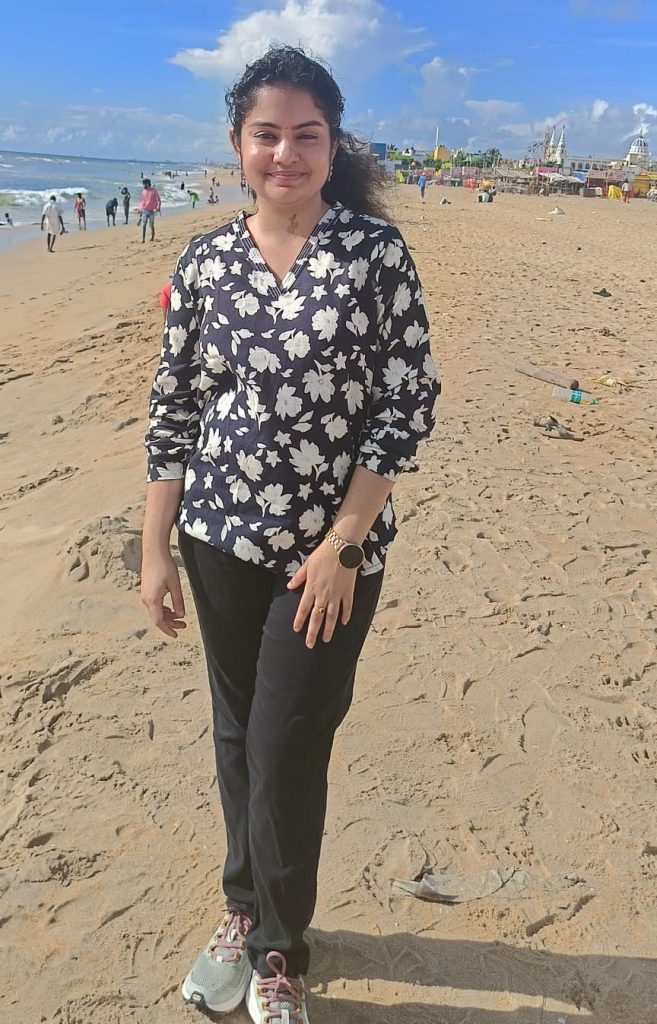
By Sanjana Raman, SIAS Alum Cohort of 2019 – 23
Campus Communications Associate, Krea University
The transition from school to university is a pivotal phase in a student’s life -one marked by growth, excitement, nervousness, and hopeful curiosity about what lies ahead. No matter how prepared one may feel, a truly transformative educational environment will always challenge students to think creatively and stretch beyond their comfort zones. This encapsulates my experience of joining the inaugural undergraduate cohort at the School of Interwoven Arts and Sciences (SIAS), Krea University in 2019.
Academic Background
I completed my schooling in 2018 through the National Institute of Open Schooling (NIOS). Unlike traditional boards in India that require senior secondary students to follow fixed streams — such as Pure Sciences, Commerce, or Computer Science — open schooling gave me the freedom to pursue academics, while exploring my artistic and creative interests. It was this flexibility that naturally led me towards a Liberal Arts education, one where I could explore courses across disciplines before deciding on a major.
Foundation Year
If I had to describe my foundation year at Krea in one word, it would be “exploratory.” It offered a valuable glimpse into the university’s unique pedagogical approach, preparing us to think critically, participate actively in class, engage in collaborative discussions, and write academic essays with confidence.
In my view, it is the Interwoven Learning model that sets Krea apart from other institutions, especially those rooted in traditional STEM education. The courses I took in the first year laid the foundation for both academic rigour and workplace readiness.
For students like myself, coming from non-international boards such as Cambridge or IB, the exposure to academic writing, research, analytical thinking, and presentation skills was limited. This rendered the first year at Krea a steep learning curve to begin with. However, it was precisely this challenge that pushed us to grow. The first-year curriculum consisted of six core courses and five skill courses across three trimesters, culminating in a jointly taught course at the end of the academic year. Each core course served as a window into the kind of subjects one might pursue as a major.
Skills that Matter
Each learning module was thoughtfully designed to reflect the value of interdisciplinary education. For example, in Literature and Arts, we learned to interpret texts through sociological and historical lenses. This encouraged us to make meaningful connections between disciplines and see knowledge as an interconnected web rather than in silos.
While the core courses provided theoretical foundations, the skills courses equipped us with practical tools. Together, they created a balanced learning experience that developed both hard and soft skills — an essential combination for success in the workplace or higher education.
Of Experiences and Examples
While it is difficult to pick one course that helped me grow, I want to list some of my favourite courses that pushed my academic and creative boundaries. They are: Writing & Oral Communication (WOC), Creative Expression (CE), and Design Thinking. WOC introduced us to academic writing in its truest sense. From reading scholarly articles to paraphrasing, citing, and building persuasive arguments, it shaped my communication abilities, both written and spoken. Creative Expression wasn’t just about the arts — it taught us how creativity can be applied across fields, even in business, data, and science.
Design Thinking, taught in the final trimester, was a standout. It helped us identify core problems and create holistic, 360-degree solutions that cater to all stakeholders. For example, in a workplace setting, design thinking might be applied when redesigning an employee onboarding process: instead of simply improving documentation, one would approach it by interviewing new hires, HR personnel, and managers to deeply understand various touch points. Then, through brainstorming and prototyping, a more inclusive and user-friendly onboarding experience could be crafted: one that improves both efficiency and employee satisfaction.
Aside from this example, the classes in Design Thinking also taught us to care for the well-being of the environment and consider it an important stakeholder when devising solutions for business problems. This nudged us to be responsible citizens.
Takeaways Aplenty
Another valuable aspect of the foundation year curriculum was the emphasis on collaboration. Almost every assignment involved teamwork, which taught me how to express my ideas clearly, listen to others, and work harmoniously with people from diverse backgrounds. These interpersonal skills, I’ve come to realise, are just as critical as technical expertise.
Through this broad academic exposure — spanning the sciences, humanities, and data analytics — I discovered my strengths, passions, and even areas for growth. This clarity eventually helped me make a well-informed decision about my major.
Internship for Impact
Another unique component of the first year was the Internship for Impact, where students apply their learnings in real-world, socially relevant contexts. My internship offered hands-on exposure to the challenges faced by grassroots organisations, deepening my understanding of how academic knowledge can translate into meaningful societal change. It was an enriching, eye-opening experience that remains one of the highlights of my undergraduate journey.
A Strong Anchor in Uncertain Times
Now, as I step into the professional world — a world rapidly shaped by Artificial Intelligence (AI), constant disruption, and an ever-evolving job market — I sometimes feel overwhelmed by the sheer pace of change. In these moments, I often find myself revisiting the lessons from my first year. It taught me to think critically, communicate well, and gave me an unshakeable foundation, one rooted in adaptability, empathy, creativity, and collaboration.
It is this foundation that continues to guide me through uncertainty, helping me stay grounded yet open to change. Krea’s first-year experience was not just an academic milestone; it was a transformative journey that shaped who I am today and will continue to shape who I become tomorrow.
For more information on Foundation Year courses, visit: https://krea.edu.in/sias/academics/