

“Be Fast, Be Curious, and Go Build Stuff”
Keynote Insights from Praveen Akkiraju at the Sricity Educational Foundation’s 2025 Winter Retreat
By Mitansh Aggarwal
Cohort of 2022-26, SIAS
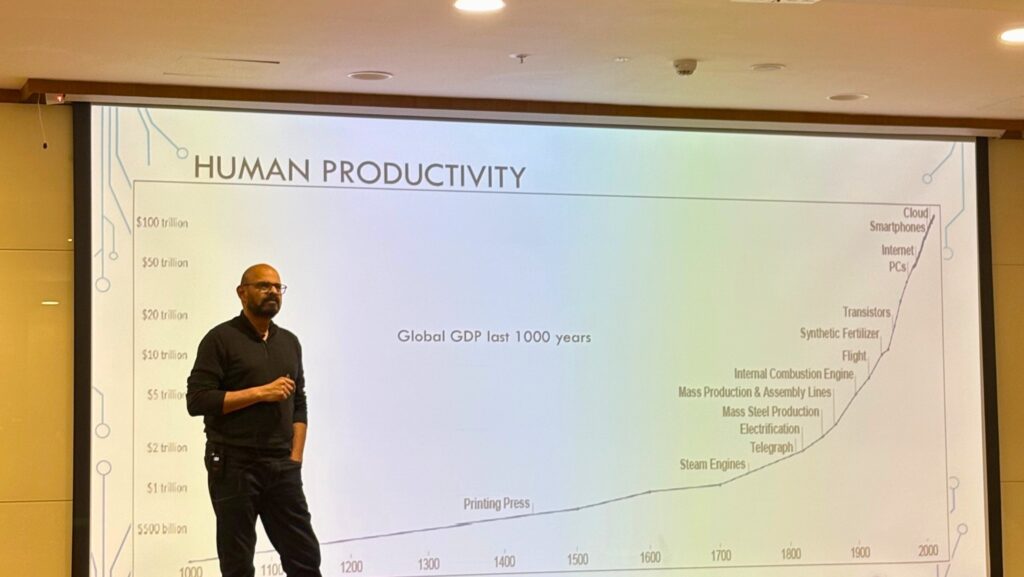
Sri City, Andhra Pradesh — November 29, 2025: Speaking at the “Investing in Tomorrow’s Workforce: The AI Imperative” keynote held at Krea University, Praveen Akkiraju, Managing Director at Insight Partners, delivered a stark message to the students and faculty in attendance: the era of AI is not coming; it is already here, and speed is the only metric that matters.
“Innovation and progress is part of humanity’s evolution,” Akkiraju began, addressing the audience at the New Academic Block auditorium. He positioned AI not merely as a new technology, but as the latest data point in the history of human productivity—akin to the wheel, fire, or the steam engine.
Drawing from a 1960s IBM advertisement that promised a computer would give a company “150 extra engineers,” Akkiraju set the challenge for the current generation: the goal of engaging with AI is to “fundamentally improve” until you become “150x of yourself”.

The Dawn of the Token Economy
Akkiraju argued that we are witnessing a fundamental shift in how information is structured. For the first time in history, as of this year, machine-generated content has surpassed human-generated content. We are moving from the internet era of bits and bytes into a “token economy”.
In this new economy, information, identity, and finance are all represented as tokens. Future enterprises will essentially function as “token factories”—effectively data centers processing quadrillions of tokens to drive workflows in healthcare, accounting, and defense.
Speed is the Only Metric That Matters
If there was one takeaway Akkiraju emphasised throughout the retreat, it was speed. “You blink and you miss a moment,” he noted, comparing the industry to a fast-paced T20 cricket match. The pace of innovation is lightning fast; for instance, the model “Gemini 3” held the top spot on leaderboards for only one week before being derailed by “Opus 4.5”.
This speed extends to infrastructure. Akkiraju cited Elon Musk’s xAI, which built a fully operational 75,000-square-foot data center in just 122 days—a timeframe in which standard construction benchmarks would barely allow for building half a house. Startups are seeing similar acceleration; while Shopify took over five years to reach $100 million in revenue, AI-native companies like Lovable are achieving that milestone in just six months.
The Geopolitics of Innovation: Bypassing Constraints
The keynote also highlighted the fierce competition between the US and China. While Silicon Valley previously believed China was two years behind in model innovation, the release of the “DeepSeek” model proved the gap is now only about three months.
Akkiraju drew a parallel between China’s AI progress and India’s ISRO. Just as ISRO developed its own cryogenic engines after being denied technology by sanctions, Chinese engineers innovated around US chip sanctions. By using algorithmic techniques to distribute computing loads, they dropped the cost of reasoning models by 100x, proving that innovation often thrives under constraint.
A Framework for Founders: Bounded vs. Unbounded
For the entrepreneurs and students at Krea University looking to build in this space, Akkiraju offered a mental model for classifying AI problems:
- Bounded Problems: These are tasks with verifiable solutions, such as coding or math. You know exactly when the model has achieved the correct answer. Insight Partners tends to favor these “bounded” problems for investment.
- Unbounded Problems: These are subjective tasks, such as “plan my vacation” or “write a recipe.” While tools like ChatGPT excel here, the lack of a definitive “right” answer makes them harder to build specialised companies around.
The India Opportunity
The talk concluded with a bullish outlook on India. India is already the number one user base for AI tools like Perplexity and number two for open-source models like DeepSeek.
Unlike the single-language environments of the US and China, India’s complexity offers a unique advantage. The vast, multi-lingual, and multi-dimensional data available in India is “incredibly valuable” for training the next generation of models. Akkiraju urged the audience to stop thinking of themselves as just software engineers and start acting as “AI Natives”—combining curiosity with speed to drive India’s future.
“You are on the ground floor of AI,” Akkiraju reminded the auditorium. “It is still very, very early… be fast, be curious, and go build stuff”.