Dr Junaid Iqbal’s paper published in Corporate Social Responsibility and Environmental Management

A research paper co-authored Dr Junaid Iqbal, Post-Doctoral Fellow, IFMR GSB has recently been published in the Corporate Social Responsibility and Environmental Management (Wiley Publishers), a Q1-ranked journal with an impact factor of 9.1. The paper is titled, The Green Advantage: Leveraging Leadership and Employee Ownership for Sustainable Business Strategy in Emerging Markets.

Brief
The current study examines the impact of Green Transformational Leadership on Employee Green Behaviour with Green Psychological Ownership acting as a mediator and Green Identity as a moderator, aligning with the United Nations Sustainable Development Goals, particularly SDG 12 and SDG 13. Using a quantitative cross-sectional design, data from 347 SME employees and managers in India were analysed using PLS-SEM. The study underscores the role of green leadership in fostering pro-environmental behaviour through psychological ownership and highlights the importance of cultivating employees’ green identity to promote sustainable practices, improve organizational performance, and reduce resource waste.

Read more

Dr Rakesh Sengupta’s paper published and presented at the 2026 IEEE International Conference – IATMSI

Dr Rakesh Sengupta, Assistant Professor, Psychology, SIAS’ latest paper titled Bio-Inspired Variance Control: Decoupling Signaling Mode from Power Constraints in Neuromorphic Systems has been published and presented at the 2026 IEEE International Conference on Interdisciplinary Approaches in Technology and Management for Social Innovation (IATMSI) in Gwalior.

The paper tackles the problem statement on how as smart devices and the Internet of Things (IoT) grow, they consume massive amounts of power, and Current AI systems struggle to balance high performance with energy efficiency. The research for this study draws inspiration from how the human cerebral cortex operates, this paper introduces a new mathematical model called “Homeostatic Variance Control. By mimicking the brain’s natural mechanisms, we demonstrated a way for systems to seamlessly transition into highly sparse, energy-efficient states without altering their baseline power budget. This provides a rigorous new framework for designing sustainable, low-power AI for the future of cyber-physical systems.

Abstract

​Advanced intelligent systems and IoT networks face a critical trade-off between signaling flexibility and power efficiency. Traditional rate-coding schemes often require shifting the mean activity to transmit information, incurring high energy costs that threaten system stability. Drawing inspiration from the Log-Normal firing regimes of the cerebral cortex, we propose a novel coding mechanism: Homeostatic Variance Control. We mathematically demonstrate that by modulating the variance of input noise (a proxy for neuromorphic gain), a system can dramatically shift its modal (most frequent) operating point toward sparsity while pinning its median resource consumption to a fixed homeostatic setpoint. We validate this mechanism using a Linear-Nonlinear-Poisson (LNP) simulation, showing that it enables a seamless transition between dense and sparse coding regimes without altering the baseline power budget. This bioinspired architecture offers a rigorous framework for designing resilient, energy-efficient Spiking Neural Networks (SNNs) for resource-constrained cyber-physical applications.

Read more

Research article by Dr Tanmoy Chakrabarty published in Physical Review B

A research article by Dr Tanmoy Chakrabarty, Assistant Professor, Physics, SIAS titled CaFe2O(PO4)2: A compound with S=5/2 corner sharing triangular saw-tooth chains has been published in Physical Review B. In this publication, Dr Chakrabarty is one of the two corresponding authors.

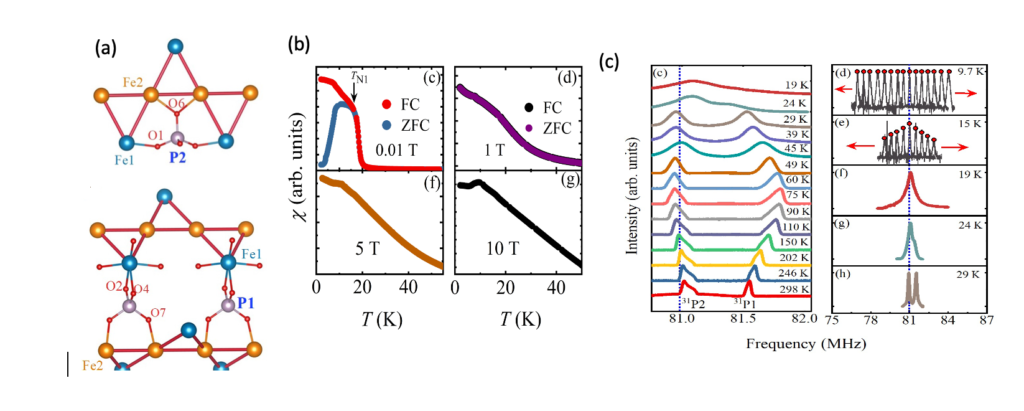
Geometric frustration and one-dimensional magnetism boost quantum fluctuations and leads to unusual states of quantum matter. To explore these effects, we used solid state nuclear magnetic resonance (SSNMR), which is a strong local probe to extract the true spin susceptibility and the spin network of a magnetic system.

Here we studied the magnetic behaviour of a well-separated S = 5/2 saw-tooth spin chain compound CaFe2O(PO4)2, which has two different 31P sites in the unit cell. Magnetic susceptibility, heat capacity, and 31P NMR measurements show evidence of strong magnetic frustration (with a frustration parameter ≈ |θCW|/TN) about 70) in CFPO. The major finding of our work came from the NMR measurements which show a broad maximum near 70 K , reflecting the low-dimensional nature and presence of short-range correlations. It is important to note that such a broad maximum feature is not seen in the bulk χ(T) or in heat capacity. Further investigating this broad maximum feature, we conclude that CFPO represents an interesting realization of a frustrated S = 5/2 sawtooth spin-chain.


(a) local environment of P1 and P2 in CFPO.  (b) (T) vs. T at various magnetic fields. (c) Plot of T-dependence of the normalized 31P NMR spectra measured as a function of frequency

Read more

Krea faculty co-author research article published in the Journal of Data Science and Intelligent Systems

A research article titled Modeling Markers for Detection of Psychiatric Disorders Using EEG Signals has been co-authored by Dr Lakshman Varanasi, Assistant Professor, Biological Sciences, SIAS; Varun Viswanathan, Visiting Assistant Professor, Psychology, SIAS; Dr Debasish Mishra, Assistant Professor, Data Science and Information Systems, IFMR GSB; and Steven Chris, Teaching Fellow, Data Science and Information Systems, IFMR GSB. The paper has been published in the Journal of Data Science and Intelligent Systems.

Abstract

The diagnosis of mental (psychiatric) disorders is challenging, and there is a lack of consensus on objective diagnostic criteria that are based on definitive signs that accompany the disorder. There is a need, therefore, to develop objective tools for the examination of these disorders. We present here a novel machine learning (ML) approach that accurately identifies disorders. The approach uses electroencephalography (EEG) signals for diagnosis, which are processed to extract novel region based markers that are found to contain key information about the types of disorders. Subsequently, a support vector machine (SVM) classifier is modeled, integrated with sequential feature (marker) selection (SFS), which identifies optimal and compact marker subsets for disorder detection. The proposed system has been validated using a publicly available dataset. The developed model was benchmarked against existing models and was shown to perform superior to the models it was extensively compared with; it demonstrated a 98.33% accuracy in detecting obsessive-compulsive disorder (OCD). Our findings indicate that an accurate psychiatric diagnosis system can be achieved using EEG signals with significantly fewer, and more interpretable markers. This simpler and transparent approach improves the practicality and trustworthiness of AI/ML-driven diagnostic tools, making them more suitable for real-world clinical integration and understanding by medical professionals.

Read more

Dr Rakesh Sengupta’s paper published in the ACOIT 2025 proceedings

A paper by Dr Rakesh Sengupta, Assistant Professor, Psychology, SIAS, titled ‘Evaluating Continuous-Time Recurrent Neural Networks for State-Dependent EEG Forecasting’ has been published in the proceedings of the 2025 2nd Asian Conference on Intelligent Technologies (ACOIT).

About the Research
The paper explores how short-term brain activity (EEG signals) can be more accurately predicted using lightweight AI models. Such forecasting is critical for real-time neurotechnologies, including Brain-Computer Interfaces (BCIs) and neurofeedback systems. The study benchmarks a Continuous-Time Recurrent Neural Network (CTRNN) against both classical methods and complex deep learning models. It finds that even a compact, highly interpretable CTRNN can effectively capture the non-linear dynamics of human brain activity, offering a competitive alternative to “black-box” AI models in real-time BCI applications.

Read more

Dr Ramadas N publishes a research paper in Physical Review A

Dr Ramadas N, Post-Doctoral Fellow, Physics, Division of Sciences, SIAS, published a research paper titled Minimal decomposition entropy and optimal representations of absolutely maximally entangled states in Physical Review A.

Abstract

Understanding and classifying multipartite entanglement is fundamental to quantum information processing. This work focuses on absolutely maximally entangled (AME) states, a class of highly entangled states characterized by their maximal entanglement across any bipartitions. To analyze and classify AME states, we employ the minimal decomposition entropy, defined as the minimum R\'{e}nyi entropy $S_q$ associated with the state’s decomposition over all local product bases. This quantity identifies the product bases in which the state is maximally localized, thereby yielding optimal representations for analyzing properties of AME states.

The team develops an efficient algorithm for computing the minimal decomposition entropy for finite $q>1$ and compare AME and Haar-random states for ( q = 2 ) and ( q = \infty ) in qubit, qutrit, and ququad systems. For ( q = 2 ), AME states of four qutrits and ququads show lower minimal entropy than generic states, indicating sparser optimal forms. For ( q = \infty ) – related to the geometric measure ofentanglement – AME states exhibit higher entanglement. The algorithm also simplifies known AME states into sparser representations, aiding in distinguishing genuinely quantum AME states from those constructible from classical combinatorial designs. The results advance the classification of AME states and demonstrate the utility of minimal decomposition entropy as both a local unitary invariant and a tool for state simplification.

Know more

Dr Smriti Sharma publishes an article in South Asia: Journal of South Asian Studies

Dr Smriti Sharma, Postdoctoral Fellow, Sociology and Social Anthropology, SIAS, published an article titled Packing Pareshani or Healthcare? The Affective Dimensions of Digitalisation in India’s Health Sector in South Asia: Journal of South Asian Studies.

In this article, author examine how digitalisation in the health sector seeks to standardise care in the name of effective service delivery. Author analyses the affective dimensions of operating a digital portal within the publicly funded health insurance scheme, Ayushman Bharat Yojana, by conceptualising the emic term, pareshani. In Hindi, pareshani encompasses a wide range of meanings, including worry, trouble, tension, helplessness, frustration, distress and exhaustion. Based on fifteen months of ethnographic fieldwork in a private hospital and the public insurer’s headquarters in Haryana, the author show how the intermedial specificity of pareshani undergirds payments and patient treatment. She argues that understanding the affective force of digital portals requires examining how pareshani becomes embedded in intermediaries’ everyday navigation and negotiation of bureaucratic standards and procedures that shape clinical work. More broadly, author reflect on what these affective dynamics reveal about the digital bureaucratic state and its modes of governing healthcare.

Know more

Professor S Sivakumar co-authors a journal article published in Physical Review A

Professor S Sivakumar, Dean – Research, and Professor, Physics, SIAS, has co-authored a journal article titled Generation of large Fock states from coherent states using Kerr interaction and displacement, published in Physical Review A.

Technical Abstract

We discuss a scheme to generate large Fock states. The scheme involves repeatedly applying an experimentally feasible unitary transformation to convert a semiclassical state into a Fock state. The transformation combines Kerr interaction, which is a non-Gaussian operation, and pulsed coherent drives. We identify suitable parameter values (Kerr strength, pulse timings, displacement amplitude) for the physical processes to implement the transformation and generate large Fock states with near-unity fidelity. The feasibility of implementing the scheme in circuit QED architectures is discussed. The method is also suitable for generating Fock states of cavity fields.

Non-technical summary

The simple harmonic oscillator is a ubiquitous model in physics, describing everything from swinging pendulums to vibrating molecules. In the quantum world, these microscopic oscillators are restricted to specific, equally spaced energy levels—effectively forming a “ladder” of energy. An electromagnetic field confined in a cavity behaves exactly like a harmonic oscillator. But how do we force this field to climb the ladder and reach a specific, high-energy rung of our choice? Our work presents a new scheme that significantly outperforms known schemes for generating large photon states. Combining nonlinearity (where the output is not strictly proportional to the input) with displacement operations (essentially, “kicking” the oscillator in phase space), we can guide the system to much higher energy levels than previously possible. The paper discusses the mechanism behind this controlled ascent.

Read more