Dr Suchika Chopra Selected for the JSIT Program and Presents Research on Gender Wealth Gap in Germany

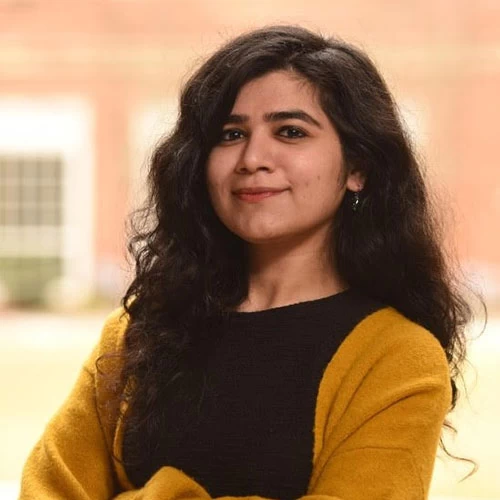
Dr Suchika Chopra, Assistant Professor of Economics, SIAS, Krea University has been chosen for the Junior Scholar Intensive Training (JSIT) program scheduled for June 2024. This program, hosted by the UW-Madison Retirement and Disability Research Center (UW RDRC) and supported by the United States Social Security Administration Retirement and Disability Research Consortium (RDRC), is a weeklong research training initiative. Its purpose is to provide mentored training to 15 scholars who are researching social safety nets, social insurance, and retirement and disability issues. Specifically, Dr Chopra will be working on understanding how state policies such as Medicare and Medicaid protect near-retirement households from the financial risk of healthcare expenses.
Additionally, on 9 February, 2024, Dr Chopra presented her paper titled Understanding the Gender Wealth Gap in Germany: Asset Value vs. Asset Ownership at the Annual Conference on Economics and Finance hosted by BITS Pilani, Hyderabad. This paper documents and investigates the gender wealth disparity among married and cohabiting couples in Germany, highlighting that this disparity stems from both differences in asset ownership at the extensive margin and differences in wealth given asset ownership at the intensive margin. 

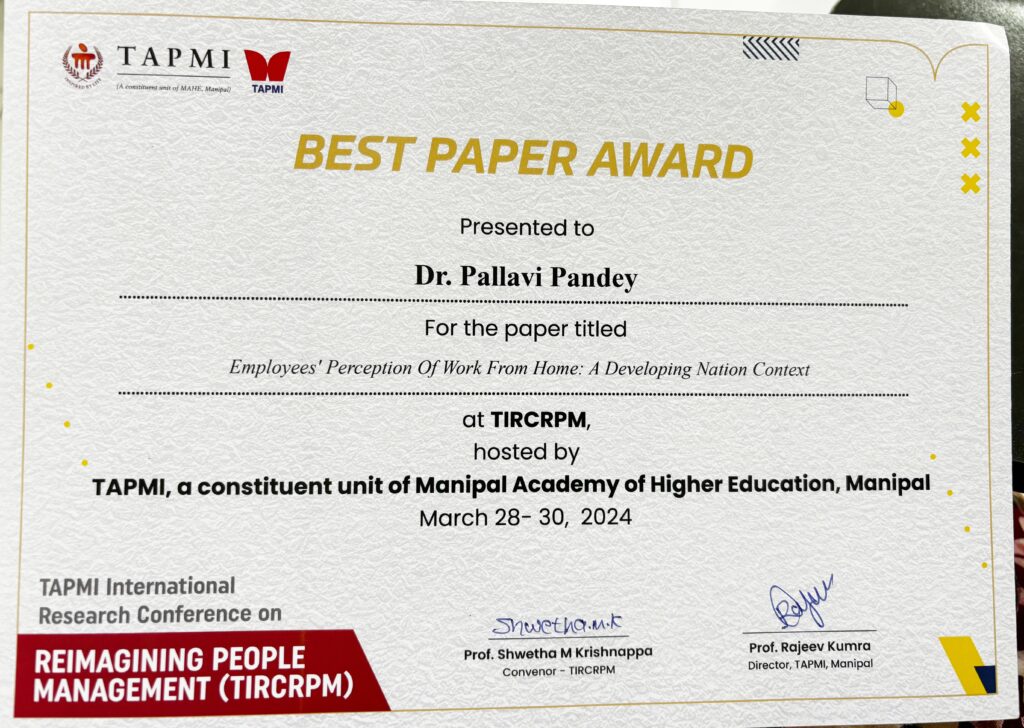
Dr Pallavi Pandey wins a Best Paper Award at TIRCRPM, TAPMI Institute of Management 

Dr Pallavi Pandey, Assistant Professor, HR & OB, and Area Chair – OB & HR, IFMR GSB, Krea University has received the Best Paper Award for her research paper titled Employees Perception Of Work From Home: A Developing Nation Context at the TAPMI International Research Conference on Reimaginging People Management (TIRCRPM), hosted by the TAPMI Institute of Management held on 28 – 30 March, 2024. 

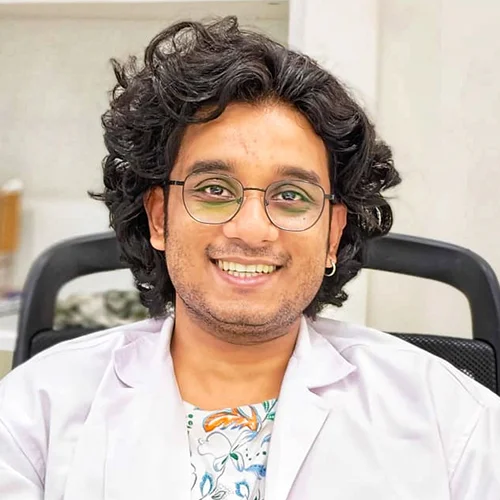
A New Publication by Sayantan Datta in the Community Development Journal (Oxford University Press)

A paper titled ‘It’s nice we can do that too’: investigating transgender persons’ negotiations with identity and community questions in Indian science institutions by Sayantan Datta, Assistant Professor of Practice, Centre for Writing and Pedagogy (CWP) at Krea University has been published in the Community Development Journal (Oxford University Press). 

In this paper, Datta draws upon the lived experiences of four interlocutors to delineate the ways in which proximal and distal networks of caste-class and gender shape transgender, gender non-conforming, and non-binary persons’ exclusion from and belonging in science collectivities. This paper is a part of the upcoming special issue on queer and trans community building in post-377 and post-NALSA India, edited by Pushpesh Kumar, Sayantan Datta, and Neha Mishra.

Link to access

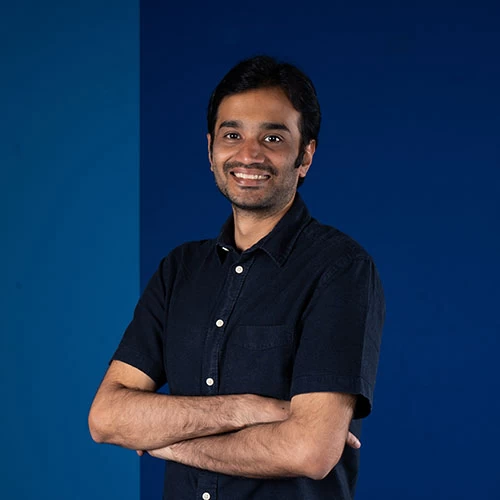
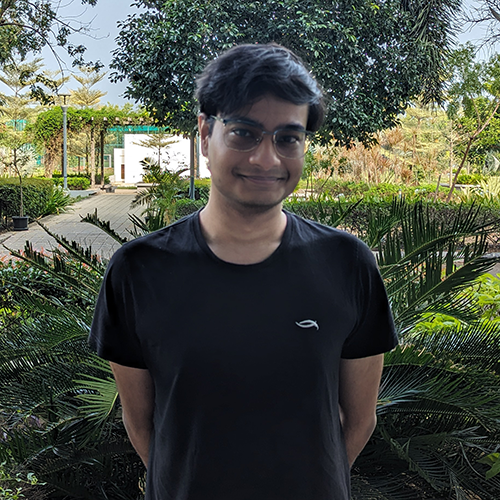
A paper co-authored by Dr Shyam Kumar Sudhakar and Kaustav Mehta published in the Brain Organoid and Systems Neuroscience Journal

A paper titled Charting Paths to Recovery: Navigating Traumatic Brain Injury Comorbidities through Graph Theory–Exploring Benefits and Challenges, co-authored byDr Shyam Kumar Sudhakar, Assistant Professor of Biological Sciences, SIAS, Krea University and Kaustav Mehta, a Biological Sciences student, SIAS PG Batch of 2023-24 has been published in the Brain Organoid and Systems Neuroscience Journal

Traumatic brain injuries (TBIs) are characterized by widespread complications that exert a debilitating effect on the well-being of the affected individual. TBIs are associated with a multitude of psychiatric and medical comorbidities over the long term. Furthermore, no medications prevent secondary injuries associated with a primary insult. In this perspective article, the authors propose applying graph theory via the construction of disease comorbidity networks to identify high-risk patient groups, offer preventive care to affected populations, and reduce the disease burden. They describe the challenges associated with monitoring the development of comorbidities in TBI subjects and explain how disease comorbidity networks can reduce disease burden by preventing disease-related complications. They further discuss the various methods used to construct disease comorbidity networks and explain how features derived from a network can help identify subjects who might be at risk of developing post-traumatic comorbidities. Lastly, they address the potential challenges of using graph theory to successfully manage comorbidities following a TBI.

Read the article here. 

Exploring Christopher Nolan’s Cinematic Grammar: A Post-Oscar Analysis by Ritwik Kaikini

Ritwik Kaikini, Visiting Faculty, Global Arts, SIAS, Krea University, delves into Christopher Nolan’s filmmaking approach in an article titled At Oscars 2024, the triumph of the Christopher Nolan grammar, published in The Federal, India. Following Nolan’s Oscar win, Kaikini examines how Nolan constructs narratives infused with science and a phenomenological perspective. The piece offers insights into Nolan’s distinct style and its impact on cinematic storytelling, shedding light on his unique approach to filmmaking.

Read the article here

Market Structure, Profitability and Regulation of Telecommunication Industry in India – A Publication by Professor Madhuri Saripalle and Dr Surabhi Somya

A paper titled Market Structure, Profitability and Regulation of Telecommunication Industry in India, co-authored by Professor Madhuri Saripalle, Professor, Economics and Chairperson – MBA Programme at IFMR GSB, Krea University and Dr Surabhi Somya, a PhD alumna of IFMR GSB, Krea University and currently a Consultant at Deloitte USI, Financial & Risk Advisory, has been published in Global Business Review

The telecom industry in India has witnessed exponential growth in the past decade; however, its profitability has been on the decline post 2008. This study analyses the determinants of profitability of the industry during 2010–2022 using the conventional structure-conduct-performance paradigm. The authors estimate a dynamic panel data model to understand the role of endogeneity and profit persistence in the industry. Results suggest that there is profit persistence in the industry. Among conduct variables, export intensity has a positive impact while selling and import intensities has a negative impact on profitability. While size is not significant, industry concentration has a negative impact on profitability. These results suggest that as the telecom industry transitioned from a monopoly to an oligopolistic market with players competing in different domains and services, selling and advertisement intensity has diminishing returns to profitability while export intensity emerges as an important driver of profitability. Results also suggest the importance of the production-linked incentive scheme encouraging exports and the need for regulating concentration and encouraging import substitution.

You can access the publication here

Dr Anannya Dasgupta authors a book chapter in the anthology Contemporary Gender Formations in India

A book chapter titled I Am as Big as the City I Walk: Documenting Maya Rao’s ‘The Walk’ by Dr Anannya Dasgupta, Director, Centre for Writing & Pedagogy (CWP) and Associate Professor of Literature, SIAS, Krea University, has been published in the anthology Contemporary Gender Formations in India. The book is edited by Nandini Dhar and published by Routledge, in March, 2024. 

For details, click here

Dr Tanmoy Chakrabarty receives a project grant from the UGC-DAE Consortium for Scientific Research

Dr Tanmoy Chakrabarty, Assistant Professor of Physics, SIAS, Krea University has been awarded a grant by the UGC-DAE Consortium for Scientific Research, An Autonomous Institution of University Grants Commission (UGC), under the Collaborative Research Scheme (CRS). 

Dr Chakrabarty is the principal investigator in this project titled Exploring the magnetically ordered states in novel magneto-electric compounds. Dr Sumanta Chattopadhyay, Scientist-D at UGC-DAE Consortium for Scientific Research, Mumbai Centre is the principal collaborator on the project. 

Can safe drinking water improve children’s educational outcomes? – An article by Narbadeshwar Mishra and Dr Jyoti Prasad Mukhopadhyay

An article by Narbadeshwar Mishra, PhD Student In Economics at IFMR GSB, Krea University, and Dr Jyoti Prasad Mukhopadhyay, Associate Professor, Economics & Area Chair – Economics at IFMR GSB, Krea University, titled Can safe drinking water improve children’s educational outcomes?, focusing on the National Rural Drinking Water Program (NRDWP)has been published in Ideas for India (I4I). I4I is an economics and policy portal that publishes evidence-based analysis and commentary on issues pertaining to growth and development in India. I4I serves as an ideologically neutral space for economists, other social scientists, and practitioners to use their research and experience to weigh in on key policy questions.

Read the article