Poster Presentation by Prof Madhuri Saripalle

A paper by Prof Madhuri Saripalle, Professor of Economics at IFMR GSB, Krea University was accepted for poster presentation at the Annual meeting of the American Economic Association, held at San Antonio, Texas on Jan 5-7, 2024. Titled Testing and Risk attitude under incomplete information: A game theoretic perspective, the work has been co-authored with Dr Vijaya C Subramanian. 

This study investigates the critical role of testing in combating the COVID-19 pandemic, employing a game theory framework to model decision-making processes for both governmental authorities and individuals under information asymmetry. The population is categorized into two groups based on immunity status (high immunity – type 1, and low immunity – type 2), known only to individuals and their engagement in risk-prone or risk-averse activities. The government holds a prior belief derived from a probability distribution regarding immunity status and faces a strategic decision of selecting one of three testing approaches: universal testing, hybrid testing, or no testing, each with associated expected costs. The study finds that increased benefits of risk-averse behaviour among type 2 individuals relative to type 1 lead to a higher odds ratio of immune individuals. Policy should aim at: (a) Implementing a hybrid testing strategy and (b) Incentivising risk-averse behaviour. In other words, instead of highlighting the costs and penalizing risk prone behaviour, the government should trumpet the benefits of risk averse behaviour.
Click here for more

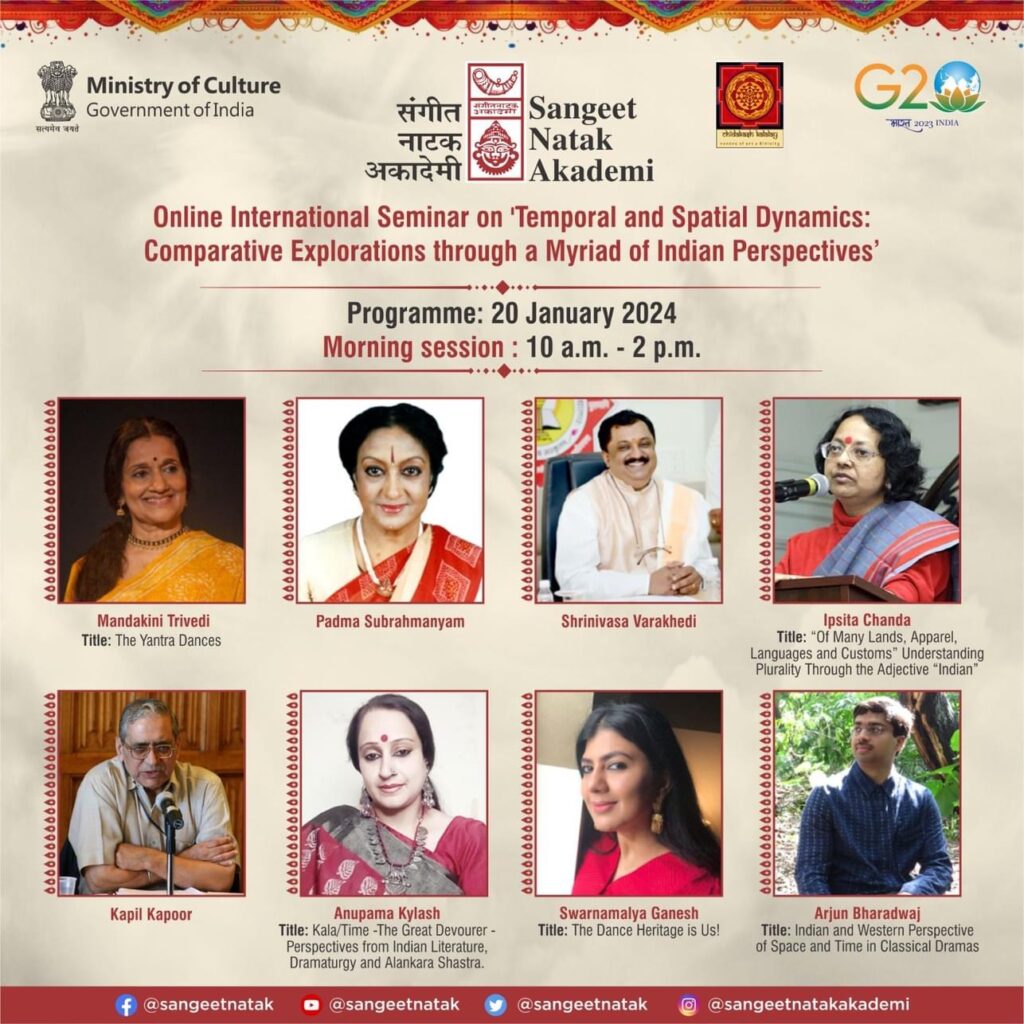
The Dance Heritage is Us! by Dr Swarnamalya Ganesh

Dr Swarnamalya Ganesh, Assistant Professor of Practice at SIAS, Krea University presented a paper titled The Dance Heritage is Us! at the international seminar organised by Sangeet Natak Akademi, Government of India, New Delhi. The topic of the seminar was Temporal and Spatial Dynamics: Comparative Explorations through a myriad of Indian Perspective.

The life of a dance is short. It begins and ends with the dancer. Sculptures, paintings and writings have captured dance through their own conceptual and speculative potential to reproduce or retain the critical space for dance in the world. In becoming historical objects of India, such sculptures and paintings, simultaneously serve as deterritorialised material cultures, housed in monuments and museums, as well as people’s beliefs, hinged on fact-based infatuations with dance.

What is the value of time in understanding how these objects inform us of a dance danced in the past, or one that is to be danced in the future? Dr Ganesh invites the audience to investigate Indian dance sculptures as not merely a collection and validation of dancing bodies through time, but as bodily reading, memorization and survival of images that showcase Us! – the living and moving heritage of dance. 

Empowering Rural India: Combating Corruption and Fostering Financial Inclusion

Dr Suresh Govindapuram, Assistant Professor of Economics at IFMR GSB, Krea University presented a paper on Empowering Rural India: Combating Corruption and Fostering Financial Inclusion at the Global Conclave 2024, held under the theme Advancing Human Development in the Global South. The Conclave was organised at the Institute for Human Development (IHD), New Delhi, in partnership with NITI Aayog, the Government of India and Research and Information System for Developing Countries (RIS), from January 11-13, 2024.

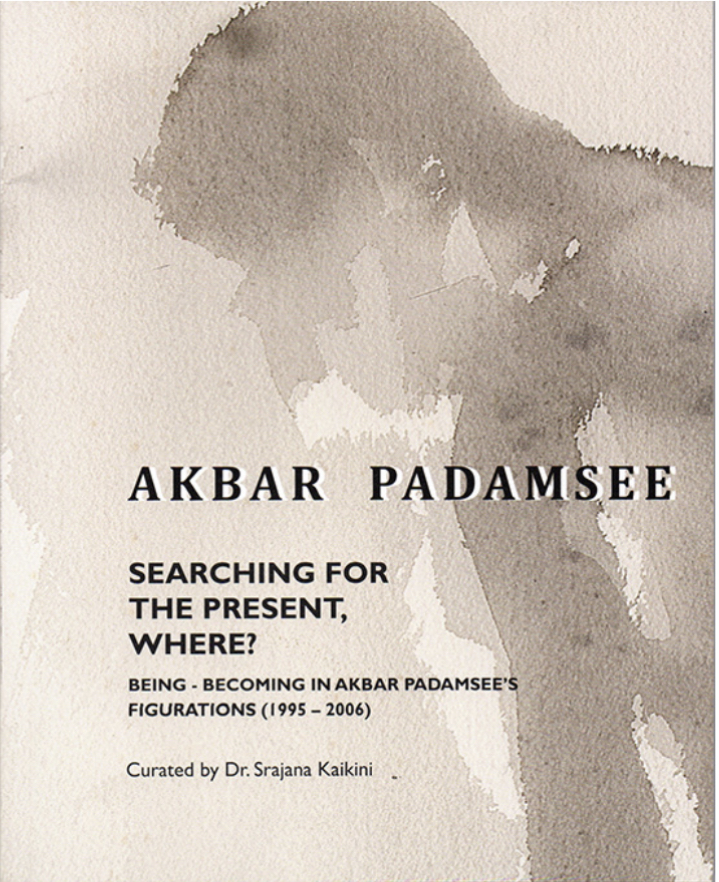
‘Padamsee’s Quest for the Present’: A Monograph Curated by Dr Srajana Kaikini

The Guild, Mumbai has published a monograph based on the exhibition of Akbar Padamsee’s Searching for the Present, Where?, curated by Dr Srajana Kaikini for the gallery and held at The Guild, Mumbai. In this monograph, Dr Kaikini offers an incisive philosophical reading of Padamsee’s figurations through photography, pencil and watercolour (1995- 2006). 

Read more: https://www.guildindia.com/publications-Catalogues.htm

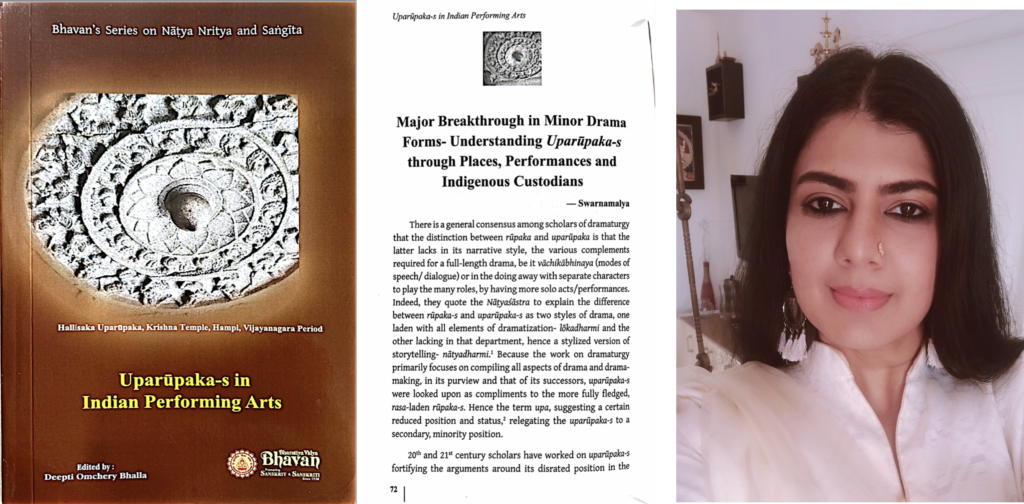
Understanding Uparūpaka-s through Places, Performances and Indigenous Custodians

Dr Swarnamalya Ganesh, Assistant Professor of Practice at SIAS, Krea University published a book section, Major Breakthrough in Minor Drama Forms – Understanding Uparūpaka-s through Places, Performances and Indigenous Custodians,  as part of Uparūpaka-s- in Indian Performing Arts, published by The Bharatiya Vidya Bhavan (ISBN 978-93-91622-83-1).

In this critical research, Dr Ganesh draws connections, textually, historically (inscriptional and archaeological) as well as performatively between Sanskrit treatises on Rūpaka-s or drama traditions and the Pān communities of the Sañgam literatures, tracing them to the tribal Pānā custodians, such as the servicing communities like Pardān-s and many others. This research brings us closer to and more definitively placing many theatrical and performing traditions in the continuum of tribal and early practices of various communities, thus helping answer some long standing “origin theories” tied around prestige networks like that of Sanskrit and gentrification of performing arts.

The exciting world of EdTech 

The article, The exciting world of EdTech by Sathyanarayanan R, Sundram Fasteners Associate Professor, Marketing, IFMR GSBhas been featured in MiTran Global Positivity Hub, the weekly newsletter of MiTran Global. MiTran Global provides scientific review, analysis, reports and positive mind transformation courses for K12 students globally. Backed with the management team which together has over 100 plus man-years of global experience in the field of Education, Coaching, Mind Transformation, Counselling for school students, teachers, and parents.

Links to Publication – Publication

Prof Ramachandra Guha: Are bad ideas at the root of the ecological crisis?

An article by Prof Ramachandra Guha, Distinguished University Professor at SIAS, Krea University, titled Are bad ideas at the root of the ecological crisis? was published in Telegraph India andScroll.

The article explores the role of bad ideas in the genesis of the ecological crisis. Centred on the book Man and Nature: The Spiritual Crisis of Modern Man (1968) by Prof Seyyed Hossein Nasr, Prof Guha delves into the historical and cultural roots of environmental degradation, highlighting flawed concepts such as the separation of humans from nature and the prioritization of economic growth over environmental sustainability, that have contributed significantly to the current environmental challenges we face.

Links to Publication – Publication 1|Publication 2

Friendship Sans Symmetry

Dr Panchali Ray, Associate Dean (Academic) and Associate Professor of Anthropology and Gender Studies at SIAS, Krea University published an essay on feminine intimacy and possibilities of impossible friendships in Qurbatein, the bi-annual publication by the Centre for Studies in Gender and Sexuality at Ashoka University. The essay Friendship Sans Symmetry– The Unlawfulness of Feminine Intimacy is part of an issue titled (un)desirable Histories.

Link to Publication – read here

Of Planet, and of Climate Change

Restoring the Planet Will Need More than a Climate Price Tag, another article co-authored by Dr Chirag Dhara, was published in Scientific American. The article argues against an overly simplistic approach to addressing climate change, known as carbon reductionism, which focuses solely on reducing carbon emissions without considering broader ecological and social contexts.

Link to Publication – read here