Dr Vivek Radhakrishnan and Dr Srajana Kaikini Join a Research Project on Modern Indian Philosophy

Dr Vivek Radhakrishnan, Assistant Professor of Philosophy, SIAS, Krea University and Dr Srajana Kaikini, Assistant Professor of Philosophy, SIAS, Krea University have been included as research collaborators on a project titled Debates and Dialogues in Modern Indian Philosophy (2023-25). This project is led by faculty from IIT Tirupati under the Scheme for Promotion of Academic and Research Collaboration (SPARC).

Philosophical Perspectives: Dr Vivek Radhakrishnan’s Recent Publications

Dr Vivek Radhakrishnan, Assistant Professor of Philosophy, SIAS, Krea University has authored two recent publications:  

1. An article titled Immaṉuel Kāṇt: Maṉithaṉai Aṟiyum Vaḻi (Immanuel Kant: Knowing the Human), published in The Hindu – Tamil Thisai

Access the publication here and here. 

2. Crito (allathu, Naṉṉaṭatai Patṟi) (Translation of Plato’s Crito), published in Kanali – Online Cultural-Literary Magazine, 34

Read the article here. 

Dr Sayandeb Chowdhury’s Articles Delve into Cinema and Political Landscape

Dr Sayandeb Chowdhury, Senior Assistant Professor of Literature, SIAS, Krea University recently authored two articles. 

The article titled The Spectre Of Sergei Eisenstein In Cinema, published in the magazine Outlook India, can be read here. 

The article titled Mistimed Politics: Why The Left Is Partly Responsible For The BJP’s Rise In West Bengal, published in The Wire, can be read here. 

Dr Vinod Kumar Saranathan and Dr Annu Jalais Publish an Article on the History of Blue Colour in Nature and Culture 

Dr Vinod Kumar Saranathan, Associate Professor of Biological Sciences, SIAS and Dr Annu Jalais, Associate Professor of Anthropology, SIAS have co-authored an article on the history of blue colour in nature and culture, titled La couleur bleue : des pigments à l’auto-assemblage, published in Photoniques, the official journal of the French Optical Society. 

Read the article here

Dr Debasish Mishra co-authors a paper on Machine Learning in Manufacturing

Dr Debasish Mishra, Assistant Professor, Data Science & Information Systems, IFMR GSB, Krea University co-authors a research article on the applications of machine learning in manufacturing. Titled Tool Wear and Remaining Useful Life Estimation in Precision Machining Using Interacting Multiple Model, published in the Journal of Manufacturing Systems, the article demonstrates a methodology for diagnosis and prognosis of cutting tools in precision machining processes, which has been validated using machining tests conducted on three different machines with varying machining parameters to develop a generalised solution.

Access the publication here. 

Professor Madhuri Saripalle co-authors a publication on the Impact of COVID-19 on production decisions of marginal, small and medium farmers

Professor Madhuri Saripalle, Professor, Economics & MBA Chairperson, IFMR GSB, Krea University along with Dr Vijaya Chebolu-Subramanian recently published her paper, Impact of COVID-19 on production decisions of marginal, small and medium farmers: empirical evidence from South India in the Journal of Agribusiness in Developing and Emerging Economies.

This study analyses the impact of COVID-19 on agricultural production in South India by evaluating the influence of market channels and socioeconomic conditions on the production decisions of farmers during two key cropping seasons. The authors base our analysis on primary data from 200 marginal, small and medium farmers, primarily focusing on the key seasonal crops, namely paddy and black gram in Villupuram district of Tamil Nadu. 

After the easing of lockdown measures in June 2020, their research revealed substantial disruptions in agricultural production during the critical Kharif and Rabi seasons. Most farmers refrained from returning to their fields during the Kharif season; those who did, produced millet as the main crop. Factors such as choice of market channels in previous seasons, economic status, access to all-weather roads, labour availability, gender and coping strategies played an important role in the return to production in the subsequent Kharif and Rabi seasons.  This study contributes to the literature on factors influencing farmer choice and decision-making and provides nuances to discussions by analyzing crop-specific supply chains, highlighting the critical role of socioeconomic factors. It also highlights the role of demographics and infrastructural factors like access to all-weather roads and access to markets that influence farmers’ production decisions.

Access the publication here. 

Dr Suchika Chopra Selected for the JSIT Program and Presents Research on Gender Wealth Gap in Germany

Dr Suchika Chopra, Assistant Professor of Economics, SIAS, Krea University has been chosen for the Junior Scholar Intensive Training (JSIT) program scheduled for June 2024. This program, hosted by the UW-Madison Retirement and Disability Research Center (UW RDRC) and supported by the United States Social Security Administration Retirement and Disability Research Consortium (RDRC), is a weeklong research training initiative. Its purpose is to provide mentored training to 15 scholars who are researching social safety nets, social insurance, and retirement and disability issues. Specifically, Dr Chopra will be working on understanding how state policies such as Medicare and Medicaid protect near-retirement households from the financial risk of healthcare expenses.
Additionally, on 9 February, 2024, Dr Chopra presented her paper titled Understanding the Gender Wealth Gap in Germany: Asset Value vs. Asset Ownership at the Annual Conference on Economics and Finance hosted by BITS Pilani, Hyderabad. This paper documents and investigates the gender wealth disparity among married and cohabiting couples in Germany, highlighting that this disparity stems from both differences in asset ownership at the extensive margin and differences in wealth given asset ownership at the intensive margin. 

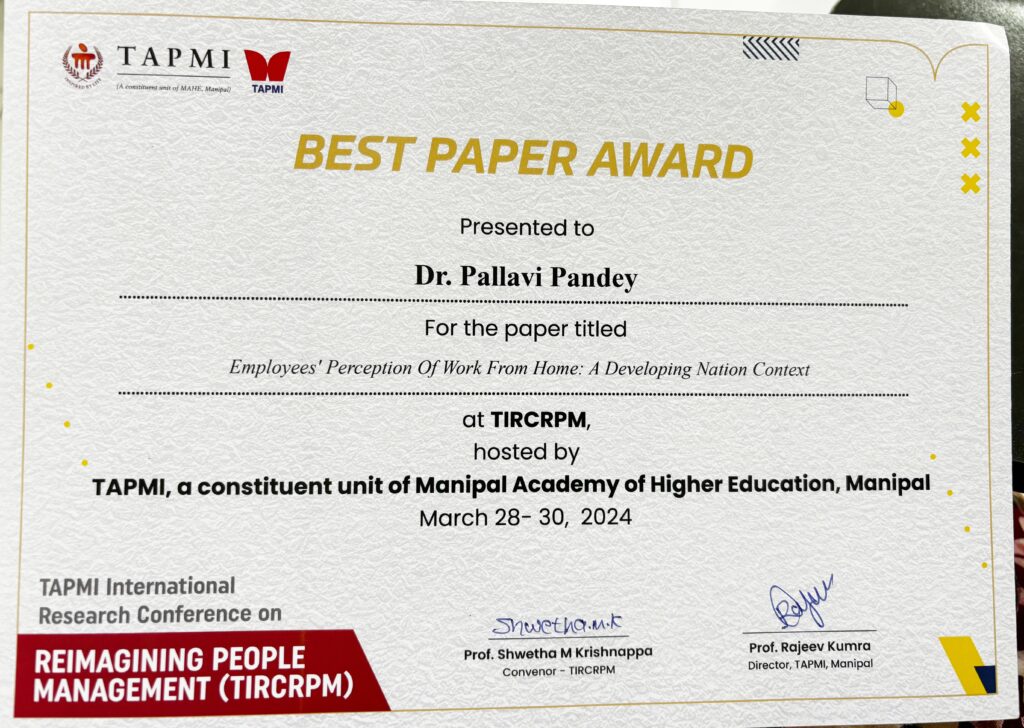
Dr Pallavi Pandey wins a Best Paper Award at TIRCRPM, TAPMI Institute of Management 

Dr Pallavi Pandey, Assistant Professor, HR & OB, and Area Chair – OB & HR, IFMR GSB, Krea University has received the Best Paper Award for her research paper titled Employees Perception Of Work From Home: A Developing Nation Context at the TAPMI International Research Conference on Reimaginging People Management (TIRCRPM), hosted by the TAPMI Institute of Management held on 28 – 30 March, 2024. 

A New Publication by Sayantan Datta in the Community Development Journal (Oxford University Press)

A paper titled ‘It’s nice we can do that too’: investigating transgender persons’ negotiations with identity and community questions in Indian science institutions by Sayantan Datta, Assistant Professor of Practice, Centre for Writing and Pedagogy (CWP) at Krea University has been published in the Community Development Journal (Oxford University Press). 

In this paper, Datta draws upon the lived experiences of four interlocutors to delineate the ways in which proximal and distal networks of caste-class and gender shape transgender, gender non-conforming, and non-binary persons’ exclusion from and belonging in science collectivities. This paper is a part of the upcoming special issue on queer and trans community building in post-377 and post-NALSA India, edited by Pushpesh Kumar, Sayantan Datta, and Neha Mishra.

Link to access

A paper co-authored by Dr Shyam Kumar Sudhakar and Kaustav Mehta published in the Brain Organoid and Systems Neuroscience Journal

A paper titled Charting Paths to Recovery: Navigating Traumatic Brain Injury Comorbidities through Graph Theory–Exploring Benefits and Challenges, co-authored byDr Shyam Kumar Sudhakar, Assistant Professor of Biological Sciences, SIAS, Krea University and Kaustav Mehta, a Biological Sciences student, SIAS PG Batch of 2023-24 has been published in the Brain Organoid and Systems Neuroscience Journal

Traumatic brain injuries (TBIs) are characterized by widespread complications that exert a debilitating effect on the well-being of the affected individual. TBIs are associated with a multitude of psychiatric and medical comorbidities over the long term. Furthermore, no medications prevent secondary injuries associated with a primary insult. In this perspective article, the authors propose applying graph theory via the construction of disease comorbidity networks to identify high-risk patient groups, offer preventive care to affected populations, and reduce the disease burden. They describe the challenges associated with monitoring the development of comorbidities in TBI subjects and explain how disease comorbidity networks can reduce disease burden by preventing disease-related complications. They further discuss the various methods used to construct disease comorbidity networks and explain how features derived from a network can help identify subjects who might be at risk of developing post-traumatic comorbidities. Lastly, they address the potential challenges of using graph theory to successfully manage comorbidities following a TBI.

Read the article here.