Installation of a multifrequency Global Navigation Satellite System at Krea Campus

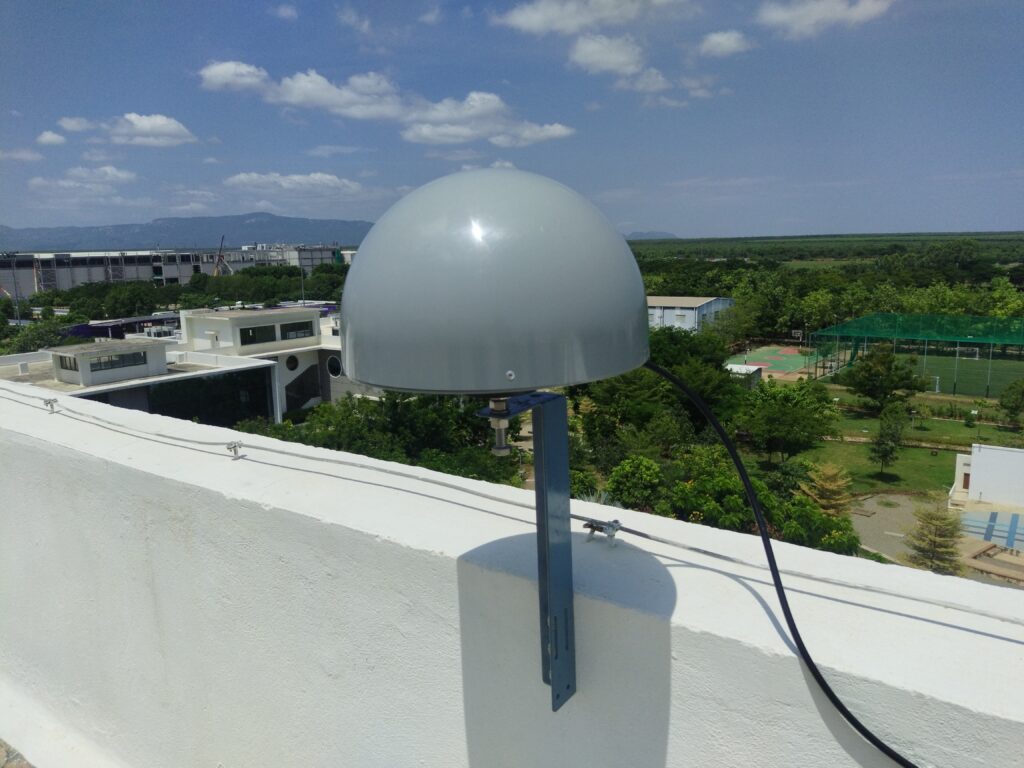
On 25 and 26 September 2025 Krea University successfully installed a multifrequency Global Navigation Satellite System receiver at the Sri City campus. The instrument is a calibrated state of the art GNSS receiver which can be operated as a reference system. This will be measuring multiple L-band radio frequencies emitted by different global satellite based positioning and timing systems such as GPS, GLONASS, Galileo, Beidou, NAVIC and QZSS. From the measurements, total electron content of the ionosphere can be estimated as a routine 24/7 data product.

This will boost the ongoing space research activities in Krea University and also at a regional level in the Indian longitude sector. The data will be immensely helpful to study the low latitude ionospheric disturbances that affect radio communications and navigation capabilities. The instrument is purchased from the financial support of ANRF through Early career grant to Dr Lakshmi Narayanan, Assistant Professor, Environmental Studies, SIAS.
SIAS Students and Faculty publish a research paper

SIAS students Aishani Tewari, Gayatri Tendulkar, and SIAS faculty members Professor S Sivakumar, Dean – Research and Professor, Physics and Dr Kalyan Chakrabarti, Associate Dean (Students) and Associate Professor, Biological Sciences and Chemistry along with Apurva Phale and Ranabir Das from National Center for Biological Sciences, Bangalore have published a paper titled, Analyzing sub-millisecond timescale protein dynamics using eCPMG experiments. The team has designed experiments to measure fast motion in proteins.

How to measure protein motion at 50,000 per second or faster? How much information can we get from the measurements? Extreme Carr-Purcell-Meiboom-Gill (eCPMG) experiments can provide such information, but there are practical considerations. The team has designed a safe and practical measurement scheme. The knowledge of the motion of protein molecules might provide clues about a wide range of diseases, from Cancer to Alzheimer’s.

Read more

Dr Dhanya Radhakrishnan and Dr Venkata Srinu Bhadram, Assistant Professor of Physics publish a collaborative paper in Journal of Applied Physics

Dr Dhanya Radhakrishnan, Lab Manager, Physics and Chemistry Labs and Dr Venkata Srinu Bhadram, Assistant Professor of Physics, SIAS have published a collaborative paper titled High-pressure structural stability of compositionally complex pyrochlore oxides in Journal of Applied Physics. It’s a collaborative work involving researchers at IIT Madras, Elettra (Italy), and Vinca Institute of Nuclear Sciences (Serbia). In this work, ​t​he researchers complex oxide ceramics remain structurally stable under extreme pressures of up to 20 gigapascals. This remarkable stability makes it promising for applications in harsh environments, such as nuclear waste immobilization, high-performance fuel cells, and heat-resistant coatings.

Read more

Dr Lakshmi Narayanan’s proposal approved under ISRO RESPOND programme

A project by Dr ​​Lakshmi Narayanan, Assistant Professor, Environmental Studies, SIAS has been approved under the prestigious ISRO RESPOND programme. The project proposal is titled ‘Large and small-scale ionospheric plasma irregularities using airglow imaging and GNSS TEC measurements’.This will be a two year project in collaboration with Physical Research Laboratory, Ahmedabad. The support is approximately Rs. 28,00,000/- and manpower at the level of Project Associate. In this project Dr Narayanan will develop a low cost instrument to study oxygen airglow at 630 nm wavelength emanating from 200 – 300 km above the surface of the earth. He will also develop software to efficiently analyse the voluminous datasets involving machine learning and artificial intelligence algorithms.

Dr Lakshmi Narayanan bags the Krea Research Fellowships 2025-26

Dr ​​Lakshmi Narayanan, Assistant Professor, Environmental Studies, SIAS has been awarded the Krea Research Fellowship 2025-26 for a project entitled ‘Multi-wavelength Airglow Imaging with Low-cost cameras (MAIL)’ with a support of Rs 3,50,000/-. The previous year Dr Narayanan developed low-cost cameras to observe a broad band of near infrared emissions known as OH airglow. This is a sequel to that project. In the present project, the team will try to measure individual airglow spectral lines (contrary to the broad band emissions) from the edge of space.

Dr Dipanjali Deka publishes in Hakara

An article titled Flow in The Living Tradition of Kabir in Malwa by ​Dr Dipanjali Deka has been published in the August Issue of Hakara bilingual online journal, centred on the theme of Flow. In the essay she examines flow, memory, and the question of “living” in the oral song tradition of Kabir, through the reading of a musical exchange between renowned folk singer Prahlad Singh Tipanya and his Guru, Chenaji Maru.
हाकारा । hākārā (ISSN 2581-9976), a peer-reviewed journal, is included in the University Grants Commission (UGC) CARE-LIST.

Read more

A research paper by Jyothis Franklin and Dr Jayasankar Ramanathan published in the Indian Journal of Marketing

A research paper by Jyothis Franklin, PhD scholar and Dr Jayasankar Ramanathan, Associate Professor, Marketing, IFMR GSB titled Understanding the Literature on Advertising Ethics Using Morphological Analysis, has been published in the Indian Journal of Marketing.

Abstract of the Paper

Purpose : This study reviews the literature on advertising ethics and identified research gaps to provide scope for future work.

Design/Methodology/Approach : The relevant literature was identified through a search of Scopus and Web of Science. The final sample of 174 articles was carefully read to determine dimensions and variants, which were used in morphological analysis to construct a cross-consistency matrix and obtain a comprehensive understanding of the domain of advertising ethics. The cross-consistency matrix was used to identify explored and unexplored areas of study.

Findings : A comprehensive morphological analysis framework, encompassing six dimensions and 27 variants of advertising ethics research was constructed, leading to the identification of 87 research gaps.

Practical Implications : Managers can use the MA framework as a guide for understanding advertising ethics and acting accordingly. Researchers can utilise the framework and the identified research gaps to extend the literature.

Originality/Value : This study is the first in the advertising ethics literature to construct a morphological analysis framework. A comprehensive literature search was undertaken by searching both Scopus and Web of Science databases.

Read more

Dr Debankur Saha publishes in Current Issues in Tourism Journal

Dr Debankur Saha, Assistant Professor, Marketing, Area Chair – Marketing, IFMR GSB has recently published a paper titled The Call of the Wild: What Draws Birdwatching Tourists to Eco-Avitourism? (co-authored with Prof. Anirban Chakraborty, IIM Lucknow), in Current Issues in Tourism (ABDC–A / Scopus–Q1, Impact factor – 4.6, Cite Score – 15.5).

The study explores the motivations and behaviours of birdwatching tourists within the ecotourism framework, offering insights that can guide policymakers and planners in designing conservation-focused, responsible tourism experiences.

Read more