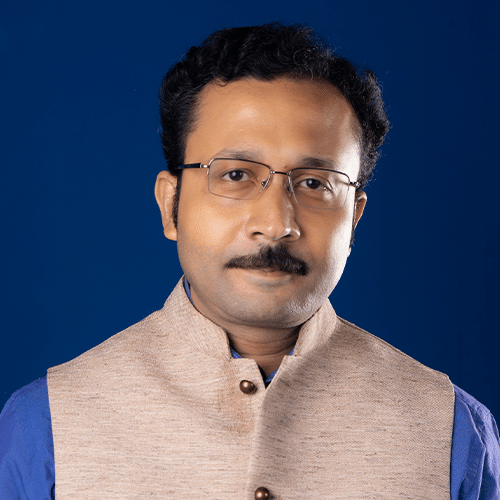
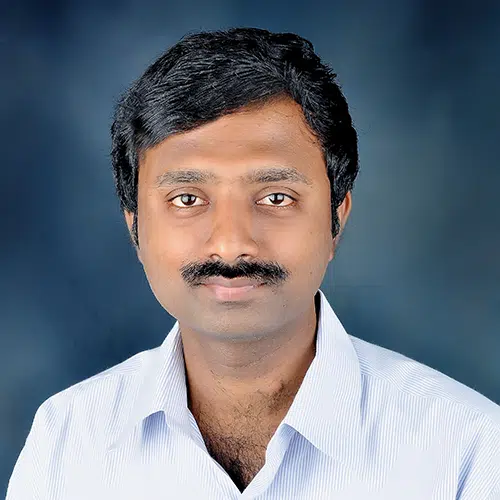
Dr Praveen Bhagawan M, Associate Professor, Finance, Accounting and Quantitative Finance and Area Chair – Finance, Accounting and Quantitative Finance presented two research papers on Bankruptcy Reforms, co-authored with Soumyabrata Basu, Centre Research Fellow Misra Centre for Financial Markets and Economy at Indian Institute of Management (IIM) Ahmedabad and Dr Jyoti Prasad Mukhopadhyay, Associate Professor, Economics and Chairperson – PhD Programme at India Finance Conference (IFC) at IIM Visakhapatnam between 18-20 December 2025. He also discussed two papers and chaired two technical sessions at IFC 2025.
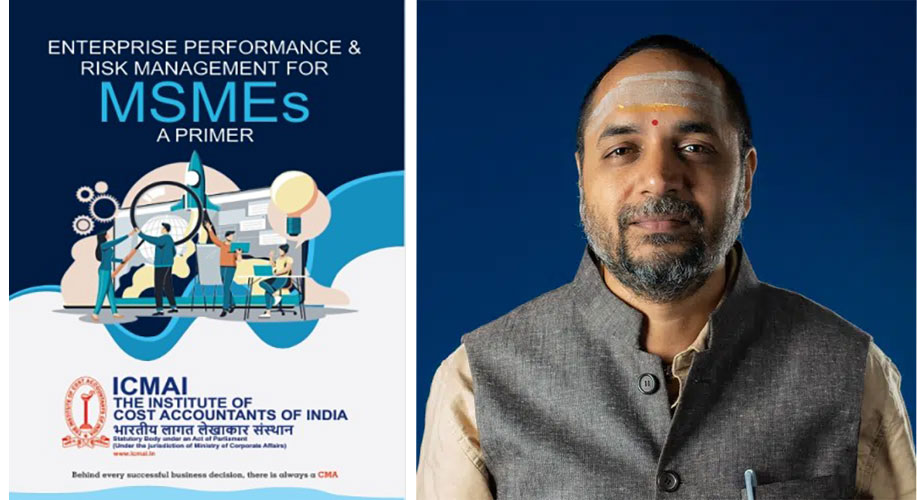
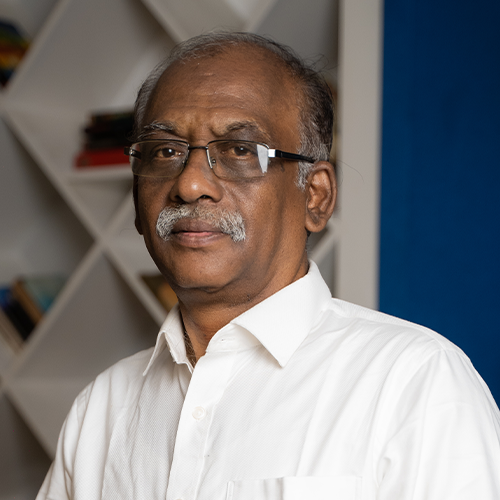
Professor Jayaram Ramakrishnan, Professor of Practice, IFMR GSB has authored a book titled, Enterprise Performance & Risk Management for MSMEs– A Primer on behalf of the Institute of Cost Accountants of India (ICMAI). The updated edition of the book was released on 11 January 26 at the 63rd National conference of The Institute of Cost accountants of India (ICMAI) at Coimbatore. The book was reviewed by leading academics and industry professionals including Professor G Balasubramanian, Senior Professor and Advisor, IFMR GSB.
The book deals with development of a Management Accounting framework for MSMEs. This was motivated by the existing low uptake and inconsistent use of Management Accounting Practices by MSMEs as observed and suggested by prior research in an Indian context. MSMEs were often found failing to leverage adequately. the potential of management accounting for helping them achieve their financial objectives (primarily profitability and liquidity) while also adequately insuring against risks.
Professor Chandrasekaran N, Professor, Operations and Strategy, Area Chair – Strategic Management & Chairperson – Executive MBA programme, IFMR GSB and Dr Suresh G, Assistant Professor, Economics, IFMR GSB along with Dr Ramasubramaniam, have authored a book chapter titled Role of Technology in Sustainable Logistics and Inventory Management with Reference to the Food Corporation of India. The chapter has been published in the forthcoming book A Circular Economy for Manufacturing Waste Management: Pathway Towards Sustainability, published by Routledge.
In Author Prajwal Parajuly romanticises Chennai winter and rightfully so, Prajwal Parajuly, Assistant Professor of Practice, Creative Writing, SIAS writes for The Hindu on how for him December in Chennai is less winter and a smug, perfectly timed takeover of sabhas, canteens, coffee shops, art spaces.
A research paper co-authored by Dr Junaid Iqbal,Post-Doctoral Fellow, IFMR GSB titled Leadership and Followers’ Voice Behavior in the Hospitality and Tourism Industry: Mapping the State-of-the-Art Trends and Future Directions has recently been published in the Journal of Hospitality and Tourism Insights (Emerald Publishing), a Q1-ranked journal.
This study investigates the knowledge structure surrounding leadership styles and employee voice behaviour within the hospitality and tourism sector. The primary objective was to provide a comprehensive overview of global research trends in this domain through a systematic bibliometric analysis. By mapping the intellectual landscape of the field, the study identifies key themes, influential authors, leading journals, and collaborative research networks that have shaped scholarly discourse over time. In doing so, it highlights the evolution of research interests, emerging hotspots, and existing gaps, thereby offering valuable insights for researchers, practitioners, and policymakers seeking to advance theory and practice related to leadership and employee voice in the hospitality and tourism context.
The paper is co-authored with Muhammad Ashraf Fauzi,Universiti Malaysia Pahang Al-Sultan Abdullah, Gambang, Malaysia, Dr Mubashir Ahmad Aukhoon, Assistant Professor, School of Management Studies, CGC University, Mohali, Punjab, India and Dr Zahoor Ahmad Parray, Assistant Professor, Department of Management Studies, South Campus, University of Kashmir, Anantnag, India.
Mugdha Kinhikar, an IFMR GSB PhD Scholar, has been selected as a mentee for the Earth System Governance (ESG) Mentoring Initiative 2026. The one-year programme supports early-career research fellows in advancing their career trajectories and fostering future leadership. The Earth System Governance Project is a global research network focused on advancing knowledge at the interface of global environmental change and governance.
A research paper titled Effect of confinement on PH3 and OH3+ inversion, coauthored by Dr Brijesh Kumar Mishra, Associate Professor, Chemistry, Professor S Sivakumar, Professor, Physics and Dean – Research, and the SIAS alumni Kaustav Mehta, Shreya Chidambaram, and Netra Krishna, has recently been published in the scientific journal Physical Chemistry Chemical Physics (PCCP).
Accessible Summary: Molecules trapped in cages (bigger molecules that enclose a volume) exhibit features distinct from those when they are free. In this work, the authors study the “inversion” of caged pyramidal molecules. Inversion is the process by which the atom at the top of the pyramid tunnels through the bottom plane of atoms to reach the symmetrically located position on the other side of the plane. Essentially, a transition from an erect pyramid to an inverted pyramid, and hence the name inversion. The cage has two prominent effects on the pyramidal molecules: it shifts the energy levels corresponding to the bending motion and changes the tunnelling barrier between the two structures. The authors carried out accurate calculations of these changes and, in many cases, produced results that compare well with measured values, surpassing earlier estimates in the literature. Apart from their importance from a fundamental perspective, caged molecules are also potential candidates for quantum information processing and metrology.
Technical Abstract: Encapsulating molecules in nanocages such as C60 provides a unique opportunity to probe how spatial confinement alters structure and dynamics. We examine umbrella inversion in hydronium (OH3+) and phosphine (PH3) in the gas phase and inside C60. Inversion profile computations for OH3+ and PH3 are based on high-level correlated methods [CCSD(T)/aug-cc-pVTZ and aug-cc-pVQZ]. Modelling confined systems requires dealing with the cage and the encapsulated molecules together, which is computationally complex. Therefore, results pertaining to encapsulated systems are based on dispersion-corrected DFT (B97-D/aug-cc-pVTZ). Barrier heights and tunnelling splittings for OH3+ and PH3 are benchmarked against CCSD(T)/aug-cc-pVQZ results. For free OH3+, the CCSD(T) barrier is computed to be ∼706 cm−1, while B97-D yields a slightly lower value (612 cm−1). The predicted tunnelling doublets closely match the experimental findings. Encapsulation of hydronium in C60 (denoted as OH3+@C60, where X@C60 indicates the encapsulation of X within C60) raises the barrier height from 612 to 871 cm−1 and markedly suppresses the splittings. In contrast, PH3 exhibits an extremely high inversion barrier (∼11 000 cm−1), effectively quenching tunnelling. Upon confinement, the barrier is lowered marginally, and the vibrational eigenstate energies are shifted upward. The interaction energies obtained using the DLPNO-CCSD(T)/def2-TZVP method confirm the stability of the encapsulated systems: −30.8 kcal mol−1 for OH3+@C60 and −13.4 kcal mol−1 for PH3@C60. Energy decomposition analysis shows that OH3+@C60 stabilization is predominantly electrostatic in nature, whereas the dispersion term in PH3@C60 is considerably larger.
A paper co-authored by Dr Aejaz Ahmad Wani, Post-doctoral Fellow, Moturi Satyanarayana Centre of Advanced Study in the Humanities and Social Sciences, Krea University and Dr Ekta Shaikh, Assistant Professor, Dyal Singh Evening College, University of Delhi has been published in Economic and Political Weekly.
In the article titled Rethinking the Governance of Begging in India: Integrating Ethics, Law, and Policy, the authors argue that India’s proposed begging governance policy must work out a sensitive, rights-compliant framework that addresses intersecting vulnerabilities of individuals engaged in begging, especially women, children and persons with disabilities. Policymakers can draw lessons from comparative anti-begging jurisprudence to implement rehabilitative, rather than coercive, strategies to deal with the problem of begging, and work on enhancing the capabilities of individuals forced to beg on the streets. They further argue that its effectiveness will depend on how it integrates ethical, legal and policy imperatives in formulating a context-sensitive and rights-compliant framework.
Professor Kai Easton, Professor, Literature & Visual Cultures, SIAS has penned a tribute and visual travelogue for South African author, Zoe Wicomb, published in Wasafiri, the international magazine of contemporary writing.
Dr Shiv Issar, Assistant Professor, Sociology and Social Anthropology, SIAS recently co-authored a book chapter titled Labor’s Odyssey Through Algorithmic Systems published in the The Sage Handbook of Digital Labour.
The abstract for the chapter: Algorithmic systems bear testimony to the sweeping transformation of labor in the 21st century. Not only do they mediate the way work is executed but they also increasingly define what constitutes possible work. They stand in direct relation to the ways labor is identified, hired, governed, performed, and evaluated. We provide a coherent framework for the emerging research around digital labor by exploring the use of algorithmic systems across four distinct dimensions of labor: algorithmic hiring, algorithmic regulation, algorithmic content moderation, and algorithmic evaluation of labor.