Dr Lakshmi Narayanan bags the Krea Research Fellowships 2025-26

Dr ​​Lakshmi Narayanan, Assistant Professor, Environmental Studies, SIAS has been awarded the Krea Research Fellowship 2025-26 for a project entitled ‘Multi-wavelength Airglow Imaging with Low-cost cameras (MAIL)’ with a support of Rs 3,50,000/-. The previous year Dr Narayanan developed low-cost cameras to observe a broad band of near infrared emissions known as OH airglow. This is a sequel to that project. In the present project, the team will try to measure individual airglow spectral lines (contrary to the broad band emissions) from the edge of space.

Dr Dipanjali Deka publishes in Hakara

An article titled Flow in The Living Tradition of Kabir in Malwa by ​Dr Dipanjali Deka has been published in the August Issue of Hakara bilingual online journal, centred on the theme of Flow. In the essay she examines flow, memory, and the question of “living” in the oral song tradition of Kabir, through the reading of a musical exchange between renowned folk singer Prahlad Singh Tipanya and his Guru, Chenaji Maru.
हाकारा । hākārā (ISSN 2581-9976), a peer-reviewed journal, is included in the University Grants Commission (UGC) CARE-LIST.

Read more

A research paper by Jyothis Franklin and Dr Jayasankar Ramanathan published in the Indian Journal of Marketing

A research paper by Jyothis Franklin, PhD scholar and Dr Jayasankar Ramanathan, Associate Professor, Marketing, IFMR GSB titled Understanding the Literature on Advertising Ethics Using Morphological Analysis, has been published in the Indian Journal of Marketing.

Abstract of the Paper

Purpose : This study reviews the literature on advertising ethics and identified research gaps to provide scope for future work.

Design/Methodology/Approach : The relevant literature was identified through a search of Scopus and Web of Science. The final sample of 174 articles was carefully read to determine dimensions and variants, which were used in morphological analysis to construct a cross-consistency matrix and obtain a comprehensive understanding of the domain of advertising ethics. The cross-consistency matrix was used to identify explored and unexplored areas of study.

Findings : A comprehensive morphological analysis framework, encompassing six dimensions and 27 variants of advertising ethics research was constructed, leading to the identification of 87 research gaps.

Practical Implications : Managers can use the MA framework as a guide for understanding advertising ethics and acting accordingly. Researchers can utilise the framework and the identified research gaps to extend the literature.

Originality/Value : This study is the first in the advertising ethics literature to construct a morphological analysis framework. A comprehensive literature search was undertaken by searching both Scopus and Web of Science databases.

Read more
Dr Debankur Saha publishes in Current Issues in Tourism Journal

Dr Debankur Saha, Assistant Professor, Marketing, Area Chair – Marketing, IFMR GSB has recently published a paper titled The Call of the Wild: What Draws Birdwatching Tourists to Eco-Avitourism? (co-authored with Prof. Anirban Chakraborty, IIM Lucknow), in Current Issues in Tourism (ABDC–A / Scopus–Q1, Impact factor – 4.6, Cite Score – 15.5).

The study explores the motivations and behaviours of birdwatching tourists within the ecotourism framework, offering insights that can guide policymakers and planners in designing conservation-focused, responsible tourism experiences.

Read more

Dr Preeti Sampat publishes in Antipode: A Radical Journal of Geography

A research paper entitled The Rentier Economy of Growth Infrastructures: Value Appropriation without Adequate Accumulation in India by Dr Preeti Sampat, Associate Professor, Sociology & Social Anthropology, SIAS has been published in published in Antipode: A Radical Journal of Geography.

Paper abstract: This paper draws on long-term research around Dholera smart city in Gujarat; the experience with special economic zones nationally and in Goa; and national data on key accumulation processes such as manufacturing and construction. ​T​he analyses reveal three distinct but overlapping moments of rent appropriation around what ​author term​s “growth infrastructures,” the inaugural moment of project announcement; the subsequent moment of land allotments to capital; and the third moment of development, lease, and sale. A key contradiction unfolds as growth infrastructures develop: value appropriation from land rent intensifies, but anticipated accumulation from investments remains elusive.

Know more

Dr Tanmoy Chakrabarty publishes in Journal of Magnetism and Magnetic Materials

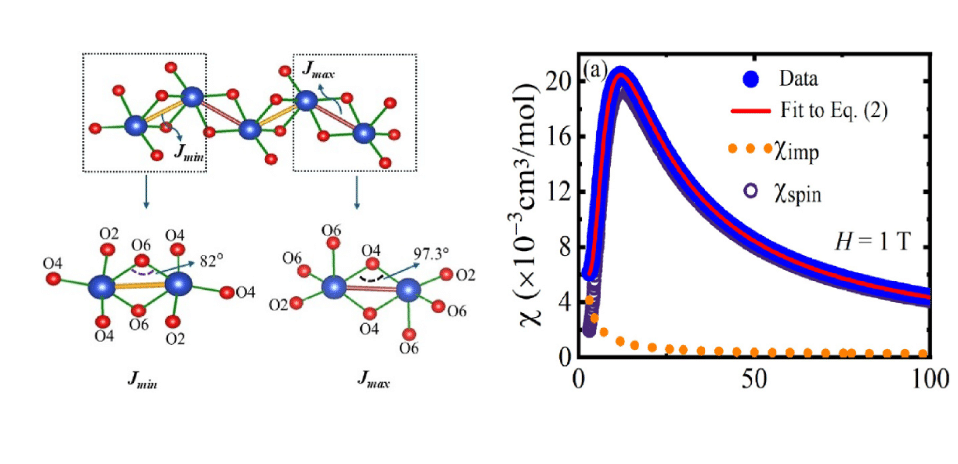
A research article by Dr Tanmoy Chakrabarty, Assistant Professor of Physics, SIAS titled Magnetic and electronic structure studies on S= 1/2 Heisenberg antiferromagnetic alternating spin chain system KCuGa(PO4)2 has been published in Journal of Magnetism and Magnetic Materials. The work highlights the low-dimensional magnetic behaviour in a novel phosphorus based cuprate system KCuGa(PO4)2. In this work the team reported the magnetic susceptibility of this S=1/2 system down to 2 K and observed a broad maximum around 12 K indicating the short-range magnetic behaviour, followed by an exponential decay, indicating the existence of a spin gap in the magnetic ground state. The magnetic susceptibility data are modeled with the Heisenberg antiferromagnetic alternating spin chain, which gives Jmin ≈ −6.47 K, Jmax ≈ −16.18 K alternation parameter (𝛼) = 𝐽min∕𝐽max ≈ 0.40, and a spin gap (𝛥)= 12 K. Magnetic heat capacity measurements further confirm the value of 𝛥 as 12 K. They have also observed field induced magnetic behavior in this system.The findings suggest that KCuGa(PO4)2 serves as an experimental model for investigating quantum phase transitions in dimerized spin systems.

Know more

​A paper co-authored by Dr Suresh Govindapuram published in the Energy Nexus journal.

​A paper co-authored by Dr Suresh Govindapuram, Assistant Professor of Economics, IFMR GSB titled Assessing Energy Efficiency of Indian Chemical Industry: Examine the Role of Innovation and Regional Heterogeneity has been published in the Energy Nexus journal.

This study aims to measure energy efficiency levels and the impact of technological innovation and regional heterogeneity on energy efficiency. Hence, the team uses Indian chemical industry data covering 85 firms from 2003-04 to 2018-19. First, they employ the stochastic frontier analysis (SFA) to measure total factor energy efficiency (TFEE). Second, they use truncated regression to assess the effect of innovation and other factors. Their time-varying TFEE has a mean level of 0.84. Most firms can improve their energy efficiency by 15%. Hence, a substantial energy-saving opportunity exists in the case of the chemical industry in India. The second-stage results suggest that firms’ innovative capability accumulates over time, enabling them to achieve higher energy efficiency. Additionally, older firms perform better than younger ones in terms of TFEE. However, having facilities at different locations reduces energy efficiency, while the number of products produced does not significantly impact energy efficiency. The study emphasises the need to consider regional heterogeneity and technological gaps when developing strategies to enhance energy efficiency at the firm level. The findings have significant implications for regulating the manufacturing sector, providing insights for policymakers and industry practitioners to design effective strategies to promote energy efficiency.

Read more

Dr Vivek Tewary and Sayantan Datta have been awarded the “Small Research Grant” by FAST India towards development of their upcoming book

Dr Vivek Tewary, Assistant Professor of Mathematics, SIAS and Sayantan Datta, Assistant Professor of Practice, Krea-CWP, have been awarded a ‘Small Research Grant’ by the Foundation for Advancement of Science & Technology (FAST) India under their India Science Book Fellowship scheme. The award will support the duo in writing their popular science book tentatively titled Equations of Life: How the Living World Speaks Mathematics, and Why We Should Learn to Listen. 

About Equations of Life: Equations of Life invites readers to wonder at the world of mathematical biology by focusing on the story of five mathematical equations that changed the course of biology, mathematics – and, at times, the world. These equations describe various biological phenomena at different scales: from molecular interactions within a single cell to movement of a large number of organisms in response to a signal. This book asks readers to consider an uncomfortable proposition: that the language of mathematics – artificial in many ways, and carefully crafted into abstraction by human beings – might be, at times, our best chance at uncovering the mysteries of the living world, a messy but beautiful marvel of nature.

About the India Science Book Fellowship: FAST-India’s India Science Book Fellowship is an incredibly competitive fellowship that seeks to support the writing of non-fiction popular science books by scientists, science writers, and communicators.

Dr Rakesh Sengupta authors article in Scientific Reports (Nature).

Dr Rakesh Sengupta, Assistant Professor, Psychology, SIAS, has authored an article titled Modeling Visual Working Memory Using Recurrent On‑Center Off‑Surround Neural Network with Distance‑Dependent Inhibition and it has been published in Scientific Reports (Nature). In this work, the author introduces a hierarchical model of visual working memory (VWM) that mimics the architectural and dynamic complexity of the visual system.The network combines top-down feedback, recurrent on-center/off-surround dynamics, and distance-dependent inhibition to simulate how feature specificity evolves—from coarse object-level representation all the way down to detailed feature encoding.

Read more

IFMR GSB Teaching Fellows publish a research article in IPE Journal of Management

A research article by Vidhya S, Teaching Fellow, OB &​ HR, ​I​FMR GSB and Naveen M​, Teaching Fellow​, Marketing, ​IFMR GSB has been published in the IPE Journal of Management (Volume 14, No. 2, July–December 2024), a UGC-CARE listed journal. The research article is titled The Dynamics of Employee Engagement: Investigating Its Influence on Job Satisfaction in the Workplace.

Read more