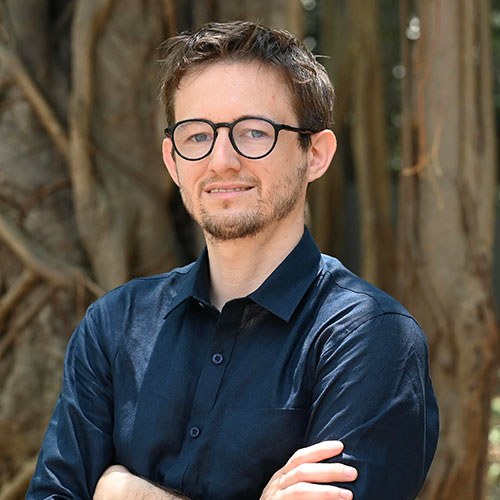
Dr Nicolas Gheeraert is a physicist whose work bridges quantum technologies, fundamental physics, and interdisciplinary science. Over the past thirteen years, he has lived and conducted research in France, the UK, Japan, and India, moving between theory and experiment. Early in his career, he also explored how life adapts under extreme environmental conditions, publishing with microbiologists on the physical limits of microbial survival—an experience that shaped his interest in crossing traditional disciplinary boundaries.
His PhD at the Institut Néel (CNRS) in France, supported by the Raman–Charpak program of CEFIPRA, sparked a long-term collaboration with the Tata Institute of Fundamental Research in Mumbai. From there, his path took him to the University of Tokyo (RCAST), where he co-developed ideas for controlling the flow of quantum information, including the design of a directional microwave photon emitter, later brought to experimental realization at MIT. In recent years, his projects have ranged from improving superconducting qubit readout with colleagues at INRIA Paris and Sorbonne Université to applying artificial intelligence to noise analysis in quantum processors with collaborators at IIT-Madras.
After completing his PhD, Dr Gheeraert held research positions at the University of Tokyo and TIFR before moving into faculty roles at IIT-Madras and now Krea University. Teaching and mentoring have been an important part of his career: he has taught across undergraduate and postgraduate levels, guided student research, and enjoyed sharing science with wider audiences through public lectures. He has also contributed to building scientific communities, organizing events such as the PiQuST 2023 conference on quantum technologies.
– Fields I (PHYS224)
– Fields II (PHYS225)
– Mathematical Methods II (PHYS202)
– Energy and Entropy (PHYS236)
– Quantum Optics (PHYS361)
– Scientific Reasoning (KCCS121)