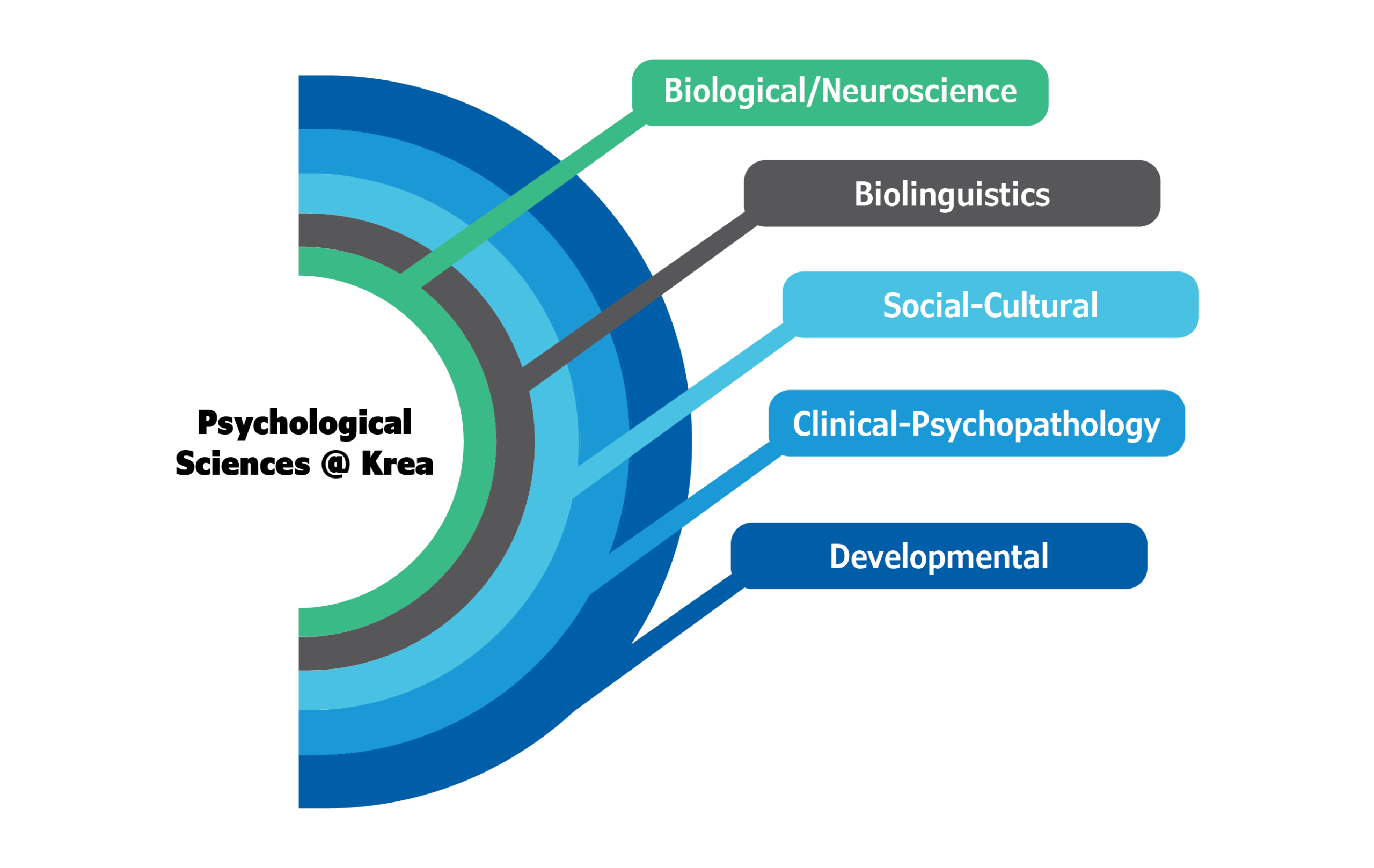
The Psychology Major at Krea University is designed to develop students’ capacities to comprehend and apply psychological knowledge, fostering a deep understanding of research methods for exploring human behaviour at multiple levels of analysis—from neural physiological and behavioural processes to social and cultural contexts. Our curriculum is built around a direct and critical engagement with cutting-edge research and hands-on empirical investigation. The programme embeds students into the wide forays of psychological theories and underlying approaches. With two dedicated labs, including a cognitive neuroscience lab equipped with state-of-the-art instruments including Electroencephalography (EEG), functional Near-Infrared Spectroscopy (fNIRS), Virtual Reality (VR) and eye-trackers, students move beyond theory to gain practical experience in the core methodologies of modern psychological science.
The Psychology programme at Krea is built on a foundation of ethical rigour, scientific integrity and a commitment to produce knowledge that is scientifically robust and socially relevant. It acknowledges the influence of unique contextual factors on human behaviour and cognition, prompting students to explore these influences in their research. Simultaneously, it addresses historical biases within the field, urging students to challenge traditional perspectives and incorporate diverse voices. The curriculum encourages students to critically engage with existing studies by reading original papers and peer-reviewed journal articles, empowering them to question methodologies, assess the reliability of findings, and validate conclusions.
The undergraduate Psychology Programme at Krea University is built on developing meaningful connections between diverse psychological theories and rigorous methodological training. In addition to core theoretical training, students are encouraged to apply psychological knowledge through specialised electives and research-intensive workshops that foster analytical thinking, methodological rigour, and ethical practice. Faculty members offer specialised niche courses drawing from their own research specialisations equipping students to gain practical hands-on skills. A key component of our training is the development of computational competence through courses that enable students to design experiments, collect data, and conduct sophisticated statistical analyses. Alongside empirical and statistical approaches, students are introduced to qualitative and interpretive traditions, including cognitive science, evolutionary psychology, phenomenology, humanistic psychology, and psychoanalysis, which deepen their capacity to engage with subjective experience and meaning making.
This foundation enables them to undertake impactful research projects under the supervision of faculty who are experts in diverse areas of Psychology. The curriculum equips students with a versatile skill set, including parsing credible sources, integrating qualitative and quantitative research methods, conducting experimental and quasi-experimental studies, and developing ethical guidelines for fieldwork. Students also master academic communication, learning to write about psychology and effectively convey research findings to both academic and general audiences.
In addition to its focus on preparing students for research and higher education, the Psychology Major at Krea University exposes them to various strands of Psychology, equipping them with the knowledge and skills to pursue a wide array of careers. By exploring different branches of Psychology, such as social, developmental, clinical, cognitive, and counselling psychology, students gain insights into their practical applications. The programme’s unique emphasis on cognitive science and quantitative methods also prepares them for emerging, high-demand fields. With growing awareness of the importance of mental health, the programme also equips students to think critically and compassionately about care, distress, and wellbeing across diverse social and cultural contexts. Whether their interests lie in clinical practice, human resources, counselling, academic research, advocacy, policy intervention, scientific journalism, user experience (UX) research, data science, or cognitive engineering, the curriculum provides a robust foundation for them to excel in their chosen careers.

Psychology, as a scientific discipline, is continuously evolving in response to emerging empirical evidence, methodological advancements, and interdisciplinary developments. To cover the vast expanse and rapidly growing landscape of psychological science, our curriculum is well equipped to match this growth.
Apart from the required courses that are mandatory for all students majoring in Psychology, we also offer a broad and diverse range of elective courses. From cognitive science to mental health, students are offered a blend of electives that allows them to choose their area of specialisation by the fourth year.
As students must engage with courses that deepen their understanding of biological mechanisms, cognition, and scientific methods driven by innovations in brain imaging, computational modelling, and cognitive theory, we offer courses in neuroscience and cognitive science. These courses enable students to apply biological, cognitive, and empirical principles to understand complex human behaviour, reinforcing foundational knowledge and empirical reasoning.
At the same time, the growing integration of big data, AI, digital tools, and human–computer interaction has expanded the discipline’s methodological boundaries. Electives in statistics, research design, cognitive science, data analytics, and computational approaches equip students with essential quantitative reasoning and analytical skills that align with modern psychological research and industry expectations.
Similarly, with mental health gaining unprecedented attention—especially after the pandemic—electives in counselling skills, psychoanalysis, motherhood, trauma, wellbeing, psychosocial support, disability and inclusion, etc., ensure that students develop ethical sensitivity, cultural competence, and applied skills essential for addressing real-world problems. These courses form key components of professional and sociocultural learning outcomes.
Further, the increasing relevance of psychology in workplaces—from organisational behaviour and leadership to consumer behaviour, user experience, and design thinking—necessitates course offerings that build communication, teamwork, problem-solving, and applied research capabilities. Moreover, psychology’s expanding intersections with public health, sustainability, economics, political science, philosophy, education, early childhood development, and digital media highlight the discipline’s inherently interdisciplinary nature.
Offering electives across these domains allows students to integrate diverse perspectives, think critically, and appreciate how psychological science operates within the real world. A wide range of courses, especially electives, is not just an academic requirement but a curriculum designed to prepare students for the multidimensional roles and emerging opportunities that define contemporary psychology.
Students engage with a wide range of assessment formats, including reflective writing, presentations, mini research projects that are data-driven, collaborative projects, lab reports, and problem-based tasks. Assessments vary based on the type of course and are deeply rooted in the principles of a liberal arts and sciences education. They are flexible, reflective, and interdisciplinary, enabling students to demonstrate understanding, apply knowledge, and refine their analytical and critical thinking skills across diverse domains.
A combination of assessments ensures that students do not simply recall information; each component helps gauge conceptual clarity, critical thinking, ethical reasoning, research competence, and the ability to connect ideas across disciplines. Instead of viewing assessment as a fixed endpoint, Krea approaches it as an ongoing, developmental process. Collaborative assignments and experiential components—such as fieldwork, labs, community-engaged learning, and interdisciplinary projects—further support teamwork, communication, and the application of theory to real-world contexts.
Importantly, Krea’s assessment practices are inclusive and student-centred, allowing multiple pathways to demonstrate learning. Rubrics, timely feedback, and transparent expectations support fairness and academic integrity while empowering students to take ownership of their learning process.
In essence, assessment at Krea extends beyond grading. It is a pedagogical tool that nurtures curiosity, intellectual flexibility, and lifelong learning—core capacities that define a rigorous liberal arts and sciences education.
|
Graduation Requirements |
3-Year Single Major |
4-Year Double Major |
3-Year Single Major |
4-year Double Major |
4-Year Minor |
3-Year Minor |
Concentration (Applicable to both 3- and 4-Year programmes) |
| Total Credits | 80 | 64 | 60 | 48 | 32 | 24 | 16 |
| Required Courses | 48 | 48 | 36 | 36 | 20 | 20 | |
| Electives | 32* | 16* | 24** | 12** | 12** | 4** |
To earn a Psychology Major, Minor, or Concentration, students must complete the required and elective credits in Psychology courses as indicated above.
The Behavioural Sciences & Neuroimaging Lab at Krea is dedicated to advancing research in human cognition through a multidisciplinary approach. The lab is broadly divided into three key areas: Child and Infant Research, Computation, Cognition and Language Research, and Behavioural Research.
Equipped with advanced tools such as Electroencephalography (EEG), Near-Infrared Spectroscopy (NIRS), Virtual Reality (VR) systems, eye-tracking technology, and a range of instruments for behavioural measurement, the lab is dedicated to furthering our understanding of the computational nature and neurobiological substrates of cognition. A particular focus is placed on studying the neonatal brain and infant cognition, exploring how early neural mechanisms shape human cognitive development.
Further, adequate facilities for conducting studies using psychological tests and qualitative methods are also available. The lab functions as a hub for fostering a research-oriented culture, empowering both students and faculty to conduct empirical studies, surveys, and experiments.
The well-equipped lab serves as a multifaceted resource for conducting research and significantly enhances student learning outcomes by providing tangible, hands-on experiences that reinforce theoretical concepts introduced in the classroom. The lab facilities also provide opportunities for researchers from diverse disciplines to leverage shared resources. This active engagement contributes to the continual advancement of psychological knowledge.
A degree in Psychology equips students with a deep understanding of human behaviour, critical thinking, and research skills. The UG curriculum, covering a broad range of courses and rigorous training, equips students to make a wide range of meaningful career choices across mental health, education, research, organisations, technology, community development, and more.
The information below provides a comprehensive overview of the major pathways available to psychology graduates:
Mental Health, Wellbeing & Therapeutic Services
Students interested in supporting individuals, families, and communities in improving their emotional wellbeing can explore careers in:
Child Development, Education & Early Intervention
For students drawn to working with children, adolescents, and learning environments, opportunities include:
Research, Academia & Scientific Careers
Students passionate about inquiry, experimentation, and theory-building may pursue:
Organisational & Workplace
This pathway combines psychology with leadership, business, and organisational systems. Careers include:
Health, Wellness & Behaviour Change
Psychology plays a key role in shaping health behaviours and supporting physical wellbeing. Opportunities exist in:
Community, Social Impact & Public Policy
For those committed to equity, systems change, and community wellbeing, careers include:
Law, Crime & Justice Systems
At the intersection of psychology and law, graduates may pursue:
Media, Communication & Public Engagement
For students who enjoy communication, storytelling, and public-facing work, opportunities include:
Technology, UX, AI & Behavioural Design
As technology transforms how people live and behave, psychology graduates are increasingly valued in:
Business, Marketing & Consumer Behaviour
Students interested in understanding decision-making, motivation, and market behaviour can explore:
Interdisciplinary & Emerging Fields
Psychology increasingly intersects with new and evolving domains, such as:
Higher Education Pathways: MSc/PhD in Clinical Psychology, Counselling Psychology, Organisational Psychology, Forensic Psychology, Educational Psychology, Health Psychology, MBA in HR or Organisational Behaviour and more.
Partnerships
Krea University has partnerships with leading universities in India and abroad that offer students pathways for higher education and research. These collaborations create opportunities for postgraduate study, academic exchange, and continued learning across disciplines. Know more
Discover how Harini Bhatia selected her Psychology major, what makes this discipline unique, the key lessons she learned, her future aspirations, and her words of wisdom for freshers.
“Krea’s commitment to diverse learning in Psychology has been a cornerstone of my academic journey. The specialised professors brought real-world insights into the classroom, empowering me to pursue my goals with confidence and clarity.”