Considering the swift evolution of technology driven by advances in computer science, a pivotal inquiry facing the pedagogy of the discipline is: “Which core principles enable one to effectively navigate the constantly shifting landscape of the field?”
In this context, the undergraduate curriculum at Krea University aims to provide a comprehensive introduction to the foundations of the discipline and its connection with technological advancements. Throughout the curriculum, we expect students to learn how to tackle computational challenges and develop insights into the conceptual principles underlying programming and computing paradigms such as machine learning and quantum computing. Students will gain a solid grounding in key mathematical principles and techniques that underlie modern computing and domains like artificial intelligence. This will be complemented by a systems-level perspective through courses covering key concepts in computer organisation, operating systems and networks. The curriculum also intends to enhance students’ understanding of how computing plays out in real life through a range of interdisciplinary courses, helping them see how computing is embedded in various domains.
The required courses in Krea are designed to provide a rigorous introduction to the conceptual core and skills that every computer science major should possess in the contemporary era. These include the ability to write correct and efficient code, reason about code, experimentally validate performance, grasp various layers of computer systems, and gain hands-on experience with systems programming. Students will also study the mathematical and theoretical foundations of computer science, and contemporary computational paradigms such as machine learning/artificial intelligence and quantum computing. They will learn to deploy their understanding to deliver real-world projects.
In their final years, students have access to a range of electives to enable further exploration, either in depth or breadth, of computer science and interdisciplinary domains. Electives may include conventional computer science areas such as deep learning, complexity theory, and computer vision, as well as interdisciplinary fields such as computational music and quantum information. Some electives can be substituted with independent study courses, where students can undertake guided study in a domain of interest with a faculty member. Additionally, students have the option to engage in a capstone project to gain hands-on experience in research, develop ancillary skills including writing research reports, and communicate their findings effectively.
At Krea, studying Computer Science is a journey into both the logic and imagination behind technology. It builds a strong foundation in the scientific principles that drive computing, equipping students with skills and perspectives that endure well beyond immediate technological trends, ensuring longevity in a fast-changing landscape. The programme brings together rigorous training in algorithms, mathematical reasoning, and systems thinking with opportunities to explore the frontiers of modern computing technologies—Machine Learning, AI, Quantum Computing, and more. Courses invite students to reason precisely, write elegantly, and connect computational thinking to broader intellectual and social questions.
Interdisciplinary electives and hands-on projects reveal how computing drives discovery across fields ranging from physics and economics to art and society. Students learn and collaborate in a vibrant research environment, engaging with faculty who are actively pursuing research in diverse areas of computer science and its interdisciplinary intersections. In their final years, students can pursue an independent study or a capstone project, developing not just technical expertise but also the curiosity, creativity, and clarity of thought needed to lead and innovate in a changing world. The capstone further provides an opportunity not just to carry out research but also to articulate ideas in Computer Science. Talks, seminars, and interactions with industry provide a first-hand glimpse into the latest research and the applied industrial interface of computer science.
Any 2 courses from the list below
Graduates will be able to:
Assessment in the Computer Science major emphasises both rigorous reasoning and practical application. Students are evaluated through a blend of mathematically precise tasks, programming and systems assignments (algorithm implementation, debugging, data structures, OS- and ML-oriented labs), and concept-driven problem sets that test depth of understanding. Many assessments require students to explain ideas clearly, justify design choices, and connect computation with broader contexts. Open-ended projects and capstone work encourage independent exploration, experimentation, and research-style thinking.
Computer Science graduation requirements for the three-year and four-year degree programmes:
|
Credits needed to earn a Single Major in Computer Science |
Credits needed to earn a Double Major in Computer Science |
Credits needed to earn a Minor in Computer Science |
Credits needed to earn a Concentration in Computer Science |
|
| 3-year programme | 60 | 48 | 24 | 16 |
| 4-year programme | 80 | 68 | 32 | 20 |
Computer Science graduation requirements for the three-year and four-year degree programmes:
| Single Major | Double Major | Minor | Concentration | |||||
| Required | Elective | Required | Elective | Required | Elective | Required | Elective | |
| 3-Year Programme | 52 | 8 | 44 | 4 | 16 | 8 | 12 | 4 |
| 4-Year Programme | 52 | 28 | 52 | 16 | 24 | 8 | 12 | 8 |
To earn a Computer Science Major, Minor, or Concentration, students must complete the required and elective credits in Computer Science courses as indicated above.
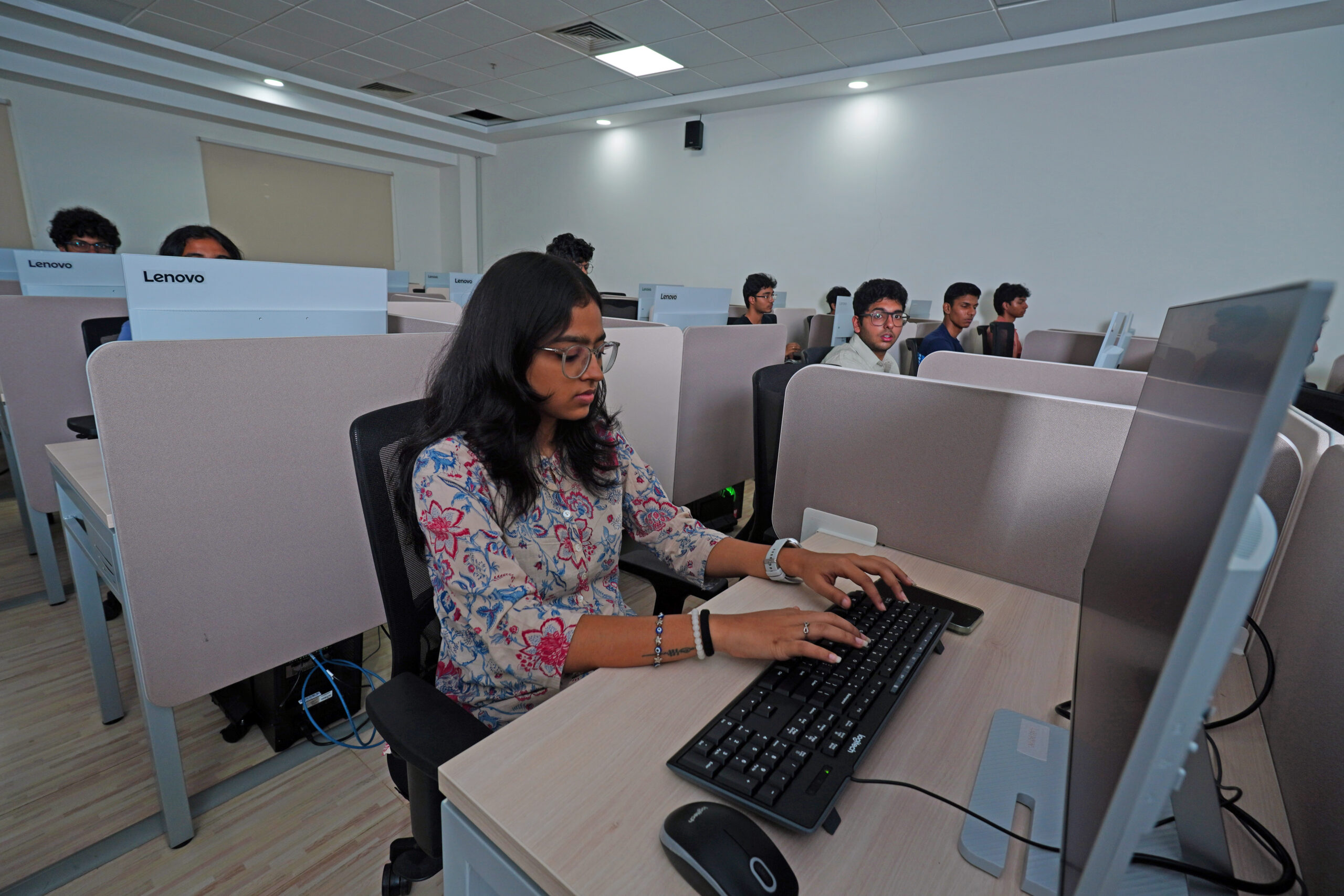
Laboratories and the High-Performance Computing (HPC) Cluster form an integral part of the Computer Science major at Krea University. Students have access to two modern computer laboratories with over 100 high-performance workstations that support hands-on instruction and structured lab sessions alongside classroom learning. The HPC Cluster is integrated into coursework and also supports faculty and undergraduate research, providing students with access to powerful computational resources from early in the programme.
Together, these facilities offer a cutting-edge computing environment that supports a wide range of academic and research activities—ranging from foundational programming and software development to advanced work in Machine Learning, Artificial Intelligence, and high-performance scientific computation. This enables students to gain practical experience, work on real-world problems, and engage deeply with contemporary computing technologies in a research-enabled setting.
The Computer Science graduate will be prepared by the programme with a strong foundation in core concepts and skills, enabling careers in technical roles, research, policy, and interdisciplinary tech-for-humanities pathways.
Partnerships
Krea University has partnerships with leading universities in India and abroad that offer students pathways for higher education and research. These collaborations create opportunities for postgraduate study, academic exchange, and continued learning across disciplines. Know more
Higher Education Pathways: Masters and PhD in, Computer Science, Artificial Intelligence and Machine Learning, Data Science, Game Design, Computational Finance, Operations Research, Computational Neuroscience, Cognitive Science, Computational Economics, Human-Computer Interaction, Digital Humanities, Information Security, Digital Media, and Quantum Computing.
Job roles: Full Stack Development, Machine Learning Engineer, Product Manager, Data Analyst, Algorithm Engineer, Data Scientist, Data Engineer, Computational Scientist, UI / UX Designer, Game Designer, Technology Consultant, Digital Humanities Analyst, Computational Social Scientist, Technology Policy Analyst, Systems Architect, Cybersecurity Analyst, Cloud Engineer, and more.
Discover how Aarav Akali selected his Computer Science major, what makes this discipline unique, the key lessons he learned, his future aspirations, and his words of wisdom for freshers.
“At Krea, Interwoven Learning wasn’t just a concept — it shaped the way I thought and worked. I learned to connect ideas across computer science, design, and business, and to approach problems with both creativity and structure. That mindset came alive during my internship with the IT team at Krea, where I had the chance to design real systems, build applications, and see my work make a difference on campus. More than skills, it gave me confidence — a belief that I could step into ambiguity, listen, experiment, and find a way forward.”