
| Component | Duration |
|
Coursework (Theory, Assessment, Practicum, Research) |
Trimesters 1–4 |
| Research Thesis | Trimesters 4–6 |
|
Field Immersion (Hospitals, NGOs, Schools, Communities) |
Trimesters 5–6 |
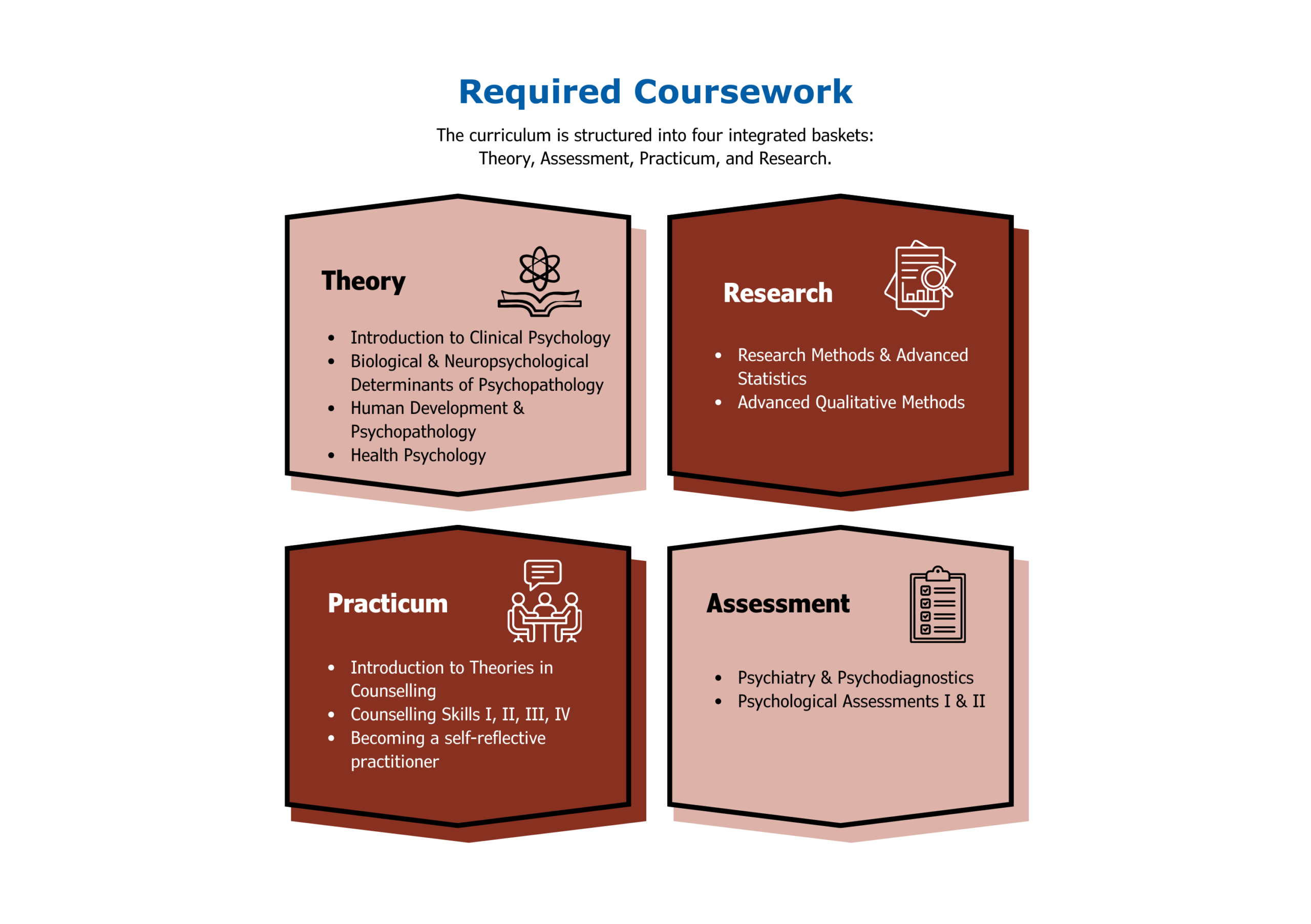
The MSc follows Krea University’s philosophy of Interwoven Learning, where theory, research, and practice are closely connected rather than taught in isolation. What you learn in the classroom informs your clinical training, your research sharpens how you think about evidence, and your supervised practice helps you apply concepts in real settings. This integrated approach ensures that you graduate as a reflective, research-informed, and practice-ready professional.
Overview
The first four trimesters cover core, interdisciplinary, and elective courses, forming the conceptual and practical foundation of clinical psychology training.
| Baskets | Courses |
| Core Coursework |
|
| Interdisciplinary Courses |
|
| Electives |
|
| Practicum |
|
Learning Experience
Overview
The final two trimesters focus on immersive practicum and the research dissertation, allowing students to apply their learning in real-world clinical and community contexts.
Field Immersion
Research Dissertation
Integration and Supervision












An MSc in Clinical Psychology is a postgraduate degree that trains you to understand, assess, and support people experiencing mental health conditions. The degree prepares you to work in hospitals, clinics, schools, NGOs, and community settings, and it can also serve as a foundation for further professional training in mental health.
Applicants should have a four-year BA (Hons)/BSc (Hons) in Psychology (preferred). Candidates with a three-year undergraduate degree plus one year of a Master’s programme, or a three-year degree with one year of work experience in the mental health sector, may also apply. Applicants from allied disciplines such as Social Work, Public Health, Biology, Medicine, and Education will be considered on a case-by-case basis.
Selection is based on three components: Your academic transcripts, the Krea Aptitude Test (KAT), and a personal interview (PI)
The entrance exam covers core areas of psychology, research methods in statistical reasoning, brain–behaviour relationships, and abnormal psychology. The interview includes a short presentation and interaction with the faculty to assess your readiness for clinical training and overall fit with the programme.
No. Krea University conducts its own admissions procedure for the MSc in Clinical Psychology, and no external entrance examinations are required or considered.
The entrance examination and personal interviews will be conducted in two rounds, in April and June. To receive updates and detailed information directly in your inbox, register your interest by filling out this Google Form:
Yes. Supervised clinical training is a central component of the programme and runs alongside academic coursework. Clinical training has two parts: on campus, students receive structured training in psychological assessment, case formulation, and counselling skills; off-campus, they complete 480 hours of supervised field immersion across hospitals, clinics, NGOs, schools, community mental health programmes, and rehabilitation centres. Supervision is provided both individually and in group formats to support skill development and professional growth.
No. The MSc in Clinical Psychology is designed in alignment with RCI training frameworks; however, it is not currently RCI accredited. Completion of the MSc alone does not confer eligibility for licensure, but it provides a strong academic and clinical foundation for students who wish to pursue recognised licensure pathways and professional practice.
The tuition fee for the two-year MSc in Clinical Psychology programme is ₹10 lakh. At present, scholarships are not available for this programme.
Yes, partly. The MSc in Clinical Psychology is a two-year, full-time programme structured across six trimesters. Students spend four trimesters in residence at the Krea University campus in Sri City, participating in coursework, supervised training, and campus-based academic activities. Two trimesters are dedicated to off-campus fieldwork immersion and data collection for the research thesis.
The MSc follows Krea University’s philosophy of Interwoven Learning, where theory, research, and practice are closely connected rather than taught in isolation. What you learn in the classroom informs your clinical training, your research sharpens how you think about evidence, and your supervised practice helps you apply concepts in real settings. This integrated approach ensures that you graduate as a reflective, research-informed, and practice-ready professional.
Fieldwork immersion placements are organised by the MSc programme in collaboration with internship partners across India. Students are placed in organisations that have formally partnered with Krea University, including hospitals, clinics, NGOs, and community mental health settings.
Yes. In the first year, students complete coursework in research methods, including advanced quantitative and qualitative approaches. In the second year, each student undertakes a research dissertation under faculty supervision, applying methodological training to a focused mental health research question.
Designed in alignment with RCI training frameworks, the MSc provides a strong foundation for pursuing recognised licensure pathways and professional practice. Graduates may work in hospitals, clinics, NGOs, schools, community mental health programmes, and policy-oriented organisations. The programme also prepares students for doctoral studies and research careers in mental health.
Write to us by filling out this Google Form:
https://forms.gle/otZUkdfYFn8DHyeQA.
Or write to: [email protected]