Dancing Their Way to Glory

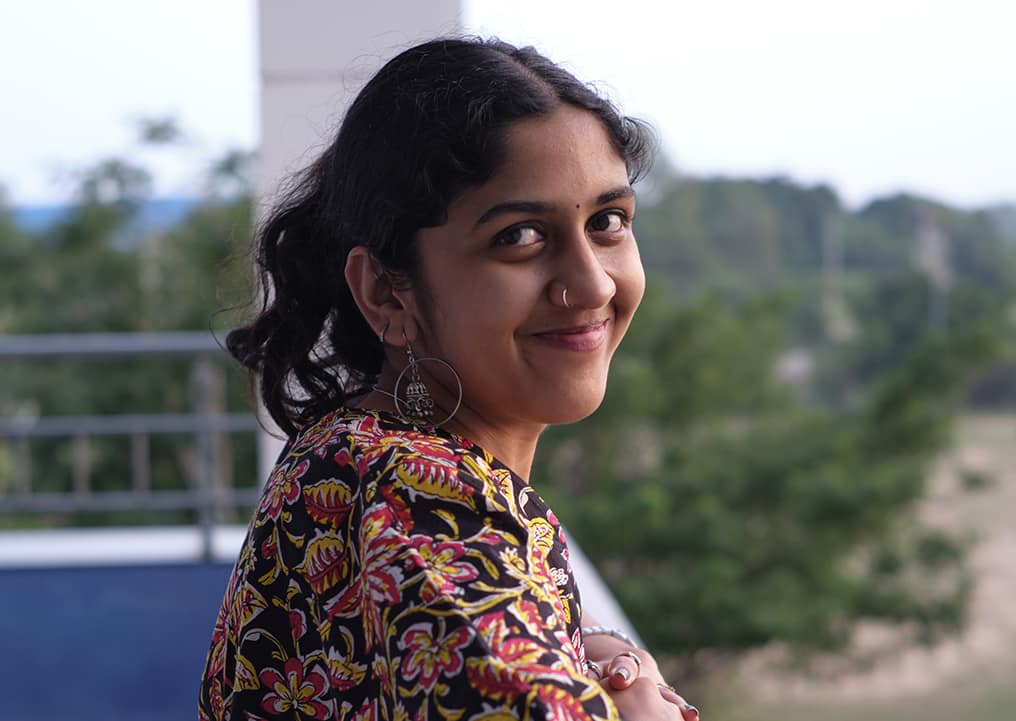
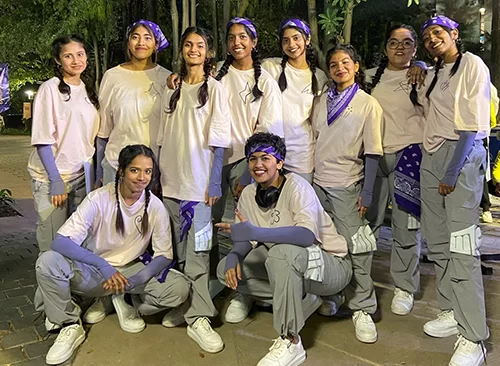
The Dance Club at SIAS, Krea University participated in Kurukshetra, the inter-college student run-fest of FLAME University. The team took part in both solo and crew dance competitions. Diya Gupta, Cohort of 2025, won second place in the solo dance competition. However, the crew, while not securing a position, was placed 4th and gained valuable insights on how to improve and excel in future competitions.

Dr Srajana Kaikini and Dr Vivek Radhakrishnan to deliver talks at the Workshop on Reason, Feeling and Experience

Dr Srajana Kaikini, Assistant Professor of Philosophy and Dr Vivek Radhakrishnan, Assistant Professor of Philosophy at SIAS, Krea University will deliver talks at the Workshop on Reason, Feeling and Experience. The workshop is co-organised by the Department of Humanities and Social Sciences at IIT Tirupati and the Philosophy Department, SIAS, Krea University. The event is set to take place on February 10, 2024. 

Dr Kaikini will present on the topic Life-Images: Curatorial Transcendence, while Dr Radhakrishnan’s  talk is on Feeling and Moral Agency: Recalibrating Kant towards Okin. 

For details about the workshop, click here

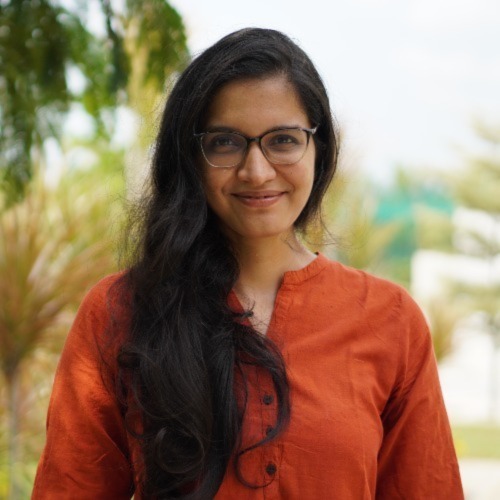
Fuelled by passion for education and social impact, Aishwarya’s journey to Harris School of Public Policy

Aishwarya Sivaramakrishnan, SIAS cohort of 2022 has secured an early action round acceptance to pursue a Master’s in Public Policy (MPP) from the Harris School of Public Policy in the University of Chicago, along with a Harris Merit scholarship. Driven by her passion for education, social impact and effective policy making, Aishwarya intends on putting policy into practice and working with the government or NGOs in the field of education.

Aishwarya reflects on her journey through Krea and the vision she holds for the future.

The Call to the Future

“The call was a shock in itself; it was unexpected and exhilarating.” The acceptance news took Aishwarya by surprise, it was like a bolt out of the blue but definitely one that held immense joy.

“The MPP programme at Harris School of Public Policy has always been my top choice due to the heavy focus on data analysis and the multidisciplinary approach towards tackling real-world issues, similar to my undergraduate experience at Krea University.”

Aishwarya has also secured a Harris Merit scholarship and believes her summer internship experiences and externships at Teach for India, Centre for Policy Research, Rhapsody Music, and Aureolis Ventures have helped her expand interests and skills and laid down the path for where she is today.

The Vision, Passion and Determination

In the past three years, Aishwarya has had the opportunity to volunteer and pursue her internship with various policy advocacy groups that lobby for grassroots-level change in state-sponsored educational institutions.

“Since then, education policy and child rights have become my passion project, and I have worked extensively in the education space in India. This has given me an insight into the ground realities of primary education facilities, opening my eyes to the pressing need for changes in both curricula and infrastructure available to school-going children, especially in semi-urban and rural areas. Some of my most cherished, valuable experiences and life lessons are from this period of working with children and individuals from all walks of life, and they have shaped the person I am today.”

On completion of her studies, Aishwarya intends on putting policy into practice and working with the government or NGOs in the field of education.

The Krea Journey

Aishwarya fondly remembers her journey at Krea with a memory from day one, something that continues to stick with her even today.

“It was the first day and I was in my room and so was my roommate and so were our families, the entire area was abuzz with hellos and greetings, people were coming in and stepping out and it all felt comforting and familiar. It just felt right and Krea truly felt like home. It remains one of my most heartening experiences till date.”

Aishwarya has always been passionate about education, teaching and training, thanks to her mother who is a teacher. Though she also remarks that before stepping into Krea, she wasn’t so sure on her path forward and there was a huge possibility that she would have headed into the family run business.

Aishwarya ran for the position of Finance and Resources Representative in the first year at Krea and was part of the first student government. It being the very first year of Krea University also helped her play an instrumental role in building the student government and pushed her to try new things, meet new people, and make the most of her newfound independence.

When asked for a piece of advice to other Masters’ aspirants, Aishwarya adds, “I applied to the Harris School of Public Policy in October close to the deadline. And though I didn’t really plan much and got admitted to the very first school I applied; planning does help. There are times when we may not feel too confident and second guess our choices, but the key is to believe in oneself.” Aishwarya does believe firmly in taking chances.

An Economics major, while she believes that she was passionate about her vision, Krea opened up her mind and the various experiences helped her pave the way forward. The Interwoven Learning aspect helped her figure out her other interests, and how she could pair them best with Economics.

When it all clicked

Her passion for impactful education was turned into a more determined drive in the first year and the internship, especially the one with Teach of India, was significant in the process. Over her UG years, Aishwarya has done various internships and online training stints which only helped her passion evolve further. 

It was in the 2nd year and through a session hosted by the Career Services Office(CSO) for Harris School of Public Policy that helped Aishwarya zero in on her dream institution.

Interestingly, Harris School of Public Policy was her first and only college application and it all fell into place. “I applied during the Early Action round and this was helpful since I was able to get an early decision and plan ahead when it came to academics at Krea and moving to Chicago.”

While the undergraduate experience at SIAS, Krea University and the upcoming Masters at Harris School of Public Policy are pivotal milestones, they are only steps into the impactful journey that this young changemaker has embarked on.
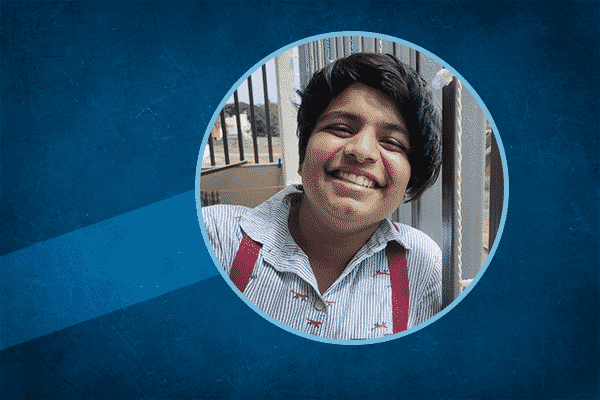
SIAS student conducts a skill development workshop for UG students at Kalasa

Shreyasi Patil (they/she), a 3rd year SIAS student at Krea, worked with the Skill Development Office of Chikkamagaluru and Srinidhi Gurunath, MGN Fellow, to conduct a soft skills and design thinking workshop for final year degree students about tackling problems of rural Malnad area.

The one-day interactive design thinking workshop was conducted at GFGC Kalasa, with the final year BCom and BA students aiming to promote soft skills and entrepreneurial values among them.

“The Design Thinking workshop was used to identify problems specific to the Malnad region and why entrepreneurship isn’t developing in the area. Especially in  Chikkamagaluru, which is well known but mostly for tourism.”

Emphasising on what contributed to a seamless building of the workshop, Shreyasi added, “ At Krea, we have a course in the 1st year on Design Thinking and in the 2nd year we have a course named Creative Economy where we build our own company and pitch in front of real life Venture Capitalists at the end of three months. Along with these I have also been part of the TiE – Young Entrepreneurs Chapter where we represented India and won the second position. All these factors together helped me plan the one day workshop.”

Kalasa is a taluk, located deep within Chikkamagaluru. “We had no clue how remote Kalasa was. A couple of government buses ply in this region and some students have to walk 6-7 kilometers each day to reach their schools. The heavy monsoons also create havoc and the students and teachers usually aren’t able to make it to the institutes in such conditions. Added to it the weak internet connectivity, the education of most students at Kalasa are hindered.”

The workshop revolved around combating these issues that the students faced in their everyday lives. They worked through the process of identifying problems, empathising, building solutions and testing the solutions – a reality check on how viable it would be if one were to implement the same.

There were around eight problems which were identified and solutions proposed. The students wrapped up the workshop with solutions like setting up a customer service team which would work as a liaison between rural places in Malnad and the telecom companies. Another suggested a bus for the safety of girl students, as many of them dropped out of school and colleges and got married early because of the lack of efficient transport systems. 

Shreyasi has been training and teaching students from a very young age. Yet, teaching and training peers and young adults of their own age was led by their experience at Krea.

 “I was comfortable training younger students, but at Krea, the student experience facilitated by being an extracurricular representative had an impact. I have been able to take up the challenges of teaching people my age. Now I know the vocabulary for it, having the right language and presentation is important. Two years of college at Krea have done to me what years of training by myself couldn’t. College has given me the language to present what I really believe in.”

Shreyasi also trains school students in gender studies through the medium of theatre. On completion of their under graduation, they plan to travel across India and teach gender studies to students across demographics, using theatre. Shreyasi hopes to pursue their future goals in the intersection of art, education and entrepreneurship.

Two SIAS students set to create TURNIP- a venture idea validated by Venture Capitalists

Thrilled and raring to go, Aditi Rajesh and Mitul Aggarwal, 2nd year undergraduate students at SIAS, Krea University, are all set to work on the Minimum Viable Product (MVP) for their venture TURNIP, an idea that was witnessed and validated by noted Venture Capitalists in the country, including Sunil Cavale and Sanjay Selvan (Speciale Invest), Praveen Sridharan (TVS Capital Funds) and Nihir Nemani (Emerald India).

So, what’s TURNIP?

“It’s a peer-to-peer learning network which seeks to make learning interesting. It aims to facilitate learning through conversations,” says Aditi.

“In short, it’s a networking platform focused on learning,” adds Mitul.

In a conversation with the Communications Team at Krea, these young minds opened up about the experience of pitching their idea to potential investors, and how the elective ‘Creative Economy’ by Prof Anil Srinivasan acted as a catalyst to the creation of TURNIP.

“Prof Srinivasan’s course has been a pillar for the Interwoven Learning Experience. A very well-structured course, there are theory classes and then industry-based sessions giving us a chance to implement learning from the classroom into real life. It’s very practical and hands on. The course in Creative Economy led us to start TURNIP. It gave us the push and the reason to work on something new. Prof Srinivasan provided us the experience of pitching to real-world investors and it really inspired us to take it further”, they added.

Aditi and Mitul are fine-tuning the idea and will be progressing to the research and development phase, in the coming weeks. Even before TURNIP, Aditi and Mitul were well on their way on the entrepreneurial journey. Aditi most recently launched Inturn, a platform that aims to connect students looking for internships/volunteer work for student-led organisations. Mitul is the co-founder of Inagiffy, a communications agency curating and creating accessible and aesthetic content to make global communication more seamless and easier.

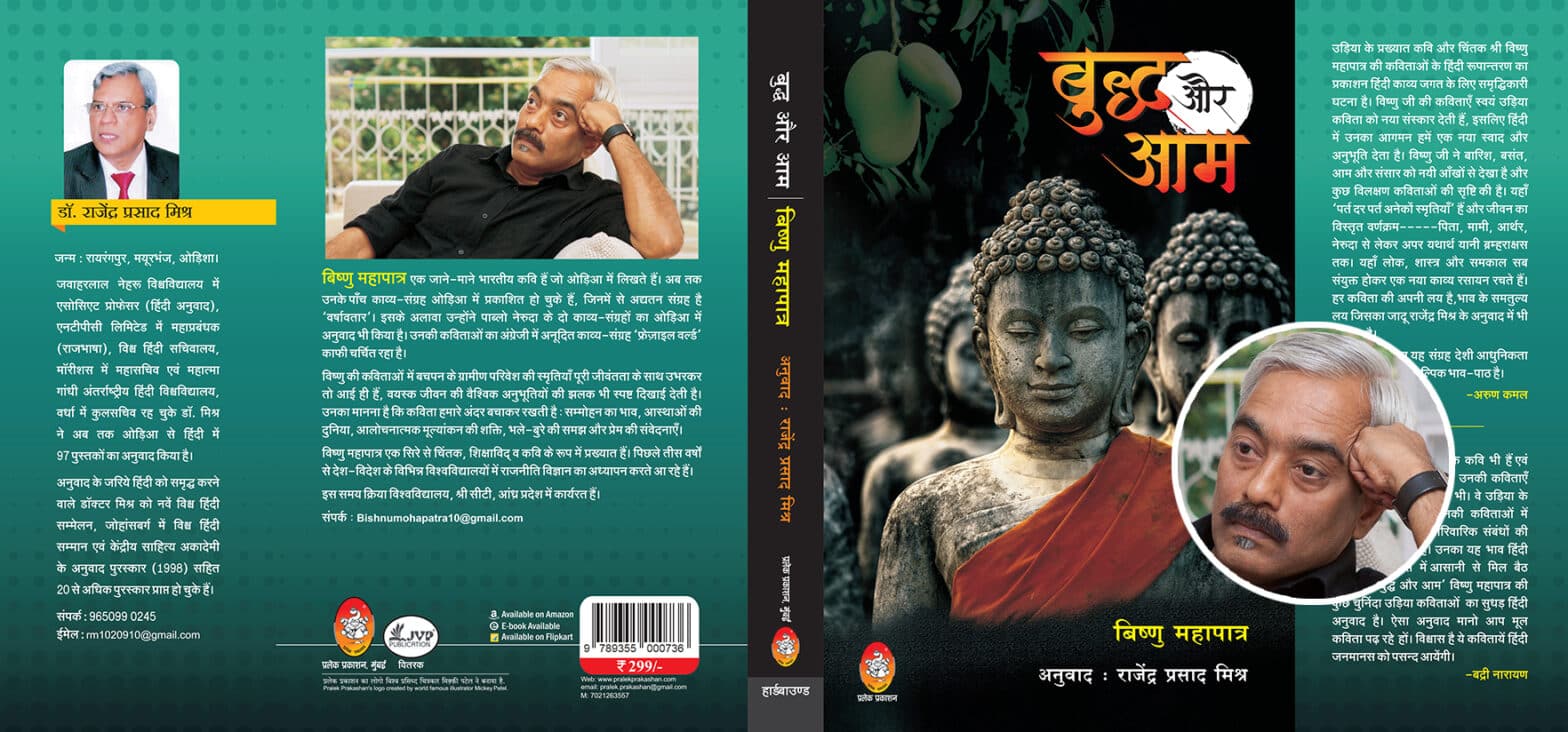
Books Banter: Q & A with Prof Bishnu Mohapatra on the launch of his book, Buddha aur Aam, Hindi translation of selection of his poems from Odia

What is the underlying idea that binds this selection of poems together in Buddha aur Aam?

The title of this poetry volume is taken from a poem evocative of the subtle and sublime force of personal faith and devotion, kept alive in times of great disenchantment.  The poems are largely taken from the first four volumes of my poetry. Many of my poems seek to re-enchant our world, by reflecting on contemporary realities through a gaze that seeks out nature’s mystery in the most unlikely of places. Memory as a weave of remembering and forgetting, as a means of understanding our place in time, is also a recurring theme in many of my poems.

What is your relationship with the Odia language and why is writing in it, particularly special?

Odia is my mother language.  It is not just the language that I learnt to speak, read and write in first, but it is also my emotive language, the language of my memory and also the language of my sensorium. 

The metaphors and the presence of nature that dominate my poetry were imprinted in memory from my childhood; the feel of wet leaves under my feet at the riverbank, the creaking of insects at night, the light of glow worms, the songs of jatras, the lament of the cuckoo, all of these were carved into my imagination in the language of the land where I was born. 

Writing poetry in Odia and doing my social science and academic work in English has given me two vast and diverse landscapes which speak to each other, and enrich each other.  Each language carries with it its own life-world, its own inner resources.  Even after living more than four decades outside Odisha, my love for Odia and its rich tradition of literature, lives and thrives inside me.  Writing poetry in Odia enlivens a connection between place and time, and moves me beyond ‘here’ and ‘there’, ‘now’ and ‘then’, to the unknown place where metaphors take shape and make meaning.

How do you work closely with a translator in a manner that the spirit and essence of your work is captured in its truest form? Why is that process so important?

I am also a translator, although I rarely translate my own poetry.  I have translated and published Pablo Neruda’s poetry into Odia and my translations of Rilke’s poetry is to be published this year. I believe that translation is also a form of interpretation, of transposition, and that the translator carries from one language into another not only the essence of the poet’s expression, but also a little bit of of themselves.  I tend not to interfere much with the translator’s work as the process of translation has its own integrity.  I am grateful to my translator Dr Rajendra Prasad Mishra for his careful and dedicated attention to carrying my voice along with his into the Hindi translation.

In the world we live in, why is reading poetry crucial?

For me, poetry has always been more than a form.  It is a way to un-conceal the world, without revealing all of its mystery.  Recently, some of my poems were published in an anthology ‘Singing in the Dark’ – a collection of poems from across the world written during the pandemic related lockdown.  What were poets writing about during these uncertain times? Why are we reading more poetry about this time?  Poetry has the capacity to hold that which cannot be understood, while signalling us towards a multitude of possibilities.  A poet’s expression is always an indication, a nudge, a glimpse towards a larger vision.  The human condition and its striving towards its hidden own possibilities is what makes reading poetry essential.

Bishnu Mohapatra, Professor of Politics, Krea University


Reach him at [email protected]

All the way from south India to the United States to participate in the HPAIR Harvard Conference 2022

Chennai, 01 February 2022: Sai Balaji, a sophomore at Krea University, majoring in Economics and minoring in Psychology recently got selected by The Harvard College Project for Asian and International Relations for the Harvard Conference which will be held from 18-21 February 2022 at the Harvard campus.

Originally from Chennai, 19-year-old Sai wears multiple hats within the University ecosystem. He is a Student Ambassador, Research Assistant, Club Representative of the Social Outreach Club “Aikyatha” and is a Content Manager for the University Newspaper “Tapestry” alongside his academics. 

Obviously excited with the opportunity to be a part of HPAIR, Sai says, “This is a fantastic platform for me. I truly believe that the overall ecosystem at Krea re-kindled the childlike curiosity within me to constantly ask questions about the various aspects of social, political, and economic issues in the 21st century. The faculty, peer group, and the overall learning culture at KREA, have played a vital role in my selection for HPAIR 2022.” 

Every Harvard Conference serves to create meaningful dialogue regarding the current socio-economic and political landscape across the globe. Speaking about what he is most excited about Sai says, “This conference gives the opportunity for me to interact with a diverse range of people and speakers.” Sai’s role specifically is to voice his views and share his knowledge with fellow delegates attending the conference. The responsibilities post the conference would mean how individuals who are a part of the conference attempt to Implement these learnings in their research and to focus on making an impact on the world with it.

The mission of HPAIR is to connect the top leaders of today and tomorrow in a dynamic forum of exchange. The Harvard College Project for Asian and International Relations (HPAIR) was founded in 1991 to create a forum of exchange for students and young professionals to discuss and learn about the most important economic, political, and social issues facing the Asia-Pacific region. Since 1991, HPAIR has organized 43 conferences in 12 different host countries, touching the lives of more than 10,000 students and young professionals. HPAIR hosts two student-led conferences a year – one on Harvard’s campus and the other in the Asia-Pacific. Prospective host cities in Asia must undergo an intensive, six-month bidding process; this year’s Asia Conference will be held in Nur-Sultan, HPAIR’s first conference in Central Asia. HPAIR conferences feature world-class speakers and guests to foster mentorship, networking, and guidance opportunities for delegates.

Krea University Faculty Receive Prestigious Ramnath Goenka Award for Environment Journalism

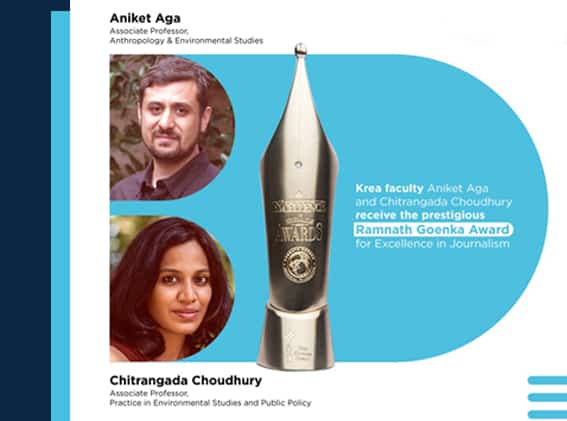
Sri City, January 6, 2022: Prof Aniket Aga (Associate Professor of Anthropology & Environmental Studies) and Prof Chitrangada Choudhury (Associate Professor of Practice in Environmental Studies & Public Policy) from Krea University have won the Ramnath Goenka Award for Excellence in Journalism in the ‘Environment, Science and Technology’ category. The Awards aim to celebrate excellence, courage and commitment, showcasing outstanding contributions every year, paying tribute to Print, Digital and Broadcast journalists who maintain the highest standards of their profession.

Prof Aga and Prof Choudhury had published two articles on illegal herbicide-tolerant GM cotton seeds and associated lethal chemical inputs like glyphosate which are sweeping through biodiversity-rich Adivasi farms of Odisha’s Eastern Ghats. Their two stories titled ‘Sowing the seeds of climate crisis in Odisha’ and ‘Cotton has now become a headache’ along with a broader climate change series published by the People’s Archive of Rural India (PARI), were named for the award.

Prof Aniket Aga’s interests span science and technology studies, democratic politics, and agrarian studies, and works on questions of environmental justice, food democracy and sustainable agriculture. His first book ‘Genetically Modified Democracy’ examining the ongoing controversy over genetically modified (GM) food crops in India is recently out from Yale University Press and will be published in South Asia in early 2022 by Orient Blackswan. He works closely with students from disadvantaged groups, including Dalit, Bahujan and Adivasi students as well as students from rural backgrounds.

Prof Chitrangada Choudhury is a multimedia journalist and researcher. Her reportage on the environment, social justice and rural, in particular indigenous communities, has been cited for multiple awards including the Sanskriti Award (2008), the Press Council of India’s National Award for Investigative Reporting (2015), and the Lorenzo Natali Journalism Prize twice (2010 & 2018). She is a Founding member of The People’s Archive of Rural India, an Editorial Board member of Article 14, anda Senior Research Associate at the Centre for World Environment History, University of Sussex.

Featured In the media
India Education Diary
Prittle Prattle News
Business News This Week
Media Bulletins
Digital Media 9
APN News
IPM News
Online Media Cafe
Sakshi Post

Industry and Academia come together for Krea University ‘Career Dialogues 2021’

Sri City, December 21, 2021: Krea University hosted their flagship event “Career Dialogues”, which brought together over 20 speakers from industry and academia on one platform.

The day-long virtual event featured 4 panel discussions exploring various Careers in Psychology; Sustainability; Arts, Media & Sport; Analytics. The aim of the event was to open the minds of young school students about future careers across multiple industry verticals.

Career Dialogues 2021 kicked off with two spectacular keynote addresses, by Mr Anurag MalikPartner – People Advisory Services at Ernst & Young and Ms Neerja BirlaFounder & Chairperson – Aditya Birla Education Trust.

In his address, Mr Malik emphasised “Interwoven Careers is the future…The new-age student who sees himself or herself as a professional in the years to come should be ready for the change, as companies are today taking a 360-degree view on skills.”

Addressing the exam time and academic stress that students face, Ms Birla said, “While it is important to do well academically, it’s equally essential to remember that grades don’t define a student.”

Each panel discussion that followed, brought multiple facets of each subject. The conversation on psychology covered Criminal, Sports, Counselling and Clinical aspects of the practice. The discussion on Sustainability hosted practitioners and academics from across Conservation, Sustainability, Economics of Environment and Climate Change. Spinning a different track, the next panel highlighted Arts Managements, Sports Media, and emerging Media technology. In the Analytics panel, experts from Media, Marketing, Financial Risk and Behavioural analytics shared their insights.

20+ speakers representing leading organisations like Tiger Analytics, McKinsey & Co, The World Bank, Centre for Wildlife Studies, Foreseti Consulting, Sony Sports, ArtSpire and many more, shared their insights on future trends in their area of work and shed light on the kind of skills industry will demand from young graduates.

In his opening address, Mr. Ramkumar Ramamoorthy, Pro-Vice Chancellor of Professional Learning at Krea University, said, “Last year, the World Economic Forum came out with a listing of the top 10 skills that will be needed to align oneself to the new opportunities that will be presented in the post-pandemic world by various discipline and industry segments. These include analytical thinking, active learning, problem finding, problem solving, creativity, originality and initiative, technology use, monitoring and control, resilience, stress tolerance, reasoning ideation and flexibility.

Career Dialogues, is an important endeavour by Krea University in partnership with industry, towards informing school leavers about various career options open to them, to encourage them to follow their interest and look at the world of careers more laterally than as silo tracks.

Professor Sudip Roy elected as Fellow of the Royal Society of Chemistry for his contribution to the Chemical Sciences

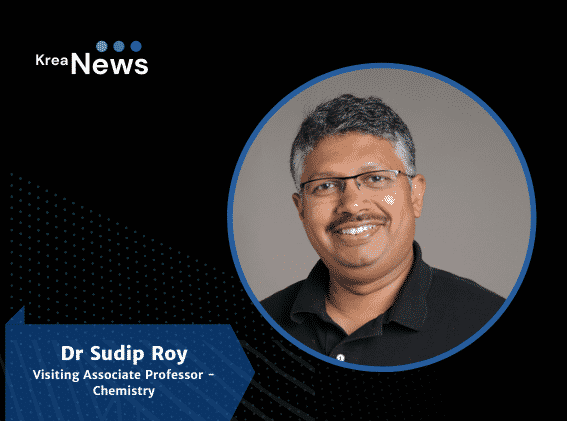
Dr Sudip Roy, Visiting Associate Professor of Chemistry, has been elected as a Fellow to the prestigious Royal Society of Chemistry. This honour is in recognition of his significant contribution to the Chemical Sciences and extensive work with Industry and promoting industry-academia collaborations. Dr. Sudip Roy has 20 years of experience in research and innovation. Dr. Roy obtained his Ph.D. in chemical sciences from the University of Saarland in Germany followed by post-doctoral work at Technical University Darmstadt, Germany. He is a Chevening fellow 2019 and studied management of research, science, and innovation at the University of Oxford.