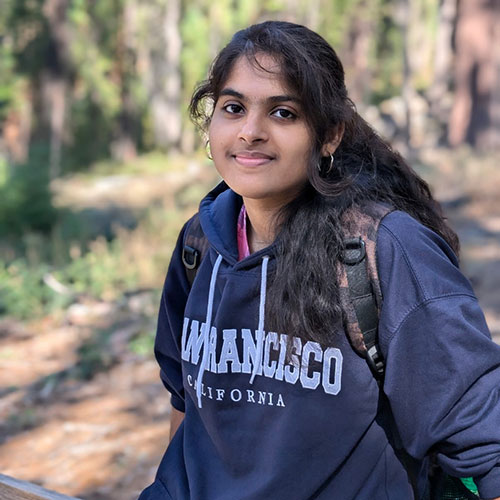
Aarthi Venkatesh, a third-year Psychology student at SIAS, has been awarded the highly selective Founding Generation Fellowship by the International Congress of Infant Studies (ICIS). As part of the fellowship, she will spend the summer at the University of British Columbia (UBC), Vancouver, conducting research at the Centre for Infant Cognition under the supervision of Dr Kiley Hamlin.
Her research will focus on investigating the early developmental foundations of moral cognition in infants. Through this work, she aims to develop both conceptual and methodological skills in developmental cognitive neuroscience. The fellowship marks an important milestone in her academic journey, deepening her long-standing interest in early cognitive development and the philosophical questions surrounding the nature of mind, knowledge, and morality.
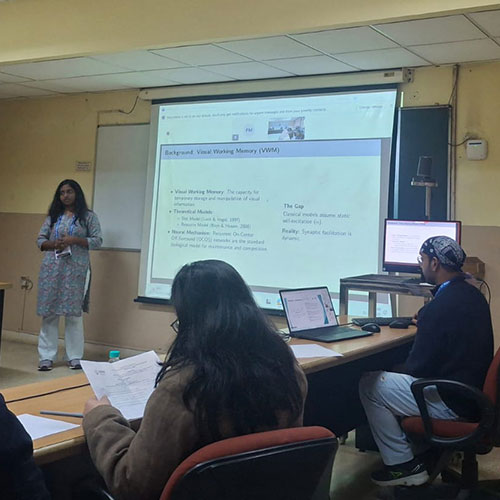
Dr Rakesh Sengupta, Assistant Professor, Psychology, SIAS delivered an online talk at IIIT Hyderabad in their Cognitive Science Seminar series on 28 January 2026. The talk was titled ‘Graph Surgery: Tuning the Connectome to Predict Distinct Neural Dynamics of Enumeration’.
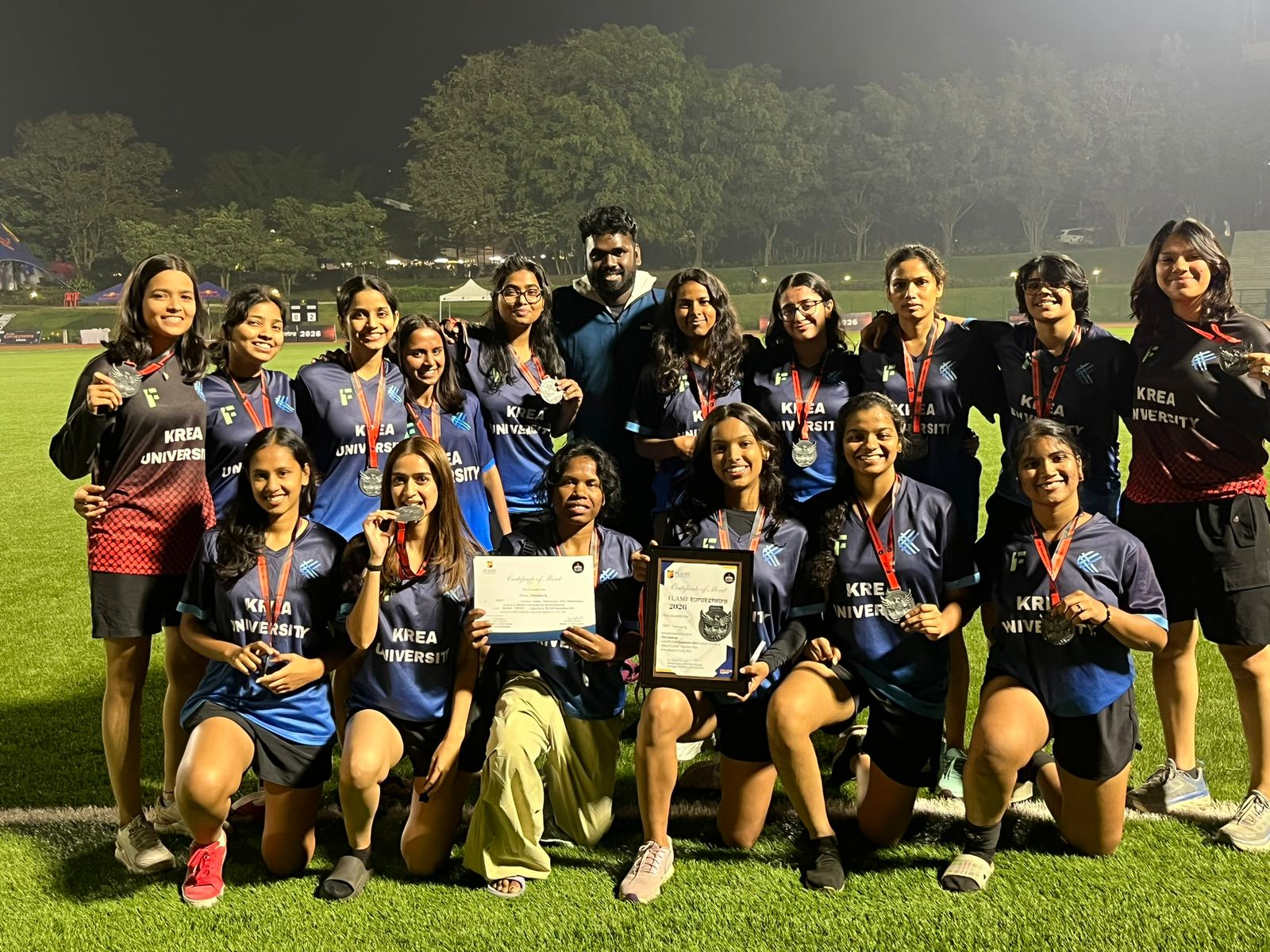
Krea students recorded a strong showing at FLAME University’s Kurukshetra Fest 2026.
TBD Crew, Krea University’s official UG Western Competing Dance Team, secured first position in the Step-Off category. Led by Ananyaa Premanand, the team included Aarushi Chowdhury, Aashna Bhartiya, Ananya Sarath, Avani Bipinkumar, Diya Saravanan, Drishti Satpal, Ishita Vohra, Pranaya Khatri, Sanika Ostwal, and Trisha Bhar. The Women’s Football Team secured second position, and we also congratulate Aavya Kedia (Basketball) and Shilpi Rani (Football) for being recognised as Best Defensive Players.
At the 5th International Conference on Advanced Network Technologies and Intelligent Computing held at Atal Bihari Vajpayee Indian Institute of Information Technology and Management (ABV-IIITM), Gwalior, India, Lekhana Priya Gundapaneni, SIAS alum and now a Teaching Fellow and Purvikalyani Prasannah, SIAS, Cohort of 2027 presented papers that will be published in Springer CCIS (Scopus indexed proceedings).
Contribution:Alpha Band Power Modulation During Covert and Overt Articulation Presenter: Lekhana Priya Gundapaneni Authors: Lekhana Priya Gundapaneni, Rakesh Sengupta, Sayantan Mandal, Madhavilatha Maganti
Contribution:Modeling Recurrent Neural Networks in Serial Recall Paradigm With Dynamic Self-Excitation Presenter: Purvikalyani Prasannah Authors: Purvikalyani Prasannah and Rakesh Sengupta
Purvikalyani Prasannah has also won the prestigious Young scientist DST Travel grant for the same.
Dr Chirag Dhara, Assistant Professor, Environmental Studies, SIAS has co-authored an article in Down To Earth’s ‘State of the Environment 2026’ report titled India’s Climate Apocalypse?
The article discusses how regional hotspots of climate change are emerging across the country and this demands regionally tailored adaptation strategies contingent not only on the nature of climate change but on the exposure and vulnerability of local communities.
Dr Sambaiah Gundimeda, Associate Professor, Politics, SIAS has authored an essay titled Public Good or Private Gain? The Battle for Andhra’s Medical Colleges in Economic and Political Weekly, Vol 61, No 2 (2026).
Abstract
The controversy over the transfer of seventeen newly sanctioned government medical colleges in Andhra Pradesh to private operators under a Public–Private Partnership (PPP) model has ignited a broad-based movement cutting across political and social divides. At its core, the dispute raises fundamental questions about whether education and healthcare should remain rights of citizenship or be commodified for private profit. The article situates this conflict within the longer trajectory of N Chandrababu Naidu’s market-led PPP vision, contrasting it with YS Jagan Mohan Reddy’s welfare-driven public investment. By highlighting issues of redistribution, reservations, and democratic accountability, it argues that the battle is less about fiscal pragmatism and more about safeguarding the moral and constitutional compass of governance.
In Author Prajwal Parajuly romanticises Chennai winter and rightfully so, Prajwal Parajuly, Assistant Professor of Practice, Creative Writing, SIAS writes for The Hindu on how for him December in Chennai is less winter and a smug, perfectly timed takeover of sabhas, canteens, coffee shops, art spaces.
A research paper co-authored by Dr Suhail Ahmad, Post-Doctoral Fellow, Psychology, SIAS has recently been published in Current Psychology (Springer Nature), a Q1-ranked journal with an impact factor of 2.6. The paper is titled Psychological and dispositional underpinnings of Internalising, Externalising, and Co-Occurring disorders in children and adolescents. Other authors include Insha Amin Makhdoomi, Clinical Psychologist, SKIMS, Srinagar, J&K; Madhumitta Bhattaccharya, Assistant Professor, Clinical Psychology, CIP Ranchi, and Keerthana CJ Assistant Professor, Psychology and Counselling, ST Joseph’s University, Bengaluru.
Brief Summary: This study investigated psychological and dispositional correlates of internalising, externalising, and co-occurring problem behaviours in children to facilitate early identification and intervention. An ex post facto cross-sectional design included 60 participants aged 11–17 years, categorised into internalising, externalising, and co-occurring groups (N = 20 per group). Measures included the Developmental Psychopathology Checklist, Child Behaviour Checklist, Raven’s Standard Progressive Matrices, Schutte Emotional Intelligence Scale, Bell Adjustment Inventory, and Thomas and Chess Temperament Characteristics. Results showed higher emotional intelligence in the internalising group and significant differences in adjustment and temperament across groups. Findings highlight the importance of emotional intelligence and temperament assessment in identifying at-risk children and guiding targeted interventions.
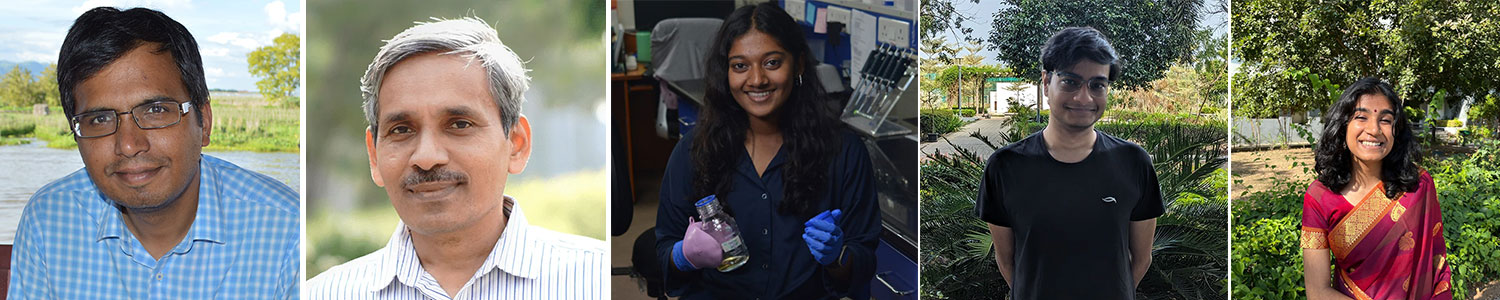
A research paper titled Effect of confinement on PH3 and OH3+ inversion, coauthored by Dr Brijesh Kumar Mishra, Associate Professor, Chemistry, Professor S Sivakumar, Professor, Physics and Dean – Research, and the SIAS alumni Kaustav Mehta, Shreya Chidambaram, and Netra Krishna, has recently been published in the scientific journal Physical Chemistry Chemical Physics (PCCP).
Accessible Summary: Molecules trapped in cages (bigger molecules that enclose a volume) exhibit features distinct from those when they are free. In this work, the authors study the “inversion” of caged pyramidal molecules. Inversion is the process by which the atom at the top of the pyramid tunnels through the bottom plane of atoms to reach the symmetrically located position on the other side of the plane. Essentially, a transition from an erect pyramid to an inverted pyramid, and hence the name inversion. The cage has two prominent effects on the pyramidal molecules: it shifts the energy levels corresponding to the bending motion and changes the tunnelling barrier between the two structures. The authors carried out accurate calculations of these changes and, in many cases, produced results that compare well with measured values, surpassing earlier estimates in the literature. Apart from their importance from a fundamental perspective, caged molecules are also potential candidates for quantum information processing and metrology.
Technical Abstract: Encapsulating molecules in nanocages such as C60 provides a unique opportunity to probe how spatial confinement alters structure and dynamics. We examine umbrella inversion in hydronium (OH3+) and phosphine (PH3) in the gas phase and inside C60. Inversion profile computations for OH3+ and PH3 are based on high-level correlated methods [CCSD(T)/aug-cc-pVTZ and aug-cc-pVQZ]. Modelling confined systems requires dealing with the cage and the encapsulated molecules together, which is computationally complex. Therefore, results pertaining to encapsulated systems are based on dispersion-corrected DFT (B97-D/aug-cc-pVTZ). Barrier heights and tunnelling splittings for OH3+ and PH3 are benchmarked against CCSD(T)/aug-cc-pVQZ results. For free OH3+, the CCSD(T) barrier is computed to be ∼706 cm−1, while B97-D yields a slightly lower value (612 cm−1). The predicted tunnelling doublets closely match the experimental findings. Encapsulation of hydronium in C60 (denoted as OH3+@C60, where X@C60 indicates the encapsulation of X within C60) raises the barrier height from 612 to 871 cm−1 and markedly suppresses the splittings. In contrast, PH3 exhibits an extremely high inversion barrier (∼11 000 cm−1), effectively quenching tunnelling. Upon confinement, the barrier is lowered marginally, and the vibrational eigenstate energies are shifted upward. The interaction energies obtained using the DLPNO-CCSD(T)/def2-TZVP method confirm the stability of the encapsulated systems: −30.8 kcal mol−1 for OH3+@C60 and −13.4 kcal mol−1 for PH3@C60. Energy decomposition analysis shows that OH3+@C60 stabilization is predominantly electrostatic in nature, whereas the dispersion term in PH3@C60 is considerably larger.
A paper co-authored by Dr Aejaz Ahmad Wani, Post-doctoral Fellow, Moturi Satyanarayana Centre of Advanced Study in the Humanities and Social Sciences, Krea University and Dr Ekta Shaikh, Assistant Professor, Dyal Singh Evening College, University of Delhi has been published in Economic and Political Weekly.
In the article titled Rethinking the Governance of Begging in India: Integrating Ethics, Law, and Policy, the authors argue that India’s proposed begging governance policy must work out a sensitive, rights-compliant framework that addresses intersecting vulnerabilities of individuals engaged in begging, especially women, children and persons with disabilities. Policymakers can draw lessons from comparative anti-begging jurisprudence to implement rehabilitative, rather than coercive, strategies to deal with the problem of begging, and work on enhancing the capabilities of individuals forced to beg on the streets. They further argue that its effectiveness will depend on how it integrates ethical, legal and policy imperatives in formulating a context-sensitive and rights-compliant framework.