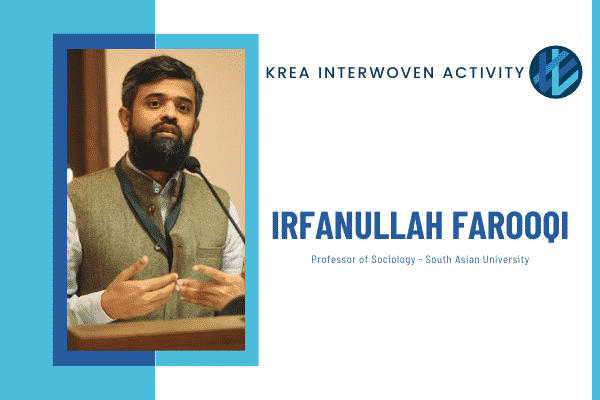
In an interactive session with the students and poetry lovers of Krea University, Prof Irfanullah Farooqi (Assistant Professor, Department of Sociology, South Asian University – New Delhi) explored the deep connections between the poetic and the political through select compositions of two iconic poets of 20th century South Asia — Muhammad Iqbal (1877-1938) and Faiz Ahmad Faiz (1911-1984). The session particularly looked at how Iqbal and Faiz had been subjected to a certain kind of religion-ness as witnessed in some of their compositions.
Category: General Topics
An info-session on India’s National Mission on Biodiversity and Human Well-Being
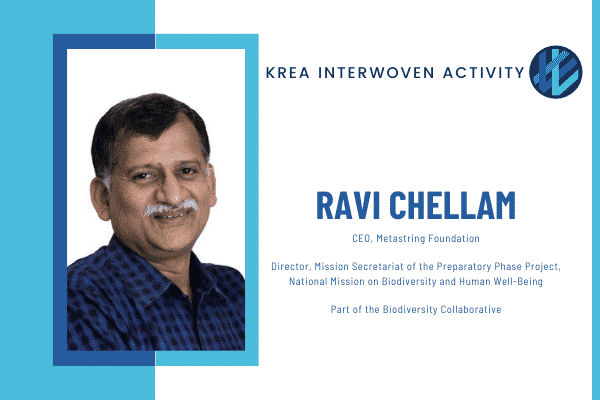
In a highly engaging session with the students of Krea University, Ravi Chellam, who has been involved with wildlife research, education, outreach and conservation since the early 1980s, shared in great detail about rhe National Mission on Biodiversity and Human Well-Being — one of the nine national missions that have been approved by the Prime Minister’s Science, Technology and Innovation Advisory Council. From elaborating the key features of this unique 10-year programme to sharing the interdisciplinary nature of the programmes and its structures, the information session was packed with insights, giving students an overview of the biodiversity and sustainable use in India.
Addressing the unpaid childcare crisis for women and girls
The learning session on ‘Addressing the unpaid childcare crisis for women and girls: How can we build better after COVID-19?’ held in December last year, as part of the learning series started by the Bill & Melinda Gates Foundation, aimed at fostering learning, exchanging ideas and establishing connections across partners working on evidence, advocacy, policies, and interventions related to COVID-19’s social and economic impacts on women and girls. As part of the larger mandate, Bill and Melinda Gates Foundation, the International Development Research Centre (IDRC), and IWWAGE at LEAD are collaborating to undertake an evidence review of the current childcare crisis and the road for post-COVID recovery and resilience. A paper is underway outlining the different pathways in which COVID-19 is impacting women’s care burden, with recommendations for policy solutions and measures that could be explored in different contexts by governments, the private sector, and other key development actors, with a focus on low- and middle-income countries (LMICs).
REBUILD: COVID-19 and women in the informal economy in India, Kenya and Uganda
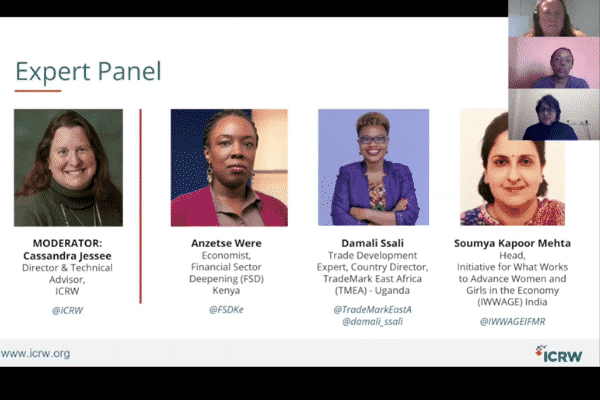
Soumya Kapoor Mehta (Head – IWWAGE) was part of an expert panel organised by the International Center for Research on Women, sharing insights on the impact of COVID-19 on women in the informal sector in India. The panel discussion was part of an upcoming collaborative research, REBUILD, focuses on the current challenges faced by women in the informal economy under COVID-19, with the aim to understand better the social and economic impact of policy responses to the pandemic in India, Kenya and Uganda. View recording here.
AVPN SAICF 21: Reimagining India’s Social Protection Architecture
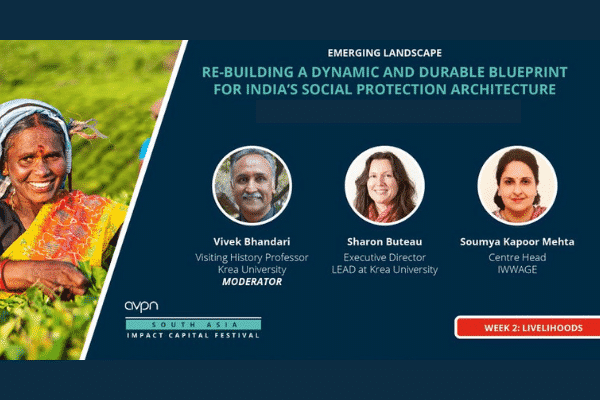
LEAD at Krea University hosted a session “Re-building a dynamic and durable blueprint for India’s Social Protection Architecture” at AVPN Asia’s South Asia Impact Capital Festival. The panel featured Executive Director Sharon Buteau and Soumya Kapoor Mehta (Head – Initiative for What Works to Advance Women and Girls in the Economy), and was moderated by Vivek Bhandari (Visiting Professor of History, Krea University). The discussion revolved around reimagining India’s social protection architecture in the new normal, using emerging design elements that are research, data, and systems driven.
Prof Sumit Mishra publishes impactful research paper on caste-based residential segregation
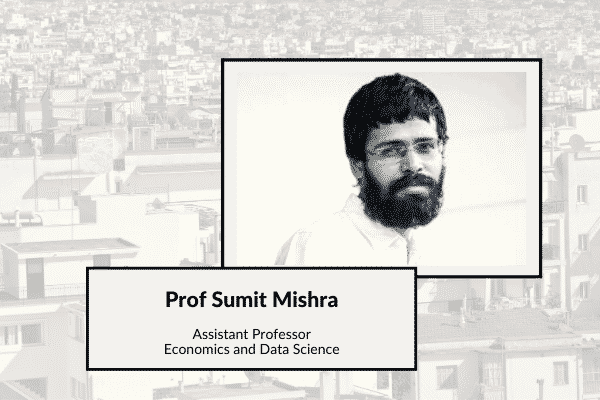
IFMR GSB faculty member — Sumit Mishra, Assistant Professor, Economics and Data Science has published an impactful research paper. His paper “Fractal urbanism: City size and residential segregation in India” co-authored with Naveen Bharathi (Harvard University), Deepak Malghan (IIM – Bangalore), and Andaleeb Rahman (Cornell University) was published as a forthcoming article on World Development — an A journal as per the ABDC list and listed amongst the top-five development econ journals. The paper presents the first-ever large-scale snapshot of urban residential segregation in India at the neighbourhood-scale. The analysis from 147 largest cities in contemporary India shows how caste-based residential segregation is independent of city size (with the sample including all cities in India, with at least 0.3 million residents in 2011).
Access a copy of the paper here. For detailed summaries of the paper, visit here and a commentary in Ideas for India here.
LEAD at IFI Summit 2021: Exploring meso-level insurance for farmers
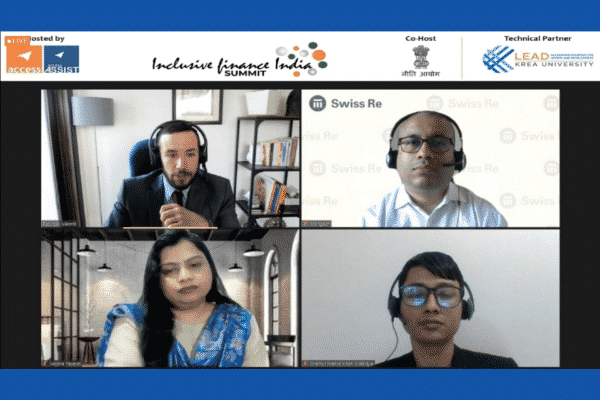
The Inclusive Finance Summit went virtual this year and presented a series of exciting events for two days. LEAD at Krea University was a technical partner at the Summit. As part of the engagement, LEAD hosted a panel discussion on ‘Mitigating Agricultural Risks: Meso-level Insurance in Agriculture’ moderated by Fabrizio Valenti, Head, Financial Inclusion. Research Fellow, Sabina Yasmin, presented insights from an ongoing study on the potential of meso-level insurance in protecting farmers from various agricultural risks, supported by CIIE.CO under the Bharat Inclusion Initiative. Other panellists included Mangesh Patankar (Swiss Reinsurance Company) and Enamul Mazid Khan Siddique (Oxfam, Bangladesh). Watch it here.
Masterclass on sea turtles with experts from India, Germany and Australia
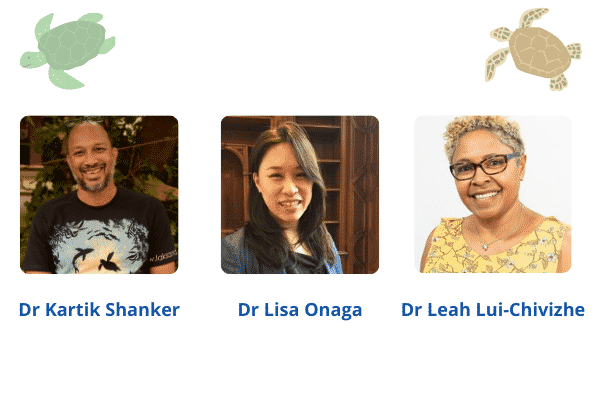
Dr Kartik Shanker from the Indian Institute of Science – Bangalore, Dr Lisa Onaga from the Max Planck Institute for the History of Science – Berlin, and Dr Leah Lui-Chivizhe from the University of Sydney, came together for a highly engaging session on sea turtles and the marine environment. Participants were introduced to the various angles of approach to sea turtles, with the speakers delving into history, conservational efforts, and research strategies. From exploring how turtles have helped guide various groups of people related to the wisdom of the earth to deep-diving into how living turtle species today manifest that wisdom, the session was informative and eye-opening for students and faculty alike.
‘Two Leaders and an Economy’ with Dr Pulapre Balakrishnan
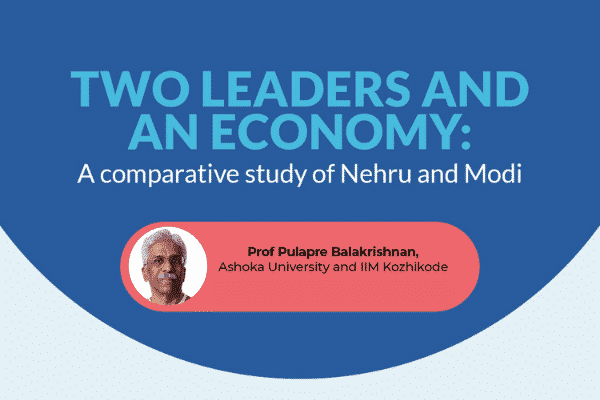
Dr Pulapre Balakrishnan — Professor of Economics at IIM Kozhikode and Ashoka University, as well as a distinguished economist well known for his scholarly work on the Indian economy and active participation in public discourse through popular writings — interacted with the students of Krea University, sharing his knowledge on the economy that was and the economy that continues to be. Through an evidence-based approach, Dr Balakrishnan provided an account of the impact Jawaharlal Nehru and Narendra Modi have had on the economy. Packed with insights, the session focused on highlighting the economic consequences of the governance of these two significant Indian leaders.
‘India in a Warming World’ with Navroz K. Dubash
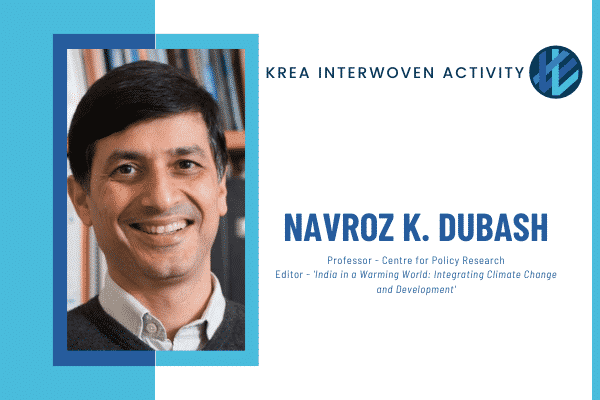
In a highly engaging session with the students of Krea University, Navroz K. Dubash – Professor at the Centre for Policy Research and Editor of ‘India in a Warming World: Integrating Climate Change & Development’ – shared in great detail about climate change and the role India plays in the current global ecological scenario. In the Indian imagination, climate change has long been constructed primarily as a problem of north-south equity. The insightful session examined how climate change now is more than a diplomatic challenge – it is also a development challenge and potentially even an opening for envisioning alternative futures.