A research article co-authored by Dr Debajit Maiti, Assistant Professor, Chemistry, SIAS titled Electrooxidative Divergent Halocyclizations of Ambident Amides has been published in Angewandte Chemie International Edition.


A research article co-authored by Dr Debajit Maiti, Assistant Professor, Chemistry, SIAS titled Electrooxidative Divergent Halocyclizations of Ambident Amides has been published in Angewandte Chemie International Edition.
Dr Shimna Kannoth, Post-Doctoral Fellow, Environmental Studies, SIAS has co-authored a paper published in Space Weather titled Impact of the Gannon Superstorm on the Equatorial Ionization Anomaly Dynamics During Its Recovery Phase on 11 May 2024. The present study, for the first time, reveals the combined influence of geomagnetic storm-induced modifications in equatorial electrodynamics, meridional wind circulation, and substantial compositional changes during the recovery phase of a superstorm on the ionospheric plasma distribution. The integration of observational evidence with model simulations provides strong corroborative support, thereby offering new insights into the complex coupling processes governing ionospheric responses during extreme geomagnetic disturbances.

Tejas Rao, a Double Major in Data Science and Biological Sciences, UG Cohort of 2023-27, School of Interwoven Arts and Sciences (SIAS), has been selected as a LINC fellow. As part of the scholarship, he will be working at the LINC center on cutting-edge neuroscience projects.

Tejas Rao, UG Cohort of 2023-27, School of Interwoven Arts and Sciences (SIAS) will be presenting his research work titled ‘Interpretable deep learning predicts polycythemia vera and identifies novel genomic associations’ at the 67th ASH Annual Meeting and Exposition to be held from 6-9 December 2025 in Orlando, Florida.
Dr Lakshmi Narayanan, Assistant Professor, Environmental Studies, SIAS was nominated to attend ‘Emerging Science, Technology, and Innovation Conclave (ESTIC) 2025’, a newly launched flagship event of Government of India. The event brought together some of the leading figures from academia, industry and policy.

Dr Sayandeb Chowdhury, Senior Assistant Professor, Literature, SIAS wrote an article in The Wire titled A Cricket Victory with Grace and Without Macho Displays of Hyper-nationalismon the triumph of the Indian Women’s cricket team, warts and all.

Cleaner air abroad could mean stronger monsoons over India, finds IITM study, an article in The Times of India discusses how global efforts to reduce air pollution could unintentionally make India’s monsoon stronger in the coming decades. The article cites a study conducted by Dr Chirag Dhara, Assistant Professor, Environmental Studies, SIAS in collaboration with researchers from the Indian Institute of Tropical Meteorology, Pune and the University of Reading, UK.
The paper in reference is titled, Future intensification of Northern Hemisphere monsoons due to declining remote aerosol pollution.
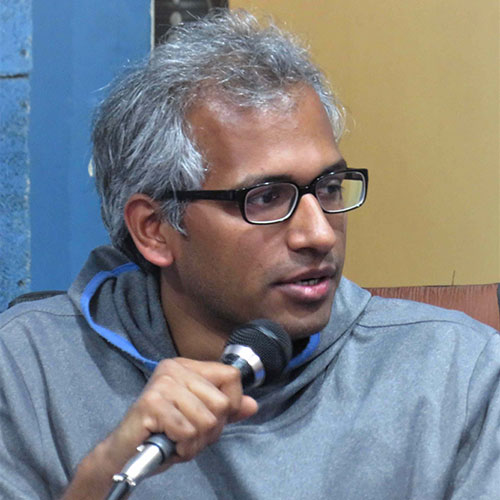
Dr Venugopal Maddipati, Associate Professor, History, SIAS delivered a talk entitled ‘A History of Gandhian Architecture as the Architecture of Martyrdom’ organised by Karwaan: The Heritage Exploration Initiative on 25 October 2025.
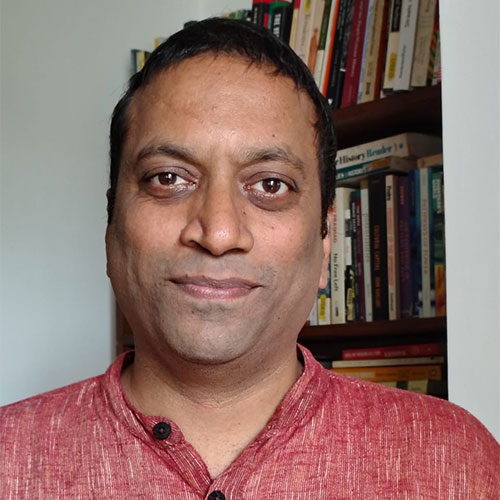
Dr Preeti Sampat, Associate Professor, Sociology & Social Anthropology, SIAS delivered a talk entitled ‘The Infrastructure and Relevance of Social Sciences Education in Rural Education’ at an event organised by Anekdhara in Hyderabad called ‘A Seminar on Rural Education: Grassroots Insights to Sustainable Pathways.’

Dr Chirag Dhara, Assistant Professor, Environmental Studies, SIAS has co-authored a paper titled Interpreting Climate Performance Indices: Implications for Equitable and Effective Policy published in Climate Policy Journal. Among the co-authors are Ishita Bagri, an SIAS Alum. They propose a novel framework to classify indices based on methodological framework and embedded normative choices, contextualising their outcomes and enhancing transparency of what the index truly measures.
Chirag Dhara, Anshuman Gupta, Ishita Bagri, Sebastián Block, and Kamal Kumar Murari (2025). “Interpreting Climate Performance Indices: Implications for Equitable and Effective Policy.” Climate Policy, 1–14.