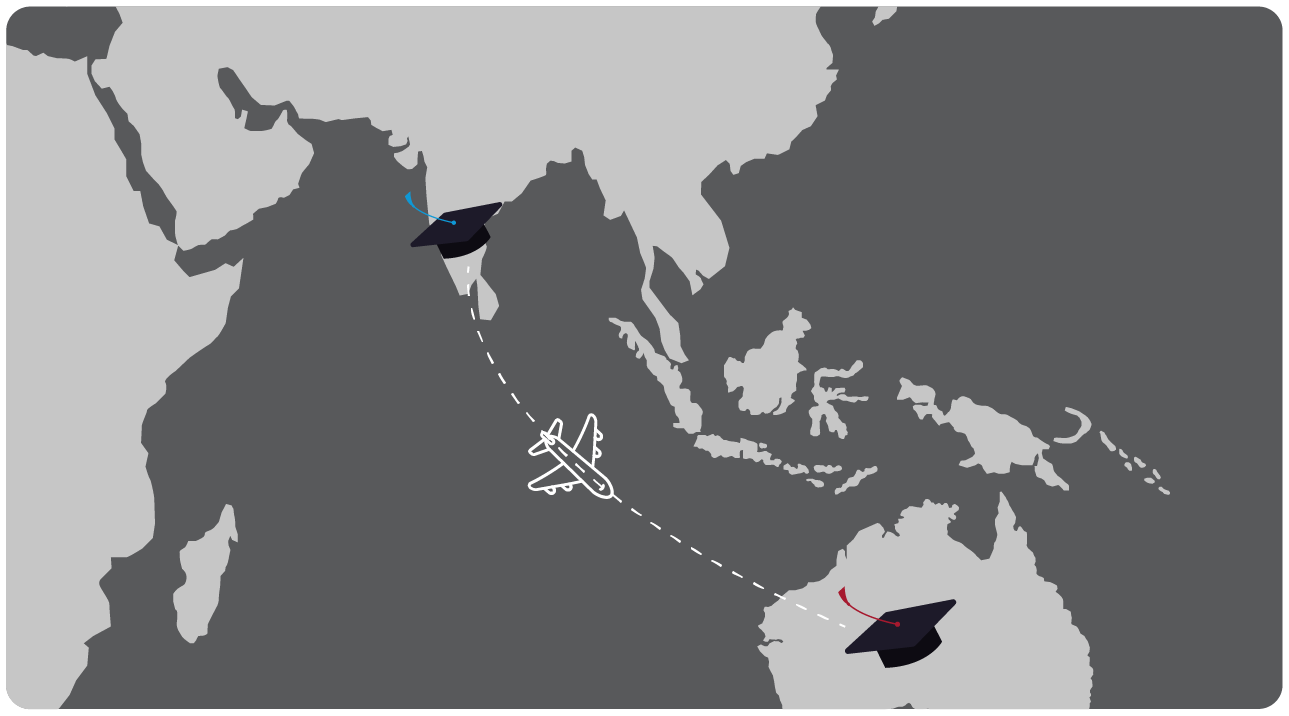
The Krea–Macquarie 2+2 Dual Degree Programme is a four-year undergraduate programme that provides students with a rare opportunity to learn and experience their first two years at Krea University’s campus in Sri City, Andhra Pradesh, before continuing their studies at Macquarie University in Sydney, Australia.
Students complete the graduation requirements of both institutions and receive two full three-year Bachelor’s degrees upon completion.
This programme offers a rare chance to experience two distinct academic environments at the undergraduate level, blending Krea’s interwoven liberal arts model and Macquarie’s research-intensive approach, without interrupting the flow of their degree. The programme is currently available to students in History, Politics, and Sociology, and is part of the Faculty of Arts at Macquarie. Intake is open for the 2026–2030 incoming batch as the inaugural cohort.
The most ambitious students deserve an education that matches their ambitions and at the undergraduate level, genuine international exposure is rare; this partnership makes this possible, while keeping it structured, affordable, and real.
Krea University is a young Liberal Education University with credentials that surpass its years, guided by the unique Interwoven Learning Model. Macquarie University is ranked among the world’s top universities, and its degrees are recognised by employers and institutions globally. This combination provides Krea graduates a meaningful international credential alongside their Indian degree.
In their first year, students complete Krea’s interwoven core and skill modules. Completion of these modules forms the basis for credit recognition at Macquarie and is a prerequisite for the transition.
In their second year, students complete the required courses for their chosen major in History, Politics, or Sociology along with a selection of electives. Students in the Politics stream also complete POLT205: Global Politics in the 21st Century, which is formally recognised as the equivalent of POIR1080 (Introduction to Global Politics) at Macquarie. Students apply to Macquarie during the second trimester of Year 2 for the July intake.
At Macquarie, students complete their degree requirements across two years. Available pathways include the Bachelor of Arts with majors in Modern History, Politics, or Sociology, and the Bachelor of Social Sciences with majors in Climate, Environment and Society; Health, Wellbeing and Society; or Work, Life and Technology. The precise course structure for Years 3 and 4 will be confirmed in full course lists to follow.
At Krea, internship opportunities are facilitated by the Corporate Relations and Career Services (CRCS) Office and can also be arranged independently. At Macquarie, students can enrol in a PACE (Professional and Community Engagement) unit, which incorporates a structured work placement component that is formally recorded on the student’s academic transcript. Students studying in Australia on a student visa are also permitted to work up to 48 hours per fortnight, giving them the opportunity to gain part-time professional experience alongside their studies.
Graduates of the programme will hold two undergraduate degrees and will have studied and lived in two countries, positioning them competitively across a wide range of sectors. These include public policy, government and international relations, civil society and development, media and journalism, education and research, and corporate roles across India and Australia.
At Macquarie, students have access to the Careers and Employment Centre, which provides job-search support, resume guidance, and interview preparation. Macquarie does not operate a placement programme, Australian employers typically engage directly with applicants or through HR agencies but the PACE programme provides an optional pathway to structured work experience that is formally recognised on a student’s transcript.
A campus is second home to students and we believe it must be conducive to their learning journey. Both campuses house state-of-the art infrastructure and are what we call world-class learning laboratories.