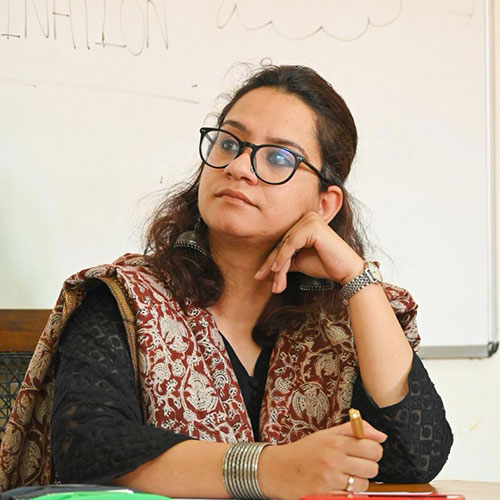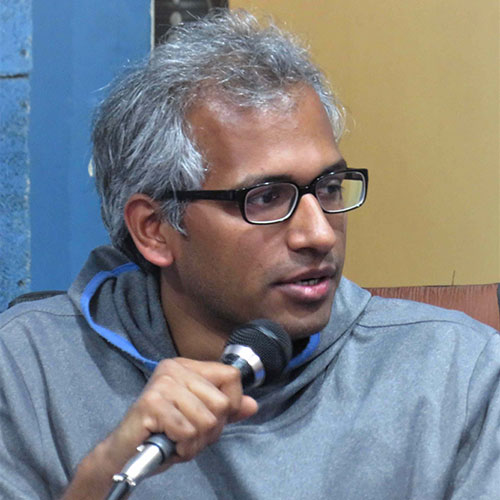
Dr Sayandeb Chowdhury, Senior Assistant Professor, Literature, SIAS, delivered a talk in Kolkata on 22 August at the invitation of DAG (formerly Delhi Art Gallery). The talk, on the idea of singularity in image tropes, was occasioned by the DAG exhibition Light and Shadow: Satyajit Ray Through Nemai Ghosh’s Lens and was titled ‘An Eye for an Eye, or Watching Ray Seeing’.
Sibling, co-founded by three kreators – Mitansh Aggarwal, Adwitiya Roy Viney Jain, was selected for Catalyst AIC (Supported by AIM, NITI Aayog)’s Startup School Innovation Challenge 2025. Sibling will be part of an intensive three-month incubation program designed for early-stage ventures with scalable ideas.
Program: 3-month incubation program (7th edition) run by Catalyst AIC under NITI Aayog’s Atal Innovation Mission.
Focus: Sector-agnostic, designed for early-stage ventures with scalable ideas or prototypes.
Structure: Expert-led sessions, mentorship office hours, and monthly milestone check-ins.
Outcome: Culminates in a Demo Day (Nov 2025) with 8 – 10 angel investors; opportunity for ₹5 lakh Startup India seed grants and access to Catalyst AIC’s equity fund.
Significance: Prestigious national-level incubation program providing visibility, mentorship, and funding opportunities.
About the start-up: Sibling is a digital mental health platform transforming how schools deliver student wellbeing. While many schools have counselors and resources, these services are often underutilised due to poor access, low visibility, and fragmented processes. Sibling bridges this gap through three integrated features: a Resource Hub offering curated content and interactive tools to build awareness; Near Peer Mentorship connecting students with trained college mentors for relatable support; and ReachOut, a confidential booking system that links students directly to school counselors with encrypted communication and case history tracking. By unifying education, mentorship, and professional care, Sibling makes mental health support accessible, stigma-free, and effective within schools.
Dr Preeti Sampat, Associate Professor, Sociology & Social Anthropology, SIAS was invited to deliver a session entitled ‘Compassionate Access to Land and it’s Affordances’ at a hybrid fellowship course “Compassionate Spaces”, developed by the Institute of Palliative Medicine, Calicut, Kerala and the Kerala chapter of the Indian Institute of Architects. The fellowship is an attempt to explore inner and outer spaces, and how to make them compassionate. Dr Sampat’s session discussed land and its more than human affordances through their historically particular material and social relationalities.
AA research paper entitled The Rentier Economy of Growth Infrastructures: Value Appropriation without Adequate Accumulation in India by Dr Preeti Sampat, Associate Professor, Sociology & Social Anthropology, SIAS has been published in published in Antipode: A Radical Journal of Geography. Paper abstract: This paper draws on long-term research around Dholera smart city in Gujarat; the experience with special economic zones nationally and in Goa; and national data on key accumulation processes such as manufacturing and construction. The analyses reveal three distinct but overlapping moments of rent appropriation around what author terms “growth infrastructures,” the inaugural moment of project announcement; the subsequent moment of land allotments to capital; and the third moment of development, lease, and sale. A key contradiction unfolds as growth infrastructures develop: value appropriation from land rent intensifies, but anticipated accumulation from investments remains elusive.
A research article by Dr Tanmoy Chakrabarty, Assistant Professor of Physics, SIAS titled Magnetic and electronic structure studies on S= 1/2 Heisenberg antiferromagnetic alternating spin chain system KCuGa(PO4)2 has been published in Journal of Magnetism and Magnetic Materials. The work highlights the low-dimensional magnetic behaviour in a novel phosphorus based cuprate system KCuGa(PO4)2. In this work the team reported the magnetic susceptibility of this S=1/2 system down to 2 K and observed a broad maximum around 12 K indicating the short-range magnetic behaviour, followed by an exponential decay, indicating the existence of a spin gap in the magnetic ground state. The magnetic susceptibility data are modeled with the Heisenberg antiferromagnetic alternating spin chain, which gives Jmin ≈ −6.47 K, Jmax ≈ −16.18 K alternation parameter (𝛼) = 𝐽min∕𝐽max ≈ 0.40, and a spin gap (𝛥)= 12 K. Magnetic heat capacity measurements further confirm the value of 𝛥 as 12 K. They have also observed field induced magnetic behavior in this system.The findings suggest that KCuGa(PO4)2 serves as an experimental model for investigating quantum phase transitions in dimerized spin systems.
Sayantan Datta, Assistant Professor of Practice, Krea-CWP has authored an article titled A random number generator using quantum physics and a blockchain published by The Hindu. While a new study isn’t the first to describe how quantum phenomena can be used in the service of generating random numbers, the technique incorporates a cryptographic tool called blockchains in their protocol. This makes the technique fully traceable and certifiable by independent parties, making it the first of its kind.
Dr Arindam Chatterjee, Postdoctoral Fellow in Biological Sciences, SIAS has been elected a Fellow of the Linnean Society of London (FLS) as of 2 July 2025. The Linnean Society was founded in 1788, and is the oldest learned society devoted to the science of natural history.
Karma and Lola, the next book in line by Prajwal Parajuly, Assistant Professor of Practice, Creative Writing, SIAS will now be published in 2026 by Tate Publishing in the United Kingdom, HarperCollins in the Indian Subcontinent and Nepalaya in Nepal. Illustrated by Ubahang Nembang, Karma and Lola is about an eight-year-old who lives in a whimsical hotel in the Himalayas with her parents and beloved dog.
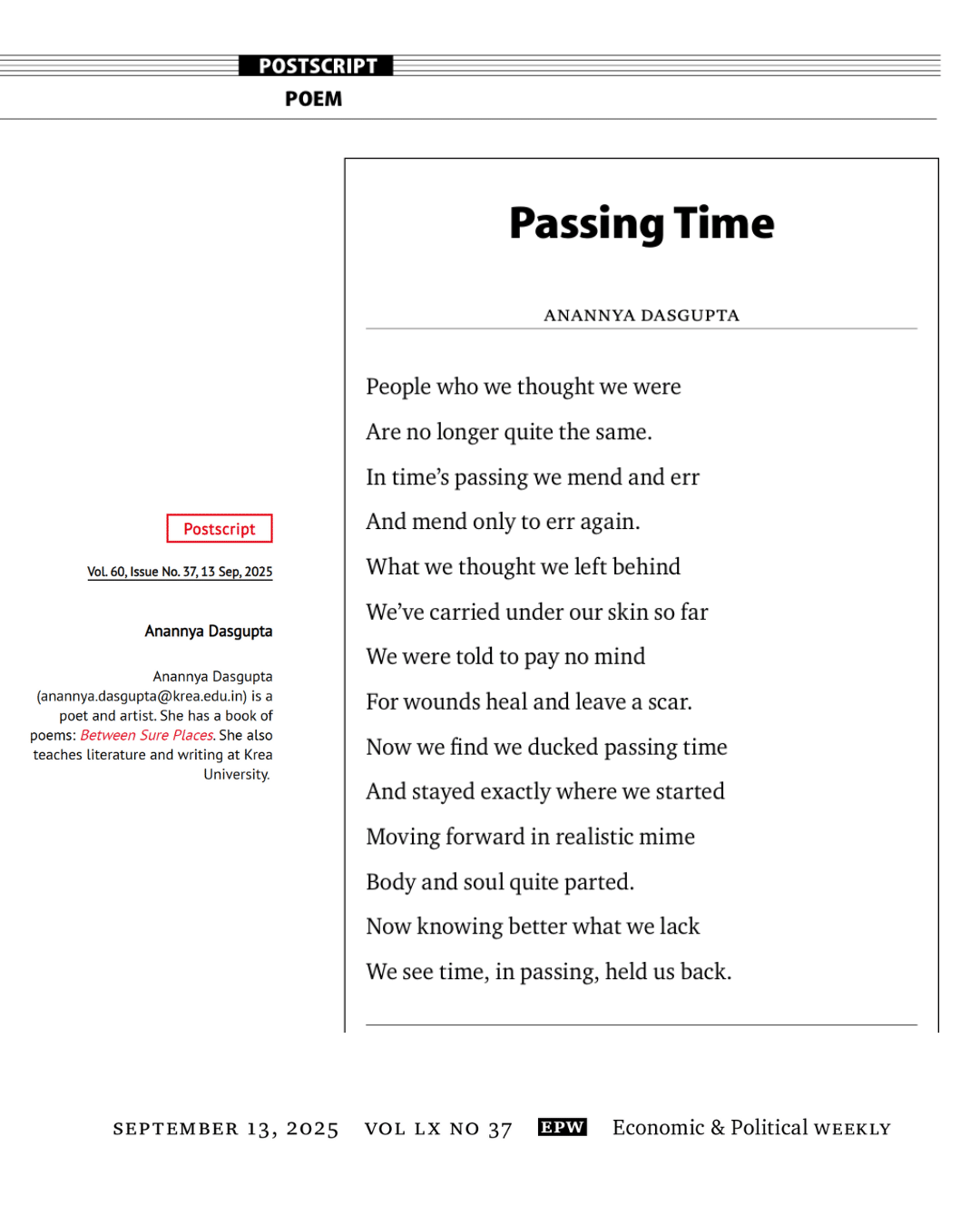
Dr Anannya Dasgupta, Director, Centre for Writing & Pedagogy (CWP) and Associate Professor of Literature, SIAS has penned an article in The Wire titled Large Servings of Slop: Writing and Research in the Age of AI.
On her recent official visit to Colombo Dr Proma Raychaudhury, Assistant Professor, Politics, SIAS represented Krea University at the 2025 Scales of Governance Conference (jointly organised by the Bandaranaike Academy for Leadership and Public Policy (BALPP), Colombo, and Sciences Po, Paris, a partner university of Krea). At the conference. Dr Raychaudhury presented a paper titled, ‘Sub-nationalism and (Gendered) Social Welfare Regimes: A Study of West Bengal under the All-India Trinamool Congress Government’.