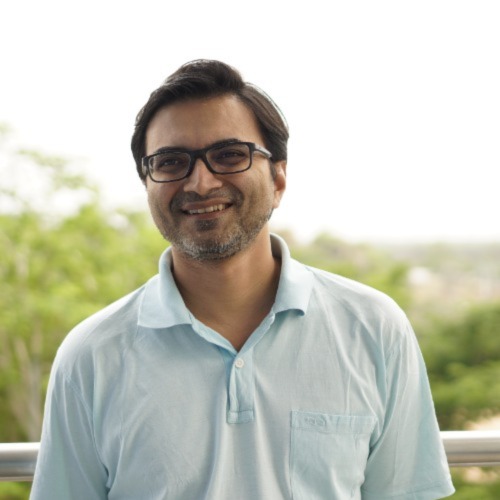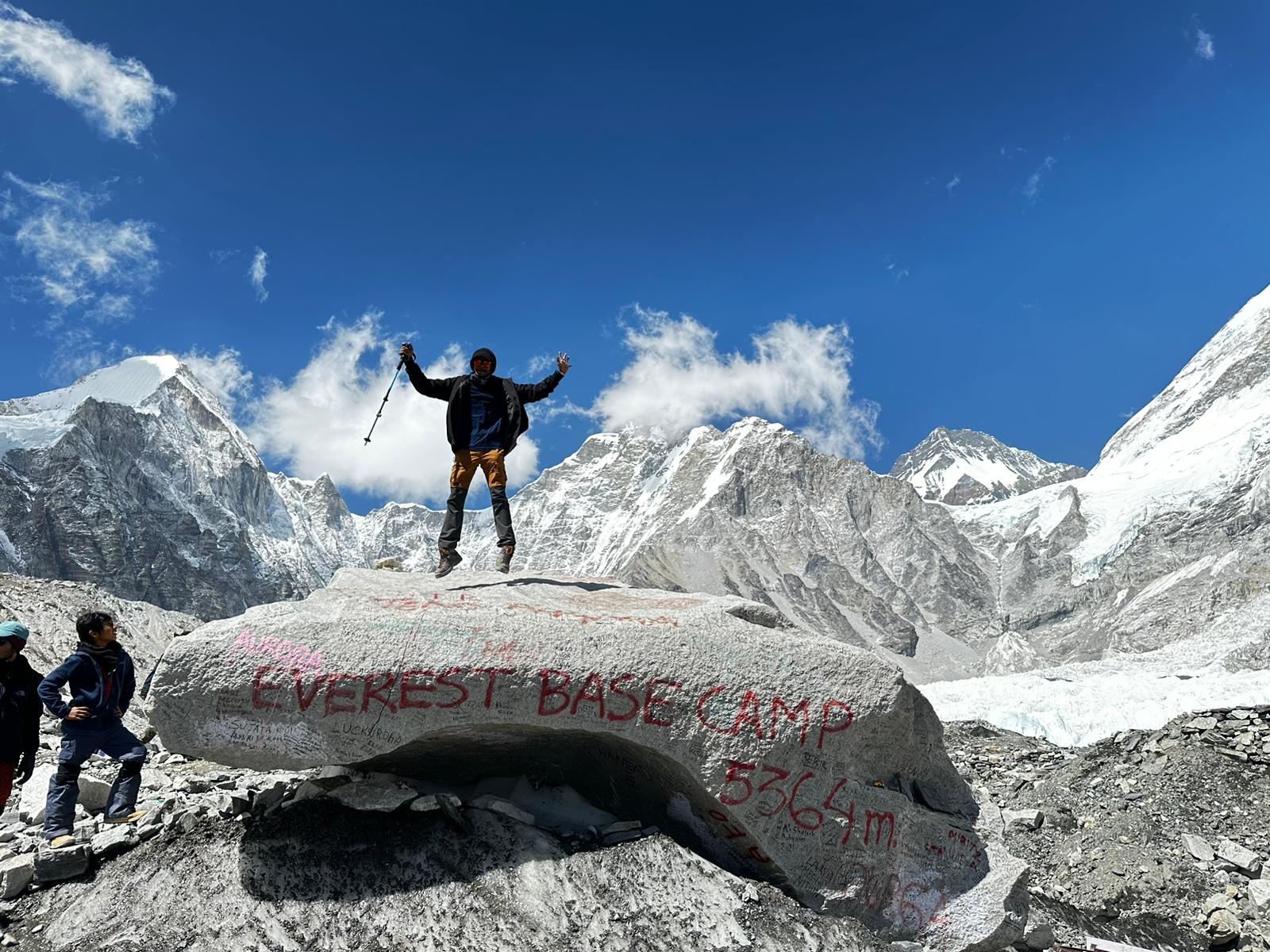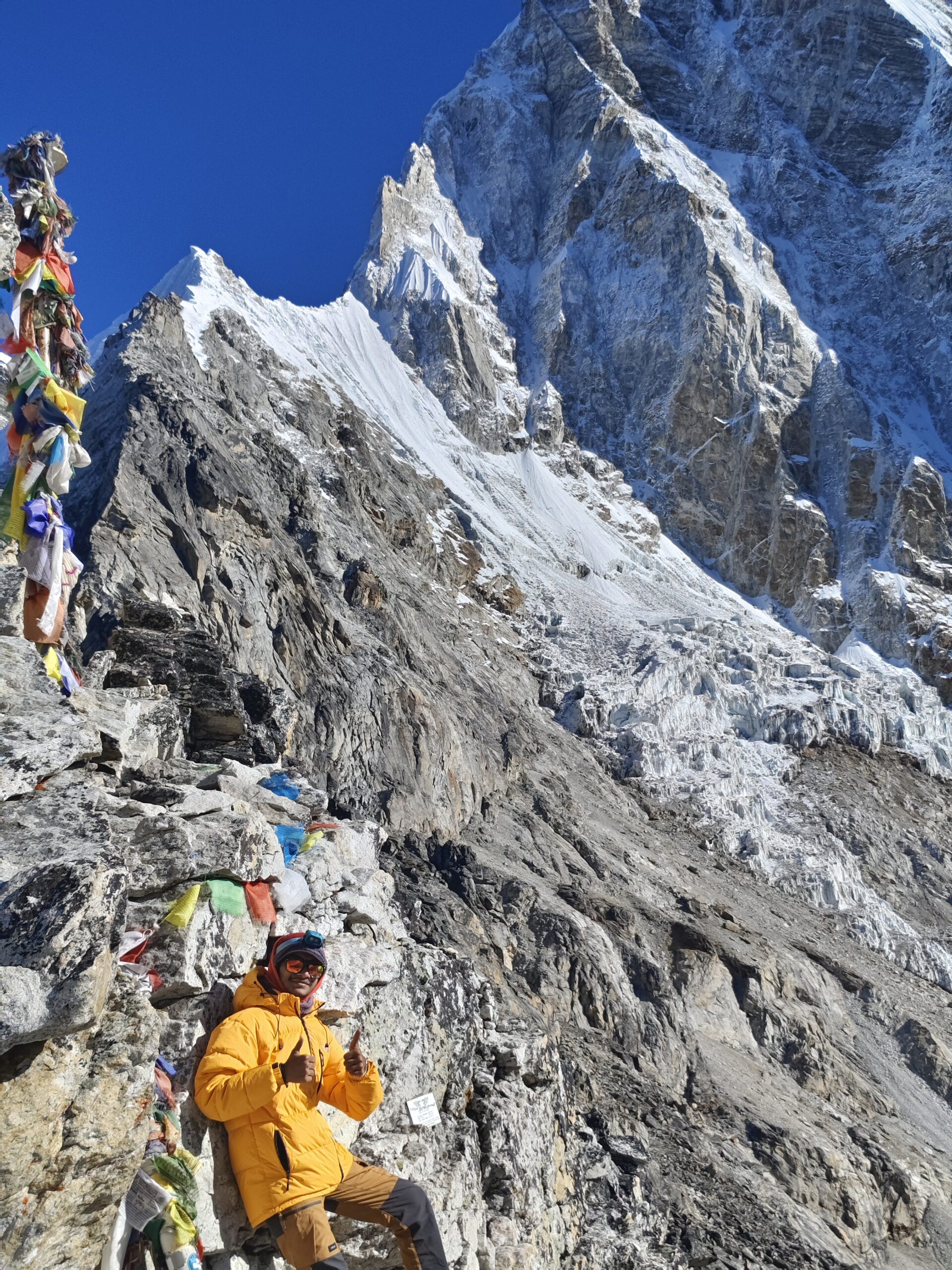
In some thrilling news from the mountains, Arnav Bajoria, SIAS Cohort of 2027, completed a trek to Kala Patthar (5645 m) and the Everest Base Camp (5364 m) on 29 May, 2024, coinciding with International Everest Day.


In some thrilling news from the mountains, Arnav Bajoria, SIAS Cohort of 2027, completed a trek to Kala Patthar (5645 m) and the Everest Base Camp (5364 m) on 29 May, 2024, coinciding with International Everest Day.


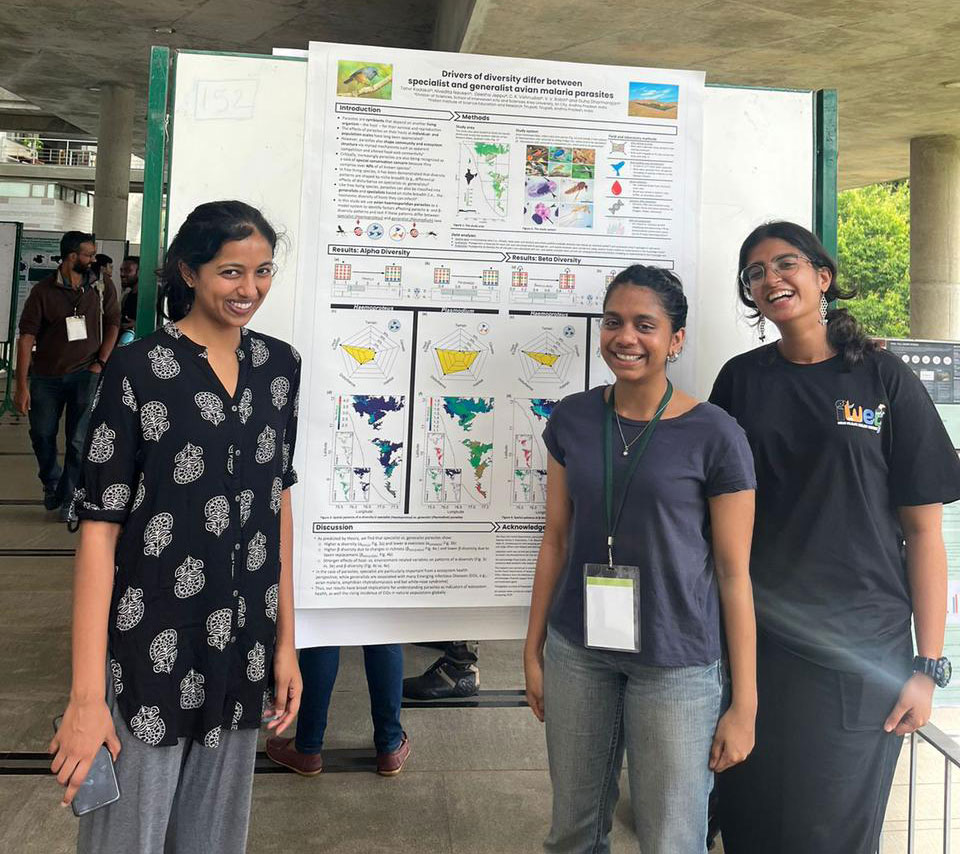
Deesha Jeppu, Tanvi Kadakol, and Nivedita Naveen from the Postgraduate Diploma Cohort of 2024, SIAS, Krea University, presented a poster at the Indian Wildlife Ecology Conference (IWEC) 2024. The conference was held at the National Centre for Biological Sciences, Bengaluru, from 14-16 June, 2024. The title of their poster was Drivers of Diversity Differ Between Specialist and Generalist Avian Malaria Parasites.

Poster abstract: Elucidating the mechanisms shaping parasite diversity patterns is critical because parasites encompass about 40% of known species, and play crucial roles in maintaining ecosystem structure and function. In free-living species, patterns of diversity in the Anthropocene are known to be shaped by niche breadth because, as predicted by theory, environmental disturbance is more likely to negatively impact specialist vs. generalist taxa. Like free-living species, parasites too can be categorised as specialists or generalists according to their niche breadth (i.e., host taxonomic diversity). However, unlike free-living species, the effects of niche breadth on parasite diversity patterns remain unclear.
In this study, the students use avian haemosporidian parasites as a model system to identify the factors affecting parasite phylogenetic diversity patterns, and test if these patterns differ between specialist (Haemoproteus) and generalist (Plasmodium) parasites. Their results demonstrate that, in keeping with ecological theory, specialist vs. generalist parasites show: (i) higher α diversity and lower evenness, and (ii) higher β diversity due to changes in richness and lower β diversity due to taxon replacement. Their results also suggest that in specialist parasites diversity is primarily shaped by host-related variables, unlike generalists which are impacted by a variety of host- and environment-related factors. Their results have broad implications for understanding the role of parasites as indicators of ecosystem health, as well as the effects of anthropogenic environmental modification on the rise of emerging infectious diseases.
View the poster
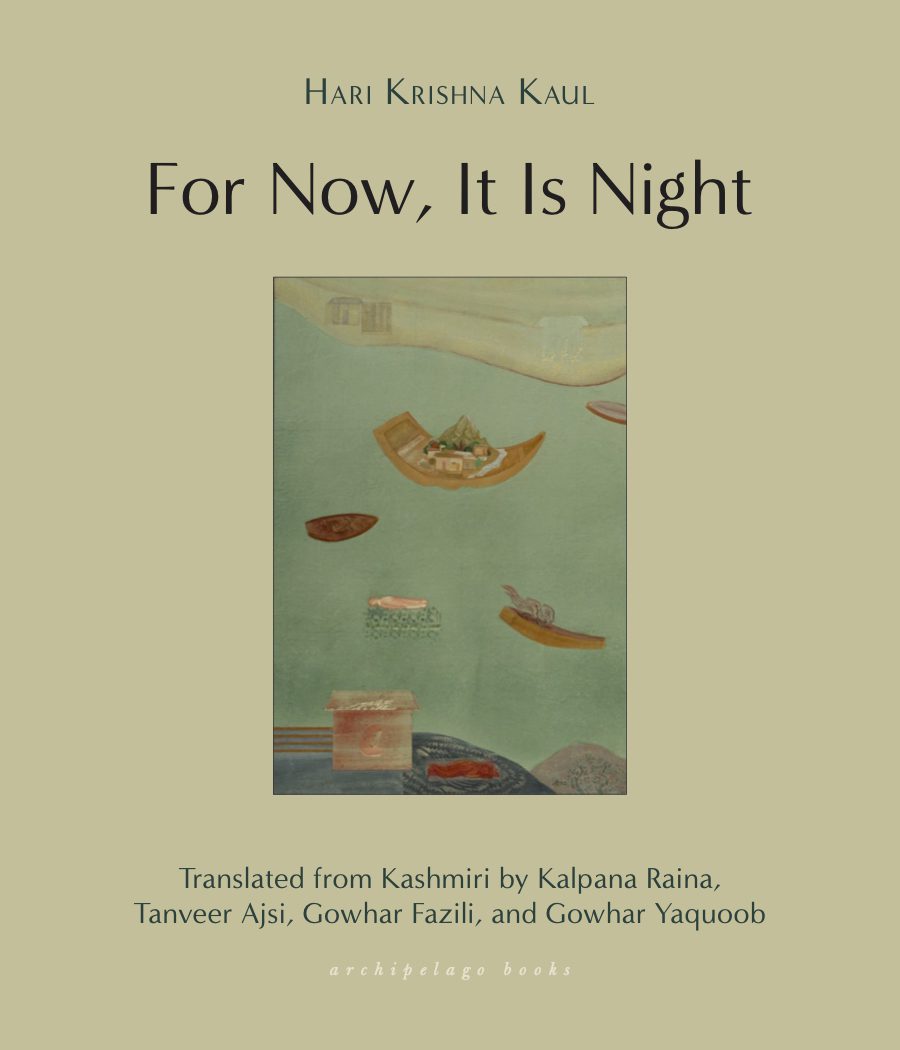
Last November, Krea University hosted the release of a book titled For Now it is Night by Hari Krishna Kaul, published by HarperCollins India. This volume of short stories, translated from Kashmiri, features the work of a team of translators, including Dr Gowhar Fazili, Assistant Professor of Social Studies, SIAS, Krea University, along with Kalpana Raina, Tanveer Ajsi, and Gowhar Yaqoob.
We are pleased to announce that the book has recently been republished in the United States by Archipelago Books, a prestigious publishing house known for works in translation.
For the US edition of the book, click here.
For the Indian edition of the book, click here.

Dr Gowhar Fazili, Assistant Professor of Social Studies, SIAS, Krea University has published a book review in The Wire. The review, titled A Fragmented Memory of Independent India and the Kashmir That Once Was, delves into M K Raina’s memoir Before I Forget. The review provides a critique of the memoir’s reflections on India’s postcolonial history and the cultural changes in Kashmir.
Read the book review here.

Dr C P Anil Kumar, Assistant Professor of Mathematics, SIAS, Krea University authored a paper titled On Infinity Type Hyperplane Arrangements and Convex Positive Bijections, published in the Indian Journal of Pure and Applied Mathematics (IJPA).
About the Publication
Consider a hyperplane arrangement, i.e., a finite collection of hyperplanes, in an n-dimensional Euclidean space. We say that an arrangement is generic if there are at least n hyperplanes and a codimension k intersection is formed by exactly k many hyperplanes. This is an interesting arrangement – for example, for a fixed m ≥ n, a generic arrangement of m hyperplanes in an n-dimensional Euclidean space has the maximum number of regions. Two arrangements are (combinatorially) isomorphic (or equivalent) if there is an ambient linear homeomorphism which preserves incidences between strata and the polyhedral structure of each stratum. In general, it is an interesting (and difficult) problem to understand the isomorphism classes of arrangements.

In this paper, the author introduces and defines a new type of hyperplane arrangements called infinity type hyperplane arrangements. The concept of normal systems (which is a collection of normal directions to these hyperplanes) are used to uniquely identify such generic arrangements. The main theorem states that the equivalence of two infinity type generic hyperplane arrangements is equivalent to the isomorphism of corresponding normal systems. The author also considers the case of all generic arrangements and proves that equivalence of arrangements implies isomorphism of normal systems. Further, a counter example is provided to show that the converse need not be true.
Read the article here.
Dr Randhir Rai, Visiting Faculty in Chemistry, SIAS, Krea University co-authored a research paper titled Solvothermal Synthesis of Cuprous Oxide Microsphere and its Application as Catalyst for Synthesis of β-Hydroxy Triazole. His co-authors included Saurav Saha, Research Scholar, Department of Chemistry, IIT Madras, and SIAS students Sreeshma Ravi and Ameena Abbas. Both students graduated in 2024. Sreeshma Ravi worked on this project as a capstone student under Dr Rai’s mentorship. Ameena Abbas voluntarily contributed to the project due to her interest in the subject.
Read the article here

Dr Proma Raychaudhury, Assistant Professor of Politics, SIAS, Krea University presented her research paper titled Gendering political party culture in contemporary West Bengal: A study of Women’s institutional belonging in the AITC at the ICAS:MP and CeMIS-Göttingen Workshop on Metamorphoses of the Political: Bengal in the New Millennium 2.0, held in Göttingen, Germany on 19-21 June, 2024.