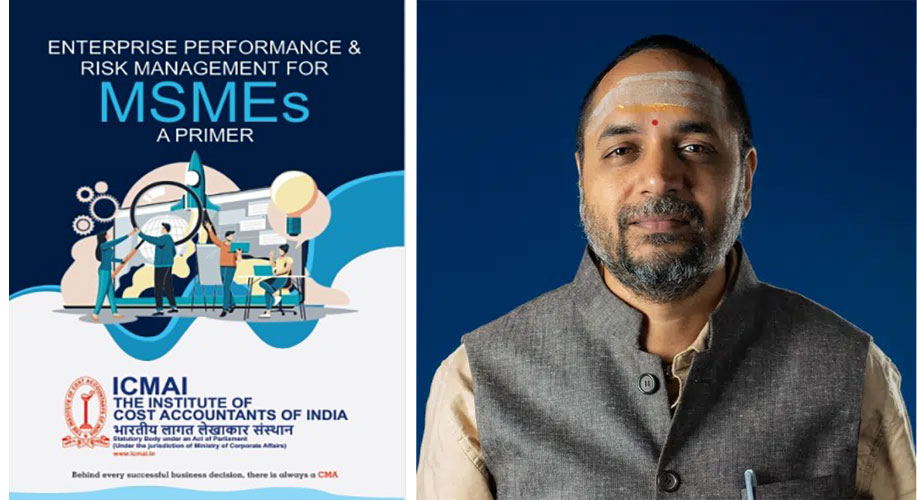
Professor Jayaram Ramakrishnan, Professor of Practice, IFMR GSB has authored a book titled, Enterprise Performance & Risk Management for MSMEs – A Primer on behalf of the Institute of Cost Accountants of India (ICMAI). The updated edition of the book was released on 11 January 26 at the 63rd National conference of The Institute of Cost accountants of India (ICMAI) at Coimbatore. The book was reviewed by leading academics and industry professionals including Professor G Balasubramanian, Senior Professor and Advisor, IFMR GSB.
The book deals with development of a Management Accounting framework for MSMEs. This was motivated by the existing low uptake and inconsistent use of Management Accounting Practices by MSMEs as observed and suggested by prior research in an Indian context. MSMEs were often found failing to leverage adequately. the potential of management accounting for helping them achieve their financial objectives (primarily profitability and liquidity) while also adequately insuring against risks.
Professor Chandrasekaran N, Professor, Operations and Strategy, Area Chair – Strategic Management & Chairperson – Executive MBA programme, IFMR GSB and Dr Suresh G, Assistant Professor, Economics, IFMR GSB along with Dr Ramasubramaniam, have authored a book chapter titled Role of Technology in Sustainable Logistics and Inventory Management with Reference to the Food Corporation of India. The chapter has been published in the forthcoming book A Circular Economy for Manufacturing Waste Management: Pathway Towards Sustainability, published by Routledge.
A research paper co-authored by Dr Junaid Iqbal,Post-Doctoral Fellow, IFMR GSB titled Leadership and Followers’ Voice Behavior in the Hospitality and Tourism Industry: Mapping the State-of-the-Art Trends and Future Directions has recently been published in the Journal of Hospitality and Tourism Insights (Emerald Publishing), a Q1-ranked journal.
This study investigates the knowledge structure surrounding leadership styles and employee voice behaviour within the hospitality and tourism sector. The primary objective was to provide a comprehensive overview of global research trends in this domain through a systematic bibliometric analysis. By mapping the intellectual landscape of the field, the study identifies key themes, influential authors, leading journals, and collaborative research networks that have shaped scholarly discourse over time. In doing so, it highlights the evolution of research interests, emerging hotspots, and existing gaps, thereby offering valuable insights for researchers, practitioners, and policymakers seeking to advance theory and practice related to leadership and employee voice in the hospitality and tourism context.
The paper is co-authored with Muhammad Ashraf Fauzi,Universiti Malaysia Pahang Al-Sultan Abdullah, Gambang, Malaysia, Dr Mubashir Ahmad Aukhoon, Assistant Professor, School of Management Studies, CGC University, Mohali, Punjab, India and Dr Zahoor Ahmad Parray, Assistant Professor, Department of Management Studies, South Campus, University of Kashmir, Anantnag, India.
Mugdha Kinhikar, an IFMR GSB PhD Scholar, has been selected as a mentee for the Earth System Governance (ESG) Mentoring Initiative 2026. The one-year programme supports early-career research fellows in advancing their career trajectories and fostering future leadership. The Earth System Governance Project is a global research network focused on advancing knowledge at the interface of global environmental change and governance.
Choosing the next step after finishing your graduation can be a very exciting experience, but it might also be a little bit frightening. A degree is still very important as the job market is becoming more and more competitive every year; however, employers are also giving a great deal of value to practical skills and the willingness to learn. That is the reason why further education is necessary for those who want to have a stable and future-proof career.
A shift can clearly be seen in the market, where the merit of skill-based qualifications with a direct industry relevance and real-world experience is being recognised alongside or even instead of traditional degrees. Such courses let you deepen your specialisation, discover new areas or just upgrade your employability skills.
This article serves as a comprehensive and convenient guide to the top courses that you can undertake after obtaining your graduation degree, thereby enabling you to decide your next move with confidence and clarity.
Why Consider Additional Courses After Graduation
Today, a graduation degree alone will not help you build a strong career, as industries are changing fast and employers are looking for graduates who have hands-on skills along with theoretical knowledge. If you pursue additional courses after graduation, you will not only polish your skills but also become more confident and be eligible for the jobs that demand the latest skills, especially in those areas which are affected by technology, innovation and global competition.
Key Reasons to pursue further courses after graduation:
Need for specialisation and industry-ready skills – The majority of professions nowadays demand a more profound understanding, practical training and equipment that conventional degrees cannot provide completely. This is the main reason why specialised courses have become indispensable for the acquisition of industry-ready skills
Higher employability and competitive salaries- Candidates with updated skills are more noticed during interviews, and hence, they get more chances. This is often because they can bring immediate value to the organisations and, as a result, they can obtain higher starting packages
Chance to change career trajectories- A person can move to new sectors like management, analytics, UI UX design, or digital marketing by just doing a short-term professional course, even if their graduation background is from a different field
Alignment with the changing industry requirements- The rapid growth in AI, data analytics, digital transformation, and automation has created a significant demand for those who understand these new areas and can make quick changes
Top Professional Courses After Graduation with Best Career Options
After graduation, pursuing a professional course will help you gain a clearer understanding, enhance your skills, and prepare you for industries that require both practical and theoretical knowledge. Here are the different courses, their subjects, and the jobs that you can choose from, based on what aspirations you have:
MBA
Educates the students on how businesses are operated at a strategic level. The course covers marketing strategies, financial planning, human resources, operations and leadership development
Instils decision-making ability in the students and helps them develop communication skills and a managerial perspective that is essential to manage teams and achieve business goals
Equips students with the knowledge that helps them take on mid to senior-level responsibilities, as well as technical roles
Job roles include marketing manager, operations manager, business manager, HR manager, etc.
PGDM
This course concentrates on hands-on learning through case studies, industry exposure, internships and live projects
Assists in the development of job-ready skills by aligning learning with industry practices
Students who prefer practical learning instead of theory-heavy learning are the most suitable for this programme
Career roles include management trainee, business analyst, operations executive, and junior management roles
Business Analytics
Teaches acquiring, cleaning, analysing, and interpreting data with the help of various analytical tools and business metrics
Helps companies to improve their performance, reduce expenses and make strategic plans by using data-driven insights
Enhances great problem-solving and logical thinking abilities
Career options include business analyst, data analyst, analytics consultant, and reporting specialist
Digital Marketing
Explains the techniques of SEO, social media marketing, content planning, paid advertising, email campaigns creation, and digital performance tracking to students
Helps in getting new customers, creating brand awareness and measuring the effectiveness of online marketing
Can lead to full-time, freelance or remote jobs
The professional journey can start with positions such as a digital marketing executive, SEO specialist, social media manager, content strategist, and performance marketer
Project Management
Gives instructions on how to design, carry out, check, and finalise projects and also how to manage time, money and materials
Provides the skills to coordinate teams, handle risks and get favourable outcomes across various industries
Perfect for individuals seeking to hold leadership and coordination positions
Positions include project coordinator, project manager, programme executive, and delivery manager
Data Science and AI
Gives knowledge about advanced data analysis, machine learning models, automation and artificial intelligence applications
Enables companies to foresee trends, improve efficiency, and create smart systems
Requires individuals who are highly analytical and engaged in self-learning, as the technology is rapidly changing
Possible job roles are data scientist, AI engineer, machine learning specialist, and analytics researcher
Cloud Computing
Discusses the cloud infrastructure, different deployment models, system operation, and how the system can be expanded to work with various platforms such as AWS, Azure, and GCP
Enables companies to handle their digital systems safely and efficiently without the need for physical servers
Suitable for IT professionals looking to move into high-demand infrastructure roles
Career options include cloud engineer, DevOps engineer, and cloud solutions architect
Cybersecurity
Focuses on identifying weaknesses, preventing cyber threats, and protecting digital assets
Helps organisations to maintain data security, comply with regulations, and gain trust in digital systems
Quite rapidly becoming an essential skill in the areas of banking, healthcare, government, and IT
Job positions include cybersecurity analyst, ethical hacker, security consultant, and risk analyst
Full Stack Development
Teaches how to build complete applications by covering frontend design, backend logic, databases, and deployment
Helps create scalable and functional digital products used by businesses and consumers
Suitable for those interested in hands-on development and problem-solving
Career roles include full-stack developer, software engineer, and web application developer
UI UX Design
Covers user research, wireframing, usability testing, interaction design, and visual design principles
Helps create digital experiences that are intuitive, accessible, and user-focused
Strong demand in tech, product-based companies, and digital agencies
Career options include UI designer, UX designer, product designer, and experience designer
Finance Certifications
Teaches financial reporting, valuation, budgeting, investment analysis, and risk assessment
Helps professionals make informed financial decisions and support business growth
Suitable for those aiming for analytical and decision-oriented finance roles
Career roles include financial analyst, finance manager, investment analyst, and corporate finance associate
Healthcare and Operations
Focuses on managing healthcare services, operations, logistics, compliance, and human resources
Helps improve efficiency, service quality, and patient outcomes in healthcare settings
Suitable for graduates interested in non-clinical roles within the healthcare sector
Career options include hospital administrator, operations manager, healthcare coordinator, and HR executive
Tips to Maximise Career Growth After Completing Any Course After Graduation
Finishing a course is basically only the very first step, as it is mostly what you work on afterwards that will decide the pace and the extent of your career growth. Having hands-on experience, growing your network, and keeping yourself informed with the latest trends of the industry can really help you in defining your career path.
Build a Professional Portfolio – Present the skills and projects you have through a digital portfolio or a GitHub repository, which focuses on the practical work, case studies, internships, or freelance projects to show your skills to potential employers
Do Internships and Freelancing – Acquire the real-world experience and first-hand exposure through the taking up of internships, freelance projects or part-time assignments, which not only helps your resume get strengthened but also helps you to understand the workplace dynamics
Network and Attend Industry Events – Meet with professionals, mentors and alumni by participating in conferences, seminars, webinars, and workshops and also by being a member of professional communities to seek different possibilities and to get the knowledge
Stay Updated with New Tools and Trends – Keep on learning and upgrade your skills by always being in line with the industry trends and master the newest tools, technologies, and frameworks that are a part of your field of work, in order to be competitive and relevant
Conclusion
One of the main points to be understood when setting up a successful career is that success cannot be achieved by merely following trends. Instead, you must align your learning not only with your interests but also with the skills that the market values most. If you direct your attention to areas that energise you, at the same time keeping industry demand in view, your development will be significant, lasting, and satisfying. Also, learning continuously is very important because industries change rapidly, and if you remain flexible, you will be able to compete and be prepared for new opportunities. By combining passion, strategic skill development and adaptability, you can confidently navigate your career journey and open doors to opportunities that align with both your aspirations and the professional landscape.
FAQS
Which courses provide access to industry mentors and professional networks?
Programmes like MBA, Business Analytics, Data Science, Digital Marketing, and Entrepreneurship courses often include mentorship from industry experts and networking opportunities, helping students gain practical insights and connect with potential employers or collaborators.
Are there courses that provide both skill development and certifications recognised globally?
Yes, certifications such as the Google Data Analytics Certificate, AWS Certification, CFA (Finance), and Global Business Management programmes offer globally recognised credentials that enhance a person’s job prospects.
Do any courses offer guaranteed internship or placement assistance after completion?
Institutions offering professional programmes, for example, MBA, Data Science, Digital Marketing, and Chartered Accountancy prep courses, have well-organised placement cells or industry tie-ups to facilitate the students in getting internships or jobs after the course completion.
Are there options to pursue these courses part-time or online while working?
A lot of programmes have online or weekend batches to blend flexible learning, mentorship, and real-world projects. In this way, working professionals can upskill, obtain certifications, and progress their careers without the need to quit their current jobs.
The process of deciding to do an MBA most of the time usually begins with a quieter question about comfort zones. Some are naturally inclined towards numbers, forecasts, and making decisions based on structured data. While others find it more comfortable when dealing with people, creating stories, and influencing choices in the market. This difference has been the reason for the debate about MBA Finance vs Marketing. Both specialisations promise a strong career path, exposure to leadership skills, and long-term personal development. However, it is often unclear what the way to each of these specialisations looks like. There are misconceptions about academic background, entrance exams, and skill requirements, which result in unnecessary confusion during the application process.
This article will explain the eligibility, entrance exams, and salary trends of MBA Finance and MBA Marketing.
What Is the Core Difference Between MBA Finance and MBA Marketing?
At first glance, the difference appears straightforward, but in real work settings, the differentiation becomes clearer through daily responsibilities and decision-making style.
Focus and Work Style
MBA Finance is rooted in managing how capital flows within an organisation. The focus stays on evaluating investments, controlling costs, measuring risk, and planning long-term financial stability. Accuracy matters at every step, and most choices are guided by numbers and models rather than instinct.
MBA Marketing, in contrast, deals with understanding customer behaviour, shaping brand perception, and driving revenue through positioning and communication. Decisions often balance data with judgment. Adaptability plays a strong role, especially in fast-moving markets.
How Decisions Are Typically Made
Finance relies extensively on structured analysis. Problems are numerically represented, analysed, and solved through the use of models and forecasts. Small mistakes in calculations can lead to huge financial losses; hence, accuracy is crucial.
Marketing decisions take a more interpretative route. Market trends, customer reactions, and timing are the major factors determining results. Though statistical supports are used for making decisions, the final strategies are usually influenced by experience and intuition.
Both MBA Finance and MBA Marketing eventually lead to leadership positions where strategic thinking matters more than specialisation. However, the first years are largely influenced by the mindset, work pattern, and the level of comfort one has with numbers or stories.
Is There a Difference in Eligibility Criteria Between an MBA in Finance and an MBA in Marketing?
Eligibility requirements remain mostly common across MBA programmes, regardless of specialisation. Still, some factors matter.
Academic Background and Graduation Discipline
A bachelor’s degree in any discipline is accepted for both MBA Finance and MBA Marketing. A background in commerce or economics may make finance concepts easier, but it is not mandatory.
Minimum Percentage and Category-Based Relaxation
Most institutes demand a minimum aggregate score. Normally, general category candidates have to score around 50% in graduation to be considered. Candidates from the reserved category are usually eligible with 45% aggregate marks. These thresholds vary slightly across universities and autonomous institutes.
Role of Work Experience in Admissions
Work experience is not a must for most full-time MBA programmes in India. But top institutions consider this factor during the selection process. One to three years of work experience can add more weightage to a candidate’s profile, but it is never a strict condition.
Which Entrance Exams Are Required for Admissions: MBA in Marketing vs MBA in Finance
National-Level MBA Entrance Exams in India
In India, the national-level exams are the main gatekeepers for admissions. The CAT is still the most common and widely accepted test for IIMs and a large number of top private schools. XAT is for XLRI and some other institutes. Besides, NMAT, SNAP, and CMAT are also some of the exams through which the well-known colleges can be accessed.
Global MBA Entrance Exams and Growing Acceptance
At the global level, the GMAT is a very important test, particularly for the international MBA programmes as well as the Indian schools that have global tie-ups. The acceptance of the GRE has been growing gradually; thus, it is a great option for applicants from a variety of academic backgrounds.
State-Level Entrance Exams and Regional Access
There are state-level exams like MAH-CET (Maharashtra) and TANCET (Tamil Nadu), which are mainly for the state-level universities and institutions.
How Entrance Exams Link to Specialisation Choice
Preparation strategy stays the same for both Finance and Marketing. Quantitative ability, verbal skills, and logical reasoning matter equally. The specialisation decision usually happens during or after the first year of study.
How Do Career Opportunities and Pay Scales Differ Across Both Specialisations?
Career Roles and Salary Range After an MBA in Finance
Finance jobs typically start with positions that require a lot of analysis and control. In the long run, the focus shifts more to decision-making, risk ownership, and taking up leadership roles. The salary increase is generally quite regular and depends a lot on accuracy and the level of impact.
Job Role
Entry-Level Salary Range (LPA)
Experience Salary Range (LPA)
Financial Analyst
₹6-₹10 LPA
₹15-₹30+ LPA
Investment Banker
₹10-₹25 LPA
₹30-₹60+ LPA
Risk Manager
₹7-₹12 LPA
₹18-₹35+ LPA
Corporate Finance Executive
₹6-₹9 LPA
₹15-₹28+ LPA
Portfolio Manager
₹8-₹15 LPA
₹25-₹50+ LPA
Career Roles and Salary Range After an MBA in Marketing
Marketing career trajectories are usually more customer and market-oriented from the very beginning. Progress happens through showing visible results, leading teams, and the capacity to scale brands or products not only in different channels but also across regions.
Job Role
Entry-Level Salary Range (LPA)
Experience Salary Range (LPA)
Brand Manager
₹5-₹9 LPA
₹15-₹30+ LPA
Product Manager
₹7-₹14 LPA
₹20-₹40+ LPA
Digital Marketing Manager
₹4-₹8 LPA
₹12-₹25+ LPA
Sales & Business Development Manager
₹5-₹9 LPA
₹18-₹35+ LPA
Marketing Strategy Lead
₹6-₹10 LPA
₹20-₹45+ LPA
Which MBA Specialisation Feels More Challenging: Marketing vs Finance
Difficulty depends less on the syllabus and more on personal alignment.
The Technical Intensity of Finance
Finance is a very technical field. Students must have a good quantitative aptitude, be very accurate, and be able to work with complex models efficiently. Errors can be very costly, and therefore, accuracy is non-negotiable.
The Pressure Dynamics of Marketing Roles
Marketing presents a different challenge; communication never stops, targets shift, and feedback is public. Success depends on persuasion, adaptability, and emotional intelligence under pressure.
Conclusion
The decision to pursue an MBA Finance or an MBA Marketing is not only about career goals but also about compatibility with thinking style, work rhythms, and one’s professional identity over the years. Finance is more about structure, accuracy, and steady responsibility, which suits those who make decisions in a measured way and prefer going deep into analysis. Marketing is about movement, visibility, and creative problem-solving, which will attract those who like dealing with the market and influencing it.
Admission criteria and entrance exams are almost the same, which makes self-alignment more important than just academic background. There are differences in salary range at the point of entry into the workforce, but they disappear when one gets more experience and takes on leadership roles.
FAQs
Is it possible for someone to dislike mathematics and still do well in MBA Finance?
Disliking mathematics does not automatically rule out success in MBA Finance. The work involves understanding numbers rather than constantly solving complex equations. With clear thinking, attention to detail, and a willingness to work through financial data carefully, many students manage the coursework well even without enjoying math itself.
Is an MBA in Marketing suitable for introverted personalities?
Being an introvert is not a handicap for a Marketer. There are many positions where one can work independently on strategy, analysis, and planning without having to be in the public eye at all times. Besides, through projects and teamwork, one can improve communication skills step by step.
Are internships equally important for students of Finance and Marketing?
Internships matter in both fields, but in different ways. A finance internship would help to gain authenticity and technical exposure, and a marketing internship would help to prove on-the-ground creativity, impact, and execution ability.
Do entrance exam score preferences differ for Finance and Marketing aspirants?
Entrance exam cutoffs are decided by the colleges. They are not different for different departments. The same score is taken into consideration for Finance and Marketing. Most of the time, the choice of the department comes after the admission has been secured.
Do MBA Finance and Marketing students compete for the same placements?
Both overlap in the recruitment processes for consulting and management positions, but the core finance and core marketing placements will typically be conducted independently. The recruiters are interested in the candidate’s subject compatibility rather than merely looking at the specialisation labels.
Can a weak undergraduate academic record be balanced through entrance exams?
A strong entrance exam score can improve chances significantly. Many institutes view exams as proof of current capability rather than relying only on past academic performance.
Management education has become one of the most reliable pathways for individuals who want to understand how organisations function, make thoughtful decisions and guide teams with confidence. As industries continue to transform and workplaces become more dynamic, the need for strong management skills is growing across fields, including technology, finance, retail, healthcare and even small family-run businesses. Whether you are seeking career growth, planning a shift into a new domain or hoping to build something of your own, a management course can offer valuable clarity and direction.
These programmes are not only useful for recent graduates. Both working professionals seeking leadership positions and entrepreneurs looking to enhance their strategic and operational skills can benefit equally. In this article, you will learn about the types of management coursesavailable, the eligibility criteria, the usual syllabus and the career opportunities that can follow, helping you decide if this path suits your long-term goals.
What Are Management Courses?
These courses are structured programmes that help learners understand how organisations function, how decisions are shaped and how people, resources and projects can be managed with clarity and purpose. These courses are designed to build practical, strategic and leadership abilities that prepare individuals for roles that involve teamwork, coordination and responsibility.
Definition
Teaches core management principles such as planning, organising, leadership, communication, and problem-solving
Helps learners understand how to manage teams and run business operations effectively
Academic Purpose
Develops analytical thinking and strategic planning abilities
Builds a strong understanding of organisational behaviour
Prepares individuals for managerial and leadership roles across industries
Key Benefits
Enhances communication, teamwork, and critical thinking skills
Improves time management and business awareness
Supports long-term career growth and adaptability in a changing workplace
Who It Is For
Students exploring their career direction
Working professionals aiming for leadership or managerial positions
Entrepreneurs seeking stronger strategic and operational knowledge
Practical Exposure
Includes case studies, internships, and group projects
Uses real business simulations to apply theoretical concepts
Builds confidence in real-world decision-making
Career Relevance
Opens opportunities in HR, marketing, finance, operations, consulting, and project management
Relevant across almost every industry and sector
Skill Development
Strengthens soft skills like leadership, negotiation, and communication
Builds hard skills such as analytical thinking, digital literacy, and problem-solving
Provides a competitive edge in the job market
Types of Management Courses Offered in India
The management courses available in India are offered at the undergraduate, postgraduate, and diploma/certificate levels. Additionally, these courses are presented in a variety of formats.
Undergraduate Management Courses
BBA (Bachelor of Business Administration)
Three-year undergraduate programme
Builds a broad understanding of core business functions
Covers management, marketing, finance, HR, and business communication
Helps develop early managerial, decision-making, and analytical skills
BBM (Bachelor of Business Management)
BMS (Bachelor of Management Studies)
Strong focus on management and leadership studies
Emphasises strategic thinking and decision-making
Balanced mix of theoretical knowledge and practical exposure
Includes projects, case studies, presentations, and industry-oriented learning
Focuses on business operations and organisational processes
Provides insights into how companies function at operational and strategic levels
Encourages entrepreneurial thinking and problem-solving skills
Suitable for students interested in business execution and enterprise management
Progresses from basic business concepts to advanced management training
Offers a seamless pathway to an MBA without separate entrance exams
Ideal for students committed early to long-term management careers
Postgraduate Management Courses
MBA (Master of Business Administration)
Two-year postgraduate degree programme
Focuses on developing managerial, analytical, and leadership skills
Offers specialisations in Marketing, Finance, HR, Operations, Analytics, International Business, and more
Strong industry credibility due to university/UGC recognition
Backed by structured placement support and alumni networks
PGDM (Post Graduate Diploma in Management)
Two-year diploma programme offered by autonomous institutes
Known for an industry-driven curriculum with frequent syllabus updates
Emphasises practical learning through case studies, live projects, and internships
Provides corporate exposure via industry interactions and training modules
Offers specialisations similar to an MBA, aligned with current market needs
Diploma & Certificate Courses
HR Management
Builds skills in recruitment, employee relations, performance management, and talent development
Prepares learners for HR roles across diverse organisations
Marketing Management
Provides specialised knowledge of marketing strategies, branding, digital marketing, and consumer behaviour
Helps learners plan and manage effective campaigns and brand initiatives
Finance Management
Equips learners with skills in financial planning, investment analysis, corporate finance, and accounting
Prepares candidates for finance and accounting roles
Business Analytics
Focuses on data-driven tools and analytical techniques
Enables learners to analyse business performance and support informed decision-making
Project Management
Develops skills in planning, execution, monitoring, and leadership
Prepares learners to successfully manage projects across industries
Digital Marketing
Teaches how to create, manage, and optimise online marketing campaigns
Covers SEO, social media marketing, and content marketing
Operations Management
Covers processes, supply chain management, logistics, and quality control
Helps learners improve operational efficiency and organisational effectiveness
Executive & Online Management Courses
Executive MBA
Postgraduate management programme designed for experienced professionals
Focuses on leadership, strategy, and senior-level managerial skills
Typically delivered in modular, weekend, or part-time formats
Online MBA
Provides flexibility through remote/online learning
Covers core MBA subjects along with various specialisations
Ideal for working professionals who cannot attend full-time programmes
Executive PGDM
Comparable to an Executive MBA but offered by autonomous institutes
Curriculum is highly industry-aligned with practical exposure
Frequently updated to stay relevant with current market needs
Online Certificate Programmes
Short-term courses aimed at targeted skill development
Focus on niche areas like digital marketing, finance, analytics, project management, and operations
Suitable for professionals looking for quick upskilling or domain-specific expertise
Eligibility for Admission Into Management Courses
Different courses have different entry requirements depending on the level and type of programme. Knowing these requirements helps learners see which courses they can apply for and plan their preparations for exams.
Eligibility Overview
Undergraduate (UG)
Completion of Class 12 from a recognised board
Minimum percentage as specified by the institute (generally 45%–50%)
Some institutes require entrance exams, such as CUET-UG
Postgraduate (PG)
A recognised bachelor’s degree
Minimum marks as per institute norms (generally 50%)
Entrance exams such as CAT, XAT, MAT, CMAT, GMAT
Executive programmes require 1–3 years of work experience
Diploma & Certificate Courses
Flexible eligibility criteria
Graduation is not mandatory for many programmes
Open to students, working professionals, or entrepreneurs, depending on the course
Syllabus of Management Courses
Management courses combine theoretical knowledge and practical learning to equip learners with the skills needed to manage organisations, make strategic decisions, and lead teams effectively. The syllabus is designed to build a strong foundation in core business concepts while offering options for specialisation and hands-on experience.
Syllabus Overview
Core Subjects
Foundational courses covering essential business and management principles
Key areas include:
Principles of Management
Business Economics
Marketing Management
Financial Accounting
Human Resource Management
Business Communication
Business Law
Strategic Management
Builds a strong conceptual base across all functional areas of business
BBA & MBA Specialisation Subjects
Domain-focused courses to develop in-depth expertise
Major specialisations include:
Marketing
Finance
Human Resource Management
Operations
International Business
Business Analytics
Entrepreneurship
Emerging and trending domains:
AI in Business
Data-Driven Decision Making
Digital Business Models
Aligns learners with evolving industry requirements
Practical Learning Components
Emphasis on experiential and application-based learning
Includes:
Internships
Case studies
Industrial training
Capstone projects
Live industry assignments
Helps learners apply theory to real-world scenarios
Enhances industry exposure, problem-solving, and decision-making skills
Career Scope After Management Courses
Completing a management programme equips learners to take on leadership, strategic, and analytical responsibilities with confidence. Graduates can enter diverse roles across industries, explore specialisations that align with their interests, and progress to higher positions as they gain experience and expertise.
Career Scope Overview
Job Roles
Business Analyst
Marketing Manager
HR Executive / HR Manager
Financial Analyst
Operations Manager
Project Manager
Supply Chain Analyst
Entrepreneur (own venture), based on skills, interests, and specialisation
Industry Sectors
IT and Technology
Banking and Finance
Retail and E-commerce
Healthcare
Hospitality and Tourism
Manufacturing
Consulting
Opportunities available in both corporate roles and entrepreneurial environments
Salary Expectations
Salaries vary depending on experience, institute reputation, skills, and area of specialisation
Entry-level roles offer moderate salary packages
Mid-level roles provide higher compensation with added leadership responsibilities
Senior-level positions command high remuneration, reflecting expertise and strategic impact
How to Choose the Right Management Course
Choosing a management course requires evaluating multiple factors that align with your background, career goals, and personal priorities. Considering these elements carefully can help ensure that the course you select provides the right skills, opportunities, and long-term benefits:
Assess your academic background and prior education to determine which management programme is suitable for you, ensuring that you can comfortably handle the course content and build upon your existing knowledge
Reflect on your career goals and personal strengths to identify programmes that will support your long-term aspirations, helping you gain skills that directly contribute to the roles and industries you are interested in
Pay close attention to specialisation options offered within the course, as your choice of focus area will influence your expertise, future job roles, and the type of industries where you can thrive
Research the accreditation, recognition, and rankings of institutes to ensure the programme is credible, provides quality education, and offers good placement opportunities with companies that value the qualification
Consider course fees in relation to potential return on investment, weighing the cost against factors such as expected salary growth, career progression, alumni network, and industry exposure to make an informed financial decision
Conclusion
Management courses offer a comprehensive mix of theoretical knowledge, practical skills, and industry exposure that equip learners to handle diverse business challenges. They cover essential areas such as leadership, strategy, finance, marketing, HR, operations, and business communication while also providing specialisation options and hands-on experiences like internships, case studies, capstone projects, and live assignments.
The relevance of management skills continues to grow as organisations seek professionals capable of making strategic decisions, leading teams effectively, and adapting to evolving business environments. Whether you are a student beginning your academic journey, a working professional aiming for career progression, or an entrepreneur looking to strengthen strategic and operational abilities, it is vital to assess your strengths, interests, and long-term goals carefully.
Selecting the right course can unlock opportunities, develop expertise, and support sustained career growth across industries and leadership roles.
FAQS
Which institutions offer the best management courses in India?
Top management institutions include the IIMs, XLRI, FMS Delhi, ISB, SPJIMR, Krea University, Amity University and MDI Gurgaon. These institutes are recognised for their strong faculty, industry connections, placement records, and global exposure opportunities.
Are there short-term management courses for skill enhancement?
Yes, many institutes and online platforms offer short-term management programs, ranging from a few weeks to a few months, focusing on specific skills like digital marketing, project management, business analytics, and leadership development.
How flexible are management courses in terms of learning modes?
Management courses are offered in full-time, part-time, online, and hybrid formats, allowing students and working professionals to choose a mode that fits their schedules and career objectives.
What role do networking and industry connections play in management courses?
Networking opportunities, industry collaborations, alumni connections, and guest lectures are integral to management programs. They help students gain insights, mentorship, internships, and better placement opportunities, complementing academic learning with real-world exposure.
Can management courses help in switching careers?
Yes, management courses provide knowledge, practical skills, and networking opportunities that enable professionals to transition into new roles, industries, or even start their own businesses, regardless of their original academic background.
The MBA interview is the stage where your application becomes real to the admission committees, allowing them to learn about the person behind the numbers, essays, and work experience. It is also a point in time when a well-thought-out preparation can really bring you success. Strong tips for MBA admissions and effective strategies for an MBA interview enable you to demonstrate your strengths clearly and prove that you are capable of handling the academic and professional challenges of a leading business school.
This article presents practical advice on how to highlight your accomplishments, express your objectives assertively and deal with the most frequent interview problems, helping you to face the interview as a genuine and goal-oriented person.
What MBA Interviews Aim to Evaluate?
MBA interviews are a chance for the admissions teams to get to know your character, how you think, and whether you are prepared for the program. The below details summarises them clearly and concisely.
Evaluation Overview
Fit with the Programme and Culture
What They Look For:
Understanding of the school’s ethos
Ability to work with diverse peers
Clear reasons for choosing the institution
Why It Matters:
Shows whether you will thrive in their environment. If you’ve explored MBA programmes in India, consider alumni networks and industry exposure; for studying abroad, reflect on global perspectives.
Communication and Leadership Potential
What They Look For:
Clear expression of ideas
Thoughtful listening and intentional responses
Evidence of leadership qualities
Why It Matters:
Demonstrates confidence, collaboration, and readiness for group-based learning. You don’t need to be perfect; show adaptability and willingness to grow.
Clarity of Career Goals
What They Look For:
Realistic understanding of your career path
How an MBA fits into your plans
Motivation for a region or industry
Why It Matters:
Helps interviewers see your career direction. If you’re considering MBA in India, think about fast-growing sectors; if abroad, consider long-term global exposure.
Problem Solving and Analytical Skills
What They Look For:
Logical breakdown of problems
Balance between intuition and data
Composure under pressure
Why It Matters:
Indicates how you approach decisions and challenges. Schools often use situational or case-style questions to judge your analytical mindset.
Important Preparation Tips for MBA Admissions
A thorough preparation for your MBA interview will enable you to clearly express your experiences, arguments, and aspirations. It is necessary to prepare properly, as it gives you an opportunity to reveal your true and self-assured nature, which in the end proves that you are the perfect match for the chosen program.
Preparation Overview
Research the B-School
What to Focus On:
Programme structure and specialisations
Teaching methods and learning environment
Faculty profiles and research interests
Alumni success stories and industry connections
How It Helps You Perform Better:
Shows that you are genuinely interested in the school
Helps you tailor your answers to the institution’s strengths
Demonstrates that you understand how the programme aligns with your goals
Understand Your Own Application
What to Focus On:
Resume details, achievements, and key responsibilities
Major projects and professional contributions
Clarity on motivations: Why MBA? Why now? Why this school?
How It Helps You Perform Better:
Ensures consistency between your application and interview responses
Helps you articulate your journey confidently
Shows self-awareness and purpose
Build a Strong Personal Narrative
What to Focus On:
Your personal and professional background
Long-term and short-term career goals
Unique strengths, values, and what you bring to the cohort
How It Helps You Perform Better:
Creates a memorable, coherent story about who you are
Helps interviewers understand your direction and potential
Allows you to stand out with authenticity
Can You Suggest a List of Core MBA Interview Strategies?
Preparing for your interview becomes quite simple when you are aware of the fact that you can provide clear and well-structured answers to the questions. These effective MBA interview strategies will be helpful in expressing your experiences to the panel and help you come across as a confident and reflective person.
Key Strategy Breakdown
Mastering Common Questions
What to Focus On:
Crafting a warm, concise response to the “Tell me about yourself” query that reflects your personal and professional journey
Explaining “Why MBA?” with clear reasoning about timing and goals
Giving specific reasons for choosing the programme, whether you plan to study MBA in India or study MBA abroad
Presenting realistic short-term and long-term goals
Why It Strengthens Your Interview:
Shows strong self-awareness
Demonstrates clarity about your direction and purpose
Helps you naturally express motivations, including why study MBA in India if that’s part of your story
Answering Using Structured Frameworks
What to Focus On:
Using the “STAR” method to structure behavioural answers
Applying the MECE approach for analytical or case-style questions
Ensuring answers are logical, clear, and easy to follow
Why It Strengthens Your Interview:
Shows organised thinking and maturity
Helps you handle challenging or unexpected questions
Demonstrates that you can analyse and communicate like a future manager
Demonstrating Leadership & Teamwork
What to Focus On:
Sharing practical examples from work, university, volunteering, or projects
Highlighting decisions you made, actions you took, and the impact achieved
Emphasising collaboration, problem-solving, and adaptability
Why It Strengthens Your Interview:
Paints a clear picture of your leadership potential
Shows you can contribute positively to group learning
How to Handle Behavioural & Situational Questions?
Behavioural and situational questions are aimed at getting a feel of your thought process, how you handle a stressful situation, and how you interact with others. Such questions intend to uncover your level of professional maturity, core values and the manner in which you make decisions.
Recognising what they want to learn about your mindset and actions
Showing patterns in how you handle real situations
Why It Strengthens Your Interview:
Helps you respond with intention rather than guessing
Demonstrates emotional intelligence and self-awareness
Allows schools to assess how you might contribute to their cohort, whether in MBA programs in India or abroad
Examples of High-Impact Responses
What to Focus On:
Sharing meaningful stories that highlight responsibility, initiative, or leadership
Using clear structure so your responses are organised and easy to follow
Choosing examples that show growth and positive outcomes
Why It Strengthens Your Interview:
Makes your experiences memorable
Shows that you can reflect on your actions thoughtfully
Demonstrates readiness for collaborative learning environments, whether you plan to study MBA in India or overseas
Examples of Resilience, Ethics, Conflict Resolution, Adaptability
What to Focus On:
Explaining instances when you successfully overcame challenges or hardships
Demonstrating your truthfulness and upholding commendable moral values throughout the period when you were challenged with ethical dilemmas
Describing the style of you handling disagreements in a grown-up, constructive manner
Highlighting adaptability when situations changed unexpectedly
Why It Strengthens Your Interview:
Presents you as a well-rounded candidate with strong character
Shows that you can remain composed under pressure
Reflects the qualities top schools evaluate when assessing why study MBA in India or abroad
Communication Skills That Influence Selection
Effective MBA interview strategies include communication, which is arguably one of the most powerful factors in an MBA interview. It shows how you work with others, your ability to guide, and how you carry yourself in a professional setting. The admission committees weigh in heavily on your verbal and non-verbal cues.
Verbal Communication
What to Focus On:
Clear articulation that is reflective of well-organised thinking
A tranquil, self-assured voice that is not forced and does not seem impromptu
Brief and to the point answers that address the question without going off-topic
Why It Matters in Your Interview:
Helps the interviewer understand your ideas easily
Shows that you can express yourself professionally
Reflects the communication style expected in classrooms, group projects, and leadership roles
Non-Verbal Communication
What to Focus On:
Body language that is open and at ease, one should not come off as stiff and nervous
Proper posture, regular eye contact, and a spontaneous smile
A clean and professional look that is appropriate for the interview
Why It Matters in Your Interview:
Reinforces your confidence and credibility
Creates a positive first impression even before you speak
Signals respect for the process and the people assessing you
Active Listening
What to Focus On:
Listening very carefully to the question before answering
If necessary, clarifying your point in a polite manner
Responding to the interviewer’s remarks and demonstrating sincere interest
Why It Matters in Your Interview:
Prevents misunderstandings and ensures stronger answers
Shows emotional intelligence and professionalism
Demonstrates that you value two-way communication, a crucial skill in any MBA cohort
How to Stand Out in Your MBA Interview?
In an MBA interview, one of the ways to substantially set yourself apart and be better is to show qualities like being authentic, having an insightful understanding and being very prepared. Telling your real stories, demonstrating your understanding, and giving a confident presentation of your personality are a few of the important tips for MBA admissions that will help you to be outstanding in your interview.
Strategies to Stand Out
Show Unique Insights From Real Experiences
What to Focus On:
Share specific, true-to-life examples from your work, studies or projects
Emphasise the quantifiable results and the takeaways
Why It Helps You Stand Out:
Makes your story memorable
Shows practical application of your skills and contributions
Display Business Awareness Beyond the Basics
What to Focus On:
Talk about the industry trends, challenges, or statistics that are relevant
Link your understanding with your ambitions and experiences
Why It Helps You Stand Out:
Demonstrates that you are informed and thoughtful
Signals readiness to engage in classroom discussions
Demonstrate Authenticity & Self-Awareness
What to Focus On:
Be honest about your strengths and recognise the areas where you need to improve
Reflect genuinely on successes and setbacks
Why It Helps You Stand Out:
Builds trust with interviewers
Shows maturity and capacity for learning
Ask Thoughtful, Well-Researched Questions
What to Focus On:
Prepare questions about the programme, faculty, or alumni
Concentrate on asking questions that provide you with deeper insights instead of generic queries
Why It Helps You Stand Out:
Shows genuine interest in the school
Positions you as an engaged, proactive candidate
Showcase Confidence Without Arrogance
What to Focus On:
Maintain a positive body language and make sure you’re communicating clearly
Don’t exaggerate your accomplishments
Why It Helps You Stand Out:
Leaves a strong, professional impression
Demonstrates self-assurance while remaining approachable
Common Mistakes to Avoid During an Interview for MBA Admission
Even a well-prepared candidate can falter in an MBA interview. Such failure is usually not due to lack of ability, but situations like nervousness or too much preparation, which tend to take over. Knowing these mistakes can keep you from getting nervous and help you be your real self and concentrate. When you understand what to avoid, your preparation and MBA interview strategies naturally come through with far more impact.
Typical Interview Mistakes and Their Effects
Issue
How It Appears
Impact on Your Interview
Over-rehearsing answers
Responses sound memorised, stiff, or overly polished
Makes you seem less authentic and prevents natural conversation
Lack of clarity on goals
Career plans sound vague, confused, or inconsistent
Reduces the panel’s confidence in your direction and long-term purpose
Speaking negatively about employers or institutions
Criticising former workplaces, managers, or academic settings
Suggests unprofessional behaviour and raises concerns about your attitude
Rambling or losing focus
Long-winded answers that drift away from the question
Dilutes your message and makes it harder for interviewers to recognise your strengths
Conclusion
These practical tips for MBA Admissions are like stepping stones to get you ready with a clear purpose and reveal your top attributes in each MBA admission interview, helping you gain confidence and clarity. Being well prepared, having good communication skills and engaging in deep reflection are the most important parts of MBA interview strategies that one must master to make their impression stronger and long-lasting.
When you go to the MBA interview, it might be helpful to think that being different from the others is not about being perfect, but instead, it is about being real, having a sense of direction and being able to tell with honesty and confidence who you are and where you want to go.
FAQS
How long should my answers be during an MBA interview?
Aim for clear and concise responses, averaging around 60 seconds per answer. This demonstrates clarity and confidence, leaving space for follow-up questions.
Do MBA interviewers expect me to know specific industry trends?
Not always, but having a basic understanding of recent developments in your chosen field demonstrates curiosity, preparation, and strategic thinking.
Is it okay to bring notes or a portfolio to the MBA admission interview?
Yes, you may carry a small folder with your resume, certificates, or portfolio samples, but avoid reading from notes. Use them only as reference material if needed.
How important is it to prepare questions for the MBA interviewer?
Very important. Thoughtful questions about the programme, culture, and learning environment show genuine interest and make the conversation more engaging.
What should I do if I don’t know the answer to a question asked during an MBA admission interview round?
Stay calm and be honest. It’s better to acknowledge the gap and share how you would approach the problem rather than guessing. Interviewers appreciate authenticity and a problem-solving mindset.
Data is now the foundation of all business decisions made by organisations in today’s data-centric world. Businesses are no longer making strategic decisions solely on intuition; they are seeking to identify trends/patterns and create informed decisions based on factual data. This increasing trend of businesses requires professionals with both an MBA and expertise in Data Science. The MBA in Data Science programme equips students to analyse large datasets and understand their impact on organisation.
This article explores the future of MBAs in Data Science, relating to an interdisciplinary skill set that will transform leadership positions, innovation and corporate strategy. Additionally, this article discusses career opportunities for individuals who have completed their MBA in Data Science.
What is an MBA in Data Science?
An MBA in Data Science is a postgraduate programme that blends business management skills with data-driven decision-making. Students learn to analyse data, apply AI and machine learning, and develop strategies that drive organisational growth. Unlike a traditional MBA or pure data science programme, it balances both technical and managerial expertise.
Analytics
What It Covers:
Statistical analysis, data visualisation, data interpretation
How It Helps in Business:
Facilitates business decisions that are informed and driven by data
Changes raw data into understandable insights that have a direct impact on a company’s strategic business decisions
Artificial Intelligence
What It Covers:
AI tools, automation, predictive algorithms
How It Helps in Business:
Optimises processes and supports innovation
Utilises AI and automation for efficiency improvement, cost reduction, and facilitation of creative problem-solving
Machine Learning
What It Covers:
Predictive modelling, algorithm design, data patterns
How It Helps in Business:
Forecasts trends and improves business strategies
Predicts changes in the market with the help of predictive analytics for planning and decision-making that is proactive
Business Strategy
What It Covers:
Leadership, finance, marketing, operations
How It Helps in Business:
Uses insights as a tool to influence the development of the organisation and its decision-making processes
Aligns the implementation of data-driven recommendations with the organisation’s objectives in order to increase the business growth, profitability, and competitive advantage
Why the Future of MBAs in Data Science Looks Promising?
The future of MBAs in Data Science looks bright as businesses are increasingly relying on data for decision-making. Companies are seeking professionals who can not only analyse complex datasets but also translate insights into strategic action. With trends like AI, automation, and big data reshaping executive roles, graduates with this unique blend of skills are becoming essential in leading organisations.
Growing Demand for Data-Driven Leaders
What It Means:
Companies are progressively depending on managers who have the ability to analyse complicated data, recognise patterns, and come up with well-informed strategic decisions
Impact on Business Roles:
Opens the door for professionals to assume leadership roles where they can use analytical insights for business growth
Adoption of AI and Automation
What It Means:
In order to optimise processes, improve efficiency, and support predictive decision-making companies are integrating AI tools
Impact on Business Roles:
Professionals who possess a blend of business knowledge and technical skills are required to be the main drivers of AI implementation. They must also ensure that the AI initiatives stay in line with the goals of the organisation
Expansion of Digital Transformation
What It Means:
Companies are digitally transforming their processes, marketing, and customer engagement
Impact on Business Roles:
Executives who have the ability to connect technology with the overall business strategy, making sure that digital initiatives lead to tangible business results, are in demand
Career Scope After an MBA in Data Science
The career scope after an MBA in Data Science is huge, as companies in different industries are using data-driven insights more and more. Graduates can take up positions where they make decisions with the help of data in sectors like technology, finance, healthcare, or even in the consulting field. The opportunities for jobs increase with the increasing use of AI, automation, and digital transformation.
Data Analytics Manager
Industry: Tech & IT
Key Responsibilities:
Lead analytics teams in executing data-driven strategies by analysing company-wide datasets to identify trends and generate actionable insights
Business Intelligence Manager
Industry: Finance
Key Responsibilities:
Break down complex data to understandable business recommendations, build dashboards, and lead executives in making strategic decisions
Healthcare Data Strategist
Industry: Healthcare
Key Responsibilities:
Develop and implement analytics solutions to improve patient outcomes, optimise hospital operations, and support evidence-based healthcare strategies
Data Science Consultant
Industry: Consulting
Key Responsibilities:
Advise clients on the creation and implementation of data analytics frameworks, the integration of AI solutions, and the initiation of digital transformation activities
Product Analytics Manager
Industry: Technology & E-commerce
Key Responsibilities:
Understand the behaviour of users, evaluate the performance of a product, and suggest feature changes that will result in higher user engagement and revenue growth
Risk Analytics Manager
Industry: Banking & Finance
Key Responsibilities:
Discover financial and operational risks that may arise and give suggestions on how to avoid them
Marketing Analytics Lead
Industry: Retail & FMCG
Key Responsibilities:
Analyse customer interactions with marketing campaigns, segment customers, and deliver insights to enhance marketing effectiveness and ROI
Operations Data Manager
Industry: Manufacturing & Logistics
Key Responsibilities:
Drive supply chain and enhance operational efficiency through the use of data to increase productivity
Skills Required to Succeed After an MBA in Data Science
To prosper in the future, MBA in Data Science graduates must skillfully combine their knowledge of technology, business, and soft skills. Companies seek candidates who, besides handling complex datasets, can understand the business implications, devise strategies and eloquently present them. This blend of skills allows them to be at the forefront of data-driven changes and influence different sectors in a significant way.
Technical Skills
Key Skills:
Python, R, SQL, Machine Learning, AI
How It Helps in Career:
It provides professionals with the capability to handle big data, create precise predictive models, and automate monotonous operations to increase work efficiency and decision-making accuracy
Converts the analytical findings into practical initiatives that have a direct impact on business goals and well-being in the long run
Soft Skills
Key Skills:
Communication, Problem-Solving, Storytelling with Data, Critical Thinking
How It Helps in Career:
It helps professionals to present complicated data in an easy and attractive manner, thus, convincing stakeholders and leading the decision-making process which is based on the input of different teams
Key Challenges for Aspiring MBA Graduates in Data Science
The future of MBAs in Data Science looks bright, but there are several issues and considerations that graduates should be aware of. It takes constant learning and the skill to combine technical knowledge with managerial duties to navigate such a fast-changing technological environment. Knowing these points allows students to get ready for a successful career in the long run.
Challenge
What It Involves
Impact on Career
How to Overcome
Rapidly Evolving Technology
Frequent updates in tools, frameworks, AI and machine learning methods
Professionals may fall behind if they do not keep up
Keep learning through online courses, certifications, industry news, and by experimenting
Continuous Learning and Upskilling
Need to strengthen both technical and managerial knowledge
Skill gaps can limit growth and promotion opportunities
Participate in workshops, webinars, advanced training, and get a relevant certification
Balancing Technical and Managerial Skills
Applying data science insights while managing teams and making strategic business decisions
Lack of balance may affect leadership effectiveness or technical credibility
Concentrate on interdisciplinary learning, getting a mentor, and real-world projects that integrate analytics and strategy
Adaptability to Industry Changes
Rapid adoption of AI, automation, and digital transformation in organisations
Professionals resistant to change may miss emerging opportunities
Become adaptable, learn new tools, and be engaged in industry talks
Communicating Complex Insights
Translating technical findings into actionable business strategies
Poor communication can limit influence and decision-making authority
Work on the abilities of storytelling, presentation, and stakeholder management
Conclusion
The future of MBAs in Data Science is promising, as companies are increasingly adopting data-driven decision-making and using advanced analytics. Graduates with this rare blend of business sense and technical skill are the right people for leadership and strategic positions.
The career scope after an MBA in Data Science is not limited to the technology sector only, but also includes the areas of finance, healthcare, consulting, and many more. A few of the career options that can be pursued with an MBA in data science include artificial intelligence, automation, and digital transformation initiatives. With the evolution of the business world, it will be very important for professionals to keep up with the times by constantly learning, developing skills from different fields, and gaining practical experience.
By combining the roles of management and technology, executives become leaders and change agents who create a lasting impact in organisations.
FAQS
Which are the top institutions offering MBA in Data Science?
Leading institutions offering specialised MBA in Data Science include IIT Madras, NMIMS Mumbai, Great Lakes Institute of Management and Krea University. These institutions are known for combining strong analytics curricula with real-world business applications.
How are global trends shaping the demand for MBAs in Data Science?
Emerging trends like AI ethics, automation, and predictive analytics are creating demand for professionals who can integrate business strategy with data insights. Companies are looking for MBA graduates who can navigate both technological and managerial challenges.
Can MBAs in Data Science transition into entrepreneurial roles?
Yes. Data-driven entrepreneurship is becoming increasingly viable. MBAs with expertise in data analytics can launch startups that leverage AI, machine learning, and business intelligence to identify market gaps, optimise operations, and drive growth.
How is the curriculum evolving to meet future business needs?
Programmes are increasingly including topics like AI strategy, ethical data use, augmented analytics, and cloud-based data management. Case studies, industry projects, and capstone assignments are being designed to prepare students for leadership roles in data-centric organisations.
Are there emerging certifications that complement an MBA in Data Science?
Certifications like Google Data Analytics, Microsoft Azure AI, AWS Machine Learning, and SAS Advanced Analytics are gaining recognition. They can enhance an MBA graduate’s profile and provide hands-on experience with cutting-edge tools in data science.
The MBA has become one of the most sought-after degrees, which can enhance and provide students with the tools and knowledge to succeed in their careers. With an increasing amount of competition in the job market, more students want to pursue an MBA. There are numerous advantages associated with both domestic and international study options. For instance, pursuing an MBA in India is a more affordable and convenient option with the availability of diverse programmes available. On the other hand, pursuing an MBA abroad provides a student with international exposure, a variety of learning methods, and networking opportunities with professionals around the world.
This article is to make it easy for you to compare why studying MBA in India would be suitable for some applicants, while opting for an MBA from abroad may appeal to other applicants. We will compare various factors, including curriculum costs, employment opportunities and cultural experiences, with the goal that you can make an informed and thoughtful decision when considering your future MBA studies.
Why Should You Consider Opting for an MBA?
Choosing to pursue an MBA is about more than earning a degree: it is about preparing for a dynamic professional journey, whether you study an MBA in India or study an MBA abroad. The programme equips you with strong business knowledge, practical skills and valuable exposure that elevate your career prospects. It helps you build a leadership mindset, navigate complex business challenges and grow a powerful professional network that supports your long-term success.
Career growth opportunities: An MBA opens doors to leadership and managerial roles across industries, equips you with the tools to start your own venture, and helps you progress faster in your existing career by providing a structured understanding of business strategy and operations
Skill enhancement: Through an MBA, you gain critical skills such as strategic thinking, analytical reasoning, and data-driven decision-making, while also developing a global perspective on business, finance, marketing, and operations, which makes you adaptable in diverse professional scenarios
Networking benefits: One of the most valuable aspects of an MBA is access to alumni networks, corporate connections, and peer learning opportunities, which can lead to mentorship, collaborations, and long-term professional relationships that extend far beyond the classroom
Impact of location on career prospects: Whether you study MBA in India or abroad can shape your exposure to industries and markets. MBA programmes in India provide insights into the local business ecosystem, while studying abroad offers global exposure, international internships, and the potential for cross-border career opportunities
Study MBA in India: A Detailed Overview
India has a rich and diverse landscape of MBA programmes catering to different career goals and professional experiences. Whether you are looking to study an MBA in India after graduation or plan to pursue an executive path later in your career, understanding the types of programmes, top institutions, entrance requirements, duration, fees, and placement opportunities can help you make a well-informed decision.
Programme Types
Full-time, part-time, Executive MBA, online MBA; each designed to suit different professional and personal commitments
Top Institutions
IIMs (Indian Institutes of Management), XLRI, FMS, ISB, SPJIMR, IFMR Krea University, AMITY University and others
Entrance Exams
CAT (Common Admission Test), XAT (Xavier Aptitude Test), GMAT (for select institutes), required for admission into most top programmes
Duration
Typically 2 years for full-time programmes, part-time and Executive programmes may vary between 1–3 years
Fees
Range from ₹7–25 lakh depending on the institute, programme type, and facilities offered
Placement Opportunities
High domestic placement rates, growing global recognition for top institutes, strong alumni networks, and opportunities across multiple sectors
Study MBA Abroad: A Detailed Overview
Exploring MBA options overseas can open doors to global learning environments, international faculty and diverse peer groups. Choosing to study MBA abroad is often driven by the desire for wider exposure, stronger international networks and access to global job markets. Understanding the popular destinations, programme types, duration requirements and overall costs can help you evaluate whether studying abroad aligns with your long-term career goals.
Popular Destinations
USA, UK, Canada, Singapore and Australia are well known for strong business education ecosystems and global industry links
Programme Types
Full-time MBA, Executive MBA, Global MBA designed for different career stages and international ambitions
Duration
Usually 1–2 years, with some programmes extending beyond 2 years depending on structure and country
Admission Requirements
GMAT or GRE scores, TOEFL or IELTS for international applicants and work experience required by many global institutions
Cost
Tuition ranges from 20 lakh to 60 lakh, with living expenses varying widely based on country, city and lifestyle
Placement Opportunities
International corporate exposure, global internships and higher global salary potential with access to multinational recruiters
Difference Between Studying an MBA in India Vs Abroad
Looking at costs, curriculum, networking, cultural exposure and long-term opportunities can make the decision regarding whether to pursue an MBA in India or abroad clearer. Whether you plan to study MBA in India or study MBA abroad, understanding these differences will help you decide which route aligns better with your goals.
Cost
MBA in India: More affordable with fees generally fitting within a moderate budget
MBA Abroad: Significantly higher with overall expenses often 3–5 times more due to tuition and living costs
Duration
MBA in India: Usually 2 years for full-time programmes
MBA Abroad: Typically 1–2 years, with some accelerated or extended formats depending on country and specialisation
Curriculum & Specialisations
MBA in India: Strong focus on core business skills and foundational subjects
MBA Abroad: Offers niche specialisations, experiential learning and global business exposure
Networking
MBA in India: Excellent domestic networks and industry connections
MBA Abroad: International exposure with access to global alumni, communities and multinational corporations
Cultural Exposure
MBA in India: Familiar cultural environment and easier adjustment for Indian students
MBA Abroad: Rich multicultural experiences through diverse classmates, global faculty and international settings
Career Opportunities
MBA in India: Strong placement rates in Indian corporates and emerging domestic sectors
MBA Abroad: Wider global opportunities with access to international job markets and cross-border roles
Global Recognition
MBA in India: Top Indian B schools are gaining global recognition
MBA Abroad: International MBAs generally enjoy broader worldwide acceptance
Work Experience Requirement
MBA in India: More flexible with many programmes open to fresh graduates
MBA Abroad: Many programmes prefer or require 2–5 years of professional experience
Study MBA in India: What are the Pros and Cons?
Pursuing an MBA in India offers a blend of affordability, strong academic foundations and access to a rapidly growing business landscape. For many students planning to study an MBA in India, the familiar environment, industry connections and practical learning structure make the journey encouraging and manageable. At the same time, it helps to look at what India offers exceptionally well and where it may feel limiting.,
Pros of Pursuing an MBA in India
Affordable Tuition and Living Costs
Indian MBA programmes are far more budget friendly, allowing students to complete their degree without excessive financial pressure, while still benefiting from reputable academic training
Strong Domestic Placement Networks
Leading institutes have deep industry ties and strong recruiter relationships, which translate into reliable placement opportunities, competitive salaries and steady career growth within the Indian market
Familiar Cultural Environment
Students often settle in quickly due to the familiar social setting, teaching style and academic expectations which helps maintain focus and confidence throughout the programme
Shorter Admission Process
Multiple exams like CAT, XAT and GMAT create flexible entry routes and a smoother application journey, reducing delays and offering more chances to secure admission
Growing International Recognition
Top Indian B schools are steadily gaining global visibility, through rankings, collaborations and expanding alumni influence, which adds value for students seeking wider recognition
Cons of Pursuing an MBA in India
Limited Global Exposure
Classrooms may include fewer international students and global case perspectives, which limits exposure to international business practices
Fewer Niche Specialisations
Innovative specialisations such as luxury management, sustainability, analytics or international business leadership may not be widely offered across Indian institutes
Less Emphasis on Experiential Learning
Some programmes rely heavily on traditional classroom methods and may offer fewer international projects, internships or global immersion experiences
Domestic Centric Career Opportunities
Placements largely target Indian companies and roles which may not immediately support students seeking global positions or overseas mobility
Study MBA Abroad: What are the Pros and Cons?
For many students, the decision to study MBA abroad is driven by the desire for global exposure, modern learning environments and access to international career opportunities. Studying overseas can offer a transformative experience with multicultural classrooms, global industry connections and hands-on learning, while it also brings certain financial and practical challenges that are important to consider before making the move.
Pros of Pursuing an MBA Abroad
International Exposure
Students learn in a culturally diverse environment, gaining cross-cultural insights and global perspectives that shape stronger leadership skills
Global Corporate Networks
Access to multinational companies, internships and recruitment channels, which can lead to higher paying roles and broader professional opportunities
Modern Teaching Methods
Exposure to case study driven learning, cutting edge research opportunities and innovative teaching practices that enhance practical problem solving
Work Opportunities Abroad
Many countries offer post-study work visas, creating pathways to gain international work experience and build a global career
Cons of Pursuing an MBA Abroad
High Tuition and Living Costs
Studying abroad can be significantly expensive with tuition, accommodation and daily expenses creating financial pressure for many students
Visa and Relocation Challenges
Navigating visa processes, adjusting to a new environment and managing cultural transitions can feel demanding during the initial phase of studying MBA abroad
Language and Academic Adaptation
Students may face language barriers and differences in teaching styles, grading systems and academic expectations
Competitive Job Markets
International job markets can be highly competitive, especially for fresh graduates, who may need additional experience to secure global roles
Key Factors to Consider When Choosing Between an MBA in India and Abroad
Before deciding whether to study an MBA in India or study an MBA abroad, it helps to look at the factors that shape your long-term outcomes. The right choice depends on what you expect from your career and why you feel drawn toward a certain path.
Career Goals – Think about whether you see your future in the Indian corporate landscape or if you aim to build an international career, since your study location directly influences the networks and opportunities you gain
Budget and ROI – Compare tuition fees, living costs and the kind of salary growth you can expect after graduation, so you get a sense of which option offers a better return on investment for your situation
Curriculum and Specialisations – Indian programmes often emphasise core business foundations, while many international MBAs offer niche or highly specialised tracks, which may be important if you have a focused career interest
Alumni and Industry Network – Consider whether a strong domestic network or a globally spread alumni base will serve your ambitions better, since both can influence internships, mentorship and job opportunities
Work Experience Requirements – Many foreign universities prefer applicants with professional experience, while Indian programmes are more flexible, making this an important factor if you are applying right after graduation
Post-MBA Opportunities – Job markets, visa rules and the global recognition of your degree can shape the pathways available to you after completing your MBA, so it is worth exploring these aspects before making your decision
Conclusion
Trying to decide between studying MBA in India and studying MBA abroad can feel confusing because both paths offer powerful advantages and shape your future in different ways. As you compare the affordability and strong networks of MBA programmes in India with the global exposure and career mobility available overseas, it becomes clear that the best option depends on your goals, budget and the kind of career you want to build. Your final decision should align with what truly matters to you – staying close to home or gaining international experience, and whether you value cost-effectiveness or global opportunities. In the end, the right MBA is the one that supports your long-term growth, inspires confidence and helps you move closer to the future you dream of.
FAQs
Which option offers better long-term career growth; an MBA in India or an MBA abroad?
Long-term growth depends more on your career goals, industry, and willingness to relocate. International MBAs may open global leadership opportunities, while Indian MBAs often provide faster access to top roles within the domestic market.
How do cultural learning experiences differ between studying in India and studying abroad?
MBA programmes abroad usually offer culturally diverse classrooms, global case studies, and international immersion, while Indian B-schools provide exposure to India-specific business challenges, emerging markets, and culturally familiar environments.
Is the return on investment (ROI) higher for MBA done from abroad compared to India?
ROI is generally higher in India due to lower fees and strong campus placements. Abroad, ROI may take longer to materialise because of higher tuition and living costs. However, one must also consider the higher international salary potential while comparing ROI.
How do visa and work permit rules affect post-MBA opportunities abroad?
Countries like the US, UK, Canada, and Australia offer varied post-study work visas. Work permits can significantly influence job search timelines and your ability to secure roles after graduation.
Do employers in India value foreign MBAs more than Indian MBAs?
Employers value skillsets and school reputation more than geography. Top-tier Indian schools and globally ranked universities abroad are both highly respected, depending on the role and industry.