
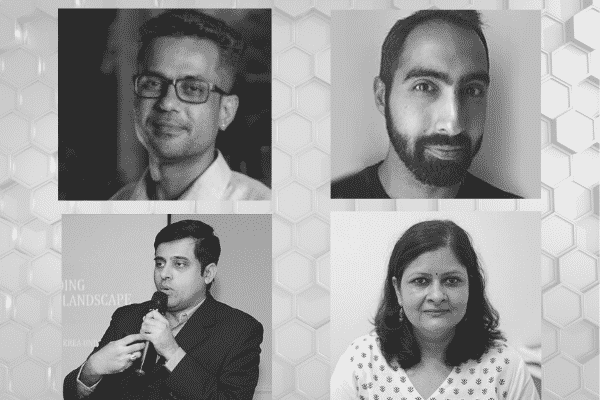
In an effort to encourage Krea University’s talented faculty in their research interests and academic endeavours, Chennai-based manufacturing company Sundram Fasteners Limited (SFL) have come on board to support 4 faculty positions in Science and Business. The proud recipients of this grant are- Prof Bharath Sundaram for Sundram Fasteners Assistant Professor of Environmental Studies; Prof Rishi Vyas for Sundram Fasteners Assistant Professor of Mathematics; Prof R Sathyanarayanan for Sundram Fasteners Associate Professor of Marketing; and Prof Vijaya Subramanian for Sundram Fasteners Associate Professor of Operations Management.
Krea University embarks on an ambitious faculty hiring plan for 2021-22
The School of Interwoven Arts and Sciences (SIAS) at Krea University has embarked on an ambitious program of faculty hiring for the academic year 2021-22.
At Krea, we take pride in the fact that our world-class faculty uphold our vision of Interwoven learning, representing the very best their disciplines have to offer in teaching, research, and practice. With successive rounds of hiring in full swing, our increased faculty strength will substantially expand areas of expertise and widen the ambit of our curriculum, course offerings, choice of majors, and research agenda.
As a result of an extensive search, a diverse pool of over 40 new hires in full time and visiting positions are slated to join the SIAS faculty cohort in the sciences, social sciences, humanities, and the arts. They are outstanding teachers and scholars/practitioners hailing from world renowned institutions in Europe, United States, and Asia (including India) in the disciplines of economics, psychology, environmental studies, computer science, biological sciences, physics, chemistry, mathematics, social studies, politics, literature, and the arts.
Here are some of the new faces we will encounter in the coming year:
Abhishek Shukla (literature, philosophy), Bharath Sethuraman (mathematics), Shibi Vasudevan (mathematics), Venkat Srinu Bhadram (physics), Vidya Bharati Rajkumar (economics, environmental studies), Soumyajit Bhar (environmental studies, economics), Anusnigdha (psychology), Srikumar Subramanian (computer science), Lakshman Varanasi (biology), Sudip Roy (chemistry), Venkateswarlu Panchagnula (chemistry), Swarna Rajagopalan (politics).
In the process of realising our aim of providing a world-class undergraduate education, we will continue to hire faculty and teaching fellows in all the above areas, more than doubling our current strength.
Please watch this space for an updated list of new additions to our faculty roster.
‘Re-imagining omnichannel in the next normal’, with Ram Narayan Iyer
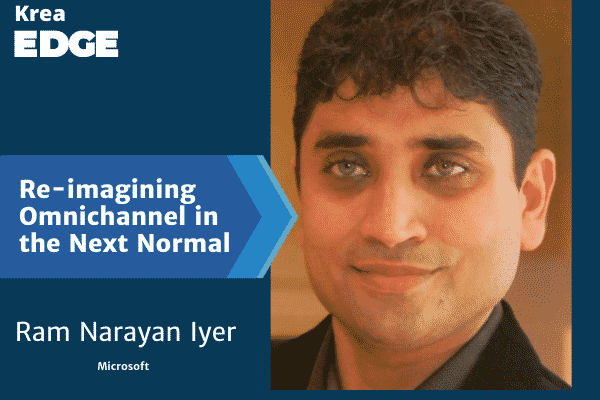
In an engaging session with the students of Krea University, Ram Narayan Iyer (Worldwide Director – Digital Strategy and eCommerce at Microsoft) spoke about the need to start re-imagining the customer experience to maximise the opportunities we all have with the digital storefront. With people and businesses across the globe dealing and managing the implications of these unprecedented times, Microsoft’s B2C marketing leader shared his perspectives on where the omnichannel strategy stands in today’s world, in addition to sharing insights about Microsoft’s futuristic visions.
Dr Sunder Ramaswamy speaks on “Covid, Education and the Big Change”, a virtual panel session hosted by The Indian Express
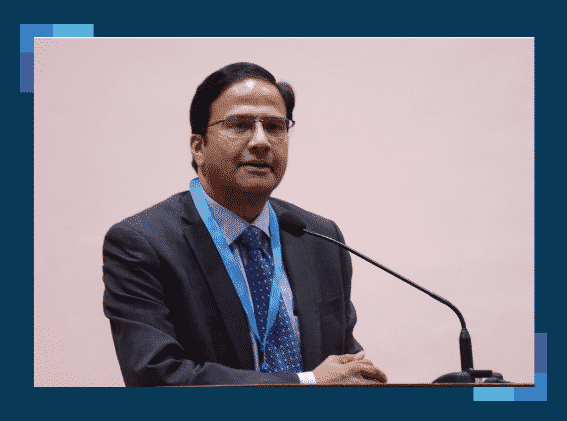
Vice Chancellor Dr Sunder Ramaswamy was a speaker in the panel on “Covid, Education and the Big Change”, along with other Indian educators organised by ‘IE Thinc’ – an initiative by The Indian Express. Sharing his insights on the way forward for post-Covid education, Dr Ramaswamy highlighted the ongoing changes and what this means for the universities of today. Watch a recording of the session here.
Krea University appoints Dr. Mahesh Rangarajan as Vice Chancellor
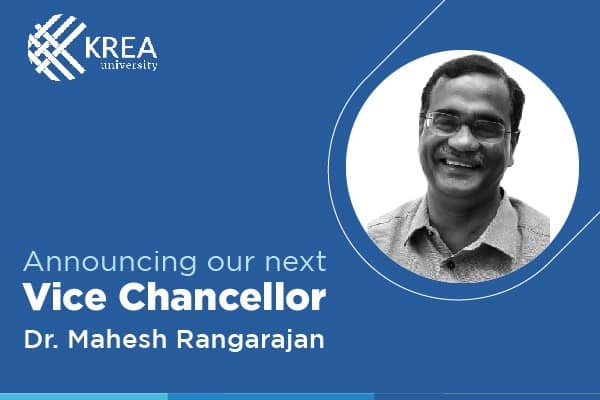
Eminent scholar of history and environmental studies to lead Krea University’s efforts to re-imagine education
31st March 2021, Sri City: Krea University announced the appointment of Dr. Mahesh Rangarajan as its next Vice Chancellor, effective July 2021.
A scholar of global renown, Dr. Rangarajan has an MA and a DPhil, both from Oxford University, where he was a Rhodes Scholar. His wide experience in academia includes faculty positions as Professor of Modern Indian History at the University of Delhi and Professor of History and Environmental Studies at Ashoka University, where he previously served as the Dean of Academic Affairs. He has also taught at Cornell University, Indian Institute of Science and National Centre for Biological Sciences. His first book ‘Fencing the Forest’ was published in 1996 and the most recent ‘Nature and Nation’, in 2018. His co-edited works include ‘India’s Environmental History’, and ‘At Nature’s Edge’. Having started his career as a journalist, he has also served in roles outside academia, including as the Director of the Nehru Memorial Museum and Library, New Delhi.
Dr. Rangarajan’s appointment by the Chancellor of Krea University, Mr. N. Vaghul, comes after a rigorous global search launched by the University last year. The search was led by a committee co-chaired by Dr. Vishakha Desai, Senior Advisor for Global Affairs to the President of Columbia University and Mr. Kapil Viswanathan, Chairman of the Executive Committee of the Governing Council. Commenting on the appointment, Mr. Kapil Viswanathan, said, “As a scholar and an administrator with a global outlook, Dr. Rangarajan is well placed to further Krea University’s mission to help humanity prepare for an unpredictable world. We look forward to Dr. Rangarajan’s leadership, building on Krea University’s strong foundations of ethics, innovation, excellence, inclusivity and accountability.”
Dr. Vishakha Desai, co-chair of the search committee added, “As a renowned scholar of history and environmental studies, Dr. Rangarajan embodies the spirit of interwoven learning that Krea University stands for. His experience in the academy and in public institutions would serve to strengthen Krea University’s commitment to bridging the intellectual world with the one beyond.”
On his appointment as Vice Chancellor, Dr. Mahesh Rangarajan said, “It is my honour and privilege to accept this position, and join the extraordinarily talented faculty, staff and students of Krea University in pursuit of our shared mission. I will strive to uphold the high standards of innovation and excellence that Krea University stands for.” Krea University’s current Vice Chancellor, Dr. Sunder Ramaswamy will complete his tenure in June 2021 and will continue to be associated with Krea as Distinguished Visiting Professor of Economics. As the inaugural Vice Chancellor, Dr. Ramaswamy played a key role in shaping Krea University in its formative years.
Student Spotlight: Shreyasi Patil
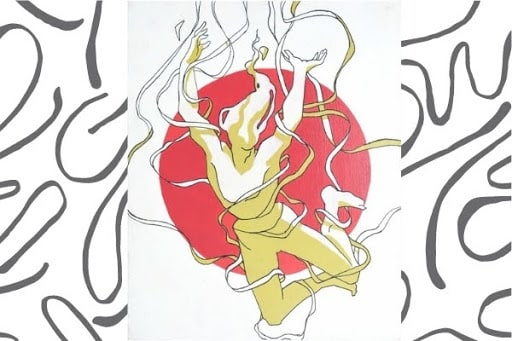
A journey to the centre of art & art curation
“An illustrative journey through canvas that we wish for each one of you to experience” – words that best describe ‘Perceptions’, an art show featuring 30 acrylic paintings by a solo artist, all curated by Krea student Shreyasi Patil.
Shreyasi Patil is an enterprising second-year student at the School of Interwoven Arts and Sciences (SIAS), Krea University. Her academic interests include Business, Social Science and Economics. Outside of academics, you will probably find her learning and picking up life skills such as negotiating and managing accounts, and poring over her understanding of arts and emotions, with a tinge of literature, politics, cooking, and entrepreneurship. Shreyasi has now ventured into curating artworks, with her first show all set to open on 26 March 2021 at the Rangoli Metro Art Centre located in the heart of Bengaluru, Karnataka.
“The show is called ‘Perceptions’. We want people to experience perceptions, so we are looking at emotions – a great example of perceptions. For instance, when we use the word love, irrespective of what language we use it in, the experience isn’t the same for everyone. The myriad of experience is what the art show explores. The artworks are not abstract; they’re very visually clear, using mythology as a tool to describe emotions,” shares Shreyasi.
While this might be her first art curation, it isn’t her first project. Inspired by her interactions with Prof Srajana Kaikini (Assistant Professor of Philosophy at Krea), Prof Akhila Ramnarayan (Associate Professor of Practice at Krea), and Meera Trivedi (a student from her cohort), Shreyasi began exploring the world of representing and curating art, delving into the nuances that go into making a stellar art show which appeals to other creators and audience alike. Her projects with her two Krea faculty members and her classmate is still a work-in-progress.
Sharing the story behind ‘Perceptions’, Shreyasi recalls that it was a chance encounter on Instagram that led to her meeting the artist in person. “In Bengaluru, there’s Church Street where vehicles are not allowed and artists simply sit down and produce and showcase their work. I went there with a friend one day and we ended up buying a lot of art from a particular artist called ‘The Artist Spud’. After meeting him a few times, I approached him, asking him if he would like to do an art show together. His work is primarily inspired by mythologies. So one fine day, we got cracking, broke down what we could showcase and thus, ‘Perceptions’ happened.”
It is believed that behind every art exhibit or gallery, there is a committed curator, who works relentlessly with the artist to not just put up a great show for the audience but also take the conversation about art and its artist forward. Through her maiden art show, 19-year-old Shreyasi also picked up some real-life skills – a learning experience that resonates with Krea’s ethos.
“I learnt to see the pragmatic side and the creative side of art. Admittedly, I found it challenging to find a middle ground between the artist’s creativity and the more practical side of curating art; it was still a good learning experience wherein I learnt the art of negotiation whilst being careful about where the money is going,” she elucidates.
Shreyasi’s art show ‘Perceptions’ is happening on the 26-28 March 2021 at the Rangoli Metro Art Centre at MG Road, Bengaluru. For more information, visit the Instagram page: @perceptions_2021
Understanding management consulting & the venture capital domain

The Undergraduate Career Services Office (CSO) organised an exclusive interaction with Ms Paula Mariwala — Founder/Co-President of Stanford Angels & Entrepreneurs India and Executive Director of Seedfund Investment Advisory Company. In this fireside chat, she highlighted the skills and competencies that undergraduate students must develop to find a place in the dynamic management consulting domain. Paula also introduced students to the emergence of boutique consulting firms and encouraged students to explore futuristic opportunities with these firms. Responding to questions about the venture capital industry, Paula patiently walked them through the different categories of funding firms. She shared her experience as a startup investor, also highlighting the growth of impact funding/investment firms which Krea undergraduate students should actively pursue.
‘Writing, Research, Community’: Krea Engage with the research centres
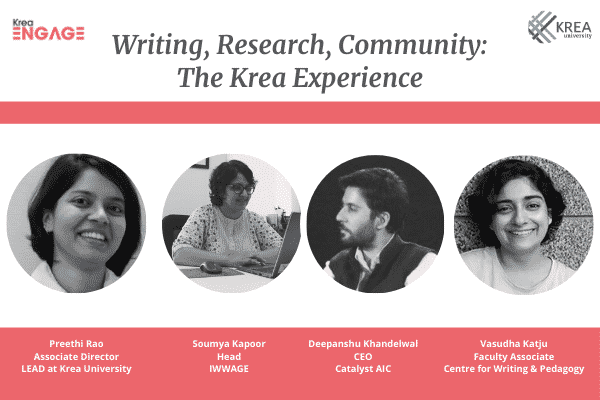
| Senior representatives from Krea research centres assembled for a virtual panel discussion, attended by prospective undergraduate students and their families. The panel highlighted the path-breaking research work and opportunities for Krea students to engage in them through projects and internships. Moderated by Kala Anand (Director – Communications, Partnerships & Career Services at Krea University), the panel discussion featured Preethi Rao from LEAD at Krea University, Deepanshu Khandelwal from Catalyst Atal Incubation Center (AIC), Soumya Kapoor from IWWAGE, and Vasudha Katju from Centre for Writing & Pedagogy (CWP). |
Prof Srajana Kaikini’s recent papers published by noted international journals

Krea faculty Prof Srajana Kaikini — Assistant Professor of Philosophy, Humanities & Social Sciences & Literature & the Arts — has had two of her recent papers published by renowned international journals. Her most recent paper explores strategies within the arts practice, while the other paper talks about COVID-19 and its social impact.
Her paper titled, ‘The Aesthetics Of Risk in Artistic Practice: What is at Stake?’, has been published in the Kunstlicht Journal 41(4) (2020). ASSESSING RISK: ON STRATEGIES FOR HEALTH, SAFETY, AND WELFARE WITHIN ARTS PRACTICE. The journal regularly features academics, authors, editors and artists sharing their insights on art, visual culture, and architecture. Access the paper here.
Her timely piece on understanding disasters and bringing the ethical language of the collective, bearing COVID-19 in mind, was published by Voices in Bioethics, an online journal in partnership with Columbia University Library. Read the article here.
Prof Kalyan Chakrabarti co-authors paper on “The happiness hormone and Parkinson’s disease”
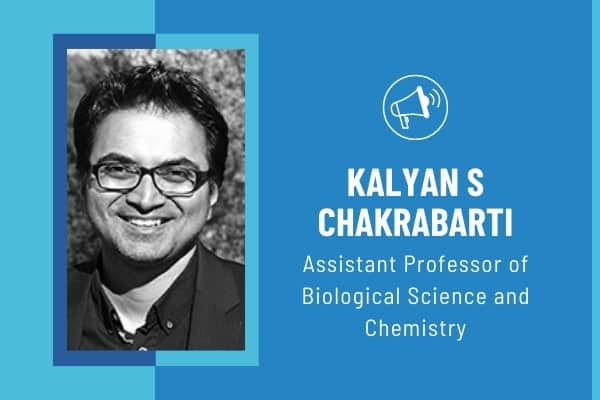
Prof Kalyan Chakrabarti published a paper on Parkinson’s disease with collaborators from University of Medicine and Max Planck Institute, Göttingen, Germany in the Journal of Neurochemistry.
About the Paper:
Parkinson’s disease (PD) is an incurable brain disorder that causes uncontrollable shaking, stiffness, and difficulty with walking, balance and coordination, along with psychological complications of dementia, depression and anxiety. In 2015, PD affected 6.2 millions people (more than 1 million cases in India) and caused about 1.2 L deaths globally. The symptomatic loss of motor function is due to the damage in the portion of midbrain that releases dopamine, commonly known as the “happiness hormone”. As a result, the standard treatment to control the symptoms of PD are related to dopamine like molecules. The cause of PD is unknown and the biological mechanism of PD is an active area of research. In the biomedical literature the role played by the protein alpha synuclein is well established. The related protein beta synuclein is reported to play a beneficial role in patients suffering from PD. In this paper the researchers have described their recent results that show that the interaction of dopamine with beta synuclein may act as a culprit in Parkinson’s disease.
Reference: Raina A, Leite K, Guerin S, Mahajani SU, Chakrabarti KS, Voll D, Becker S, Griesinger C, Bähr M & Kügler S “Dopamine promotes the neurodegenerative potential of beta-synuclein”, Journal of Neurochemistry, DOI: 10.1111/jnc.15134
Read the complete paper, here.