Dr Debankur Saha delivered a talk at Symposium on Biodiversity and Wetland Conservation

Krea University recently hosted a Symposium on Biodiversity and Wetland Conservation as part of the Flamingo Festival, organised by the Andhra Pradesh Government in association with Bombay Natural History Society and Sri City.

As part of the symposium, Dr Debankar Saha, Assistant Professor & Area Chair – Marketing, IFMR GSBdelivered a talk on ‘Ecotourism as a Pathway to Sustainable Development at Pulicat Lake.’ His presentation highlighted the role of ecotourism in fostering conservation efforts, supporting local communities, and promoting sustainable practices in the region.
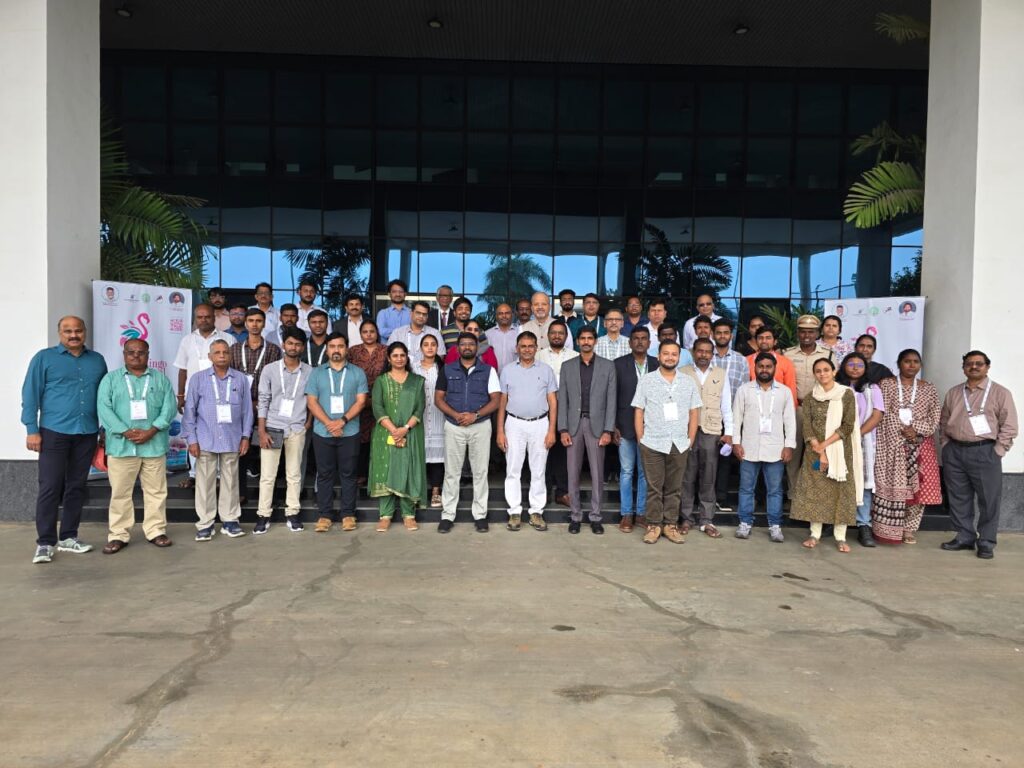
The symposium attracted participants from various leading organizations involved in biodiversity conservation, sustainable tourism, and environmental research. Experts, policymakers, and academicians engaged in discussions on strategies to protect Pulicat Lake’s fragile ecosystem, enhance community-based conservation efforts, and promote responsible tourism.

IFMR GSB PhD student Pratibha Jain presented a research paper at IIM Sambalpur

Pratibha Jain, PhD student, IFMR GSB, presented a research paper at the IMPeC 2025 Conference held at IIM Sambalpur. The paper, titled The Retention Puzzle: A Comprehensive Review of Non-Profit Employee Dynamics, was co-authored and developed under the guidance of Dr Pallavi Pandey, Assistant Professor, OB & HR, IFMR GSB. The conference was conducted from 30 January, 2025 to 1 February, 2025. 

Dr Vijaya C was Track Chair and Reviewer for Finance Case studies at COGNOSCO 2025

Dr Vijaya C, Assistant Professor, Finance, IFMR GSB was invited as the Track Chair and Reviewer for Finance Case studies presented at the 15th Annual Case Conference, COGNOSCO 2025 organised by The School of Business and Management (MBA) and the Centre for Case Research and Development (CCRD) of Christ Deemed to be University, Bengaluru on 24 January 2025. 

COGNOSCO, initiated in 2012, is a platform for case writers to present their case studies and promote the development of quality teaching cases among the teaching fraternity and also business practitioners.

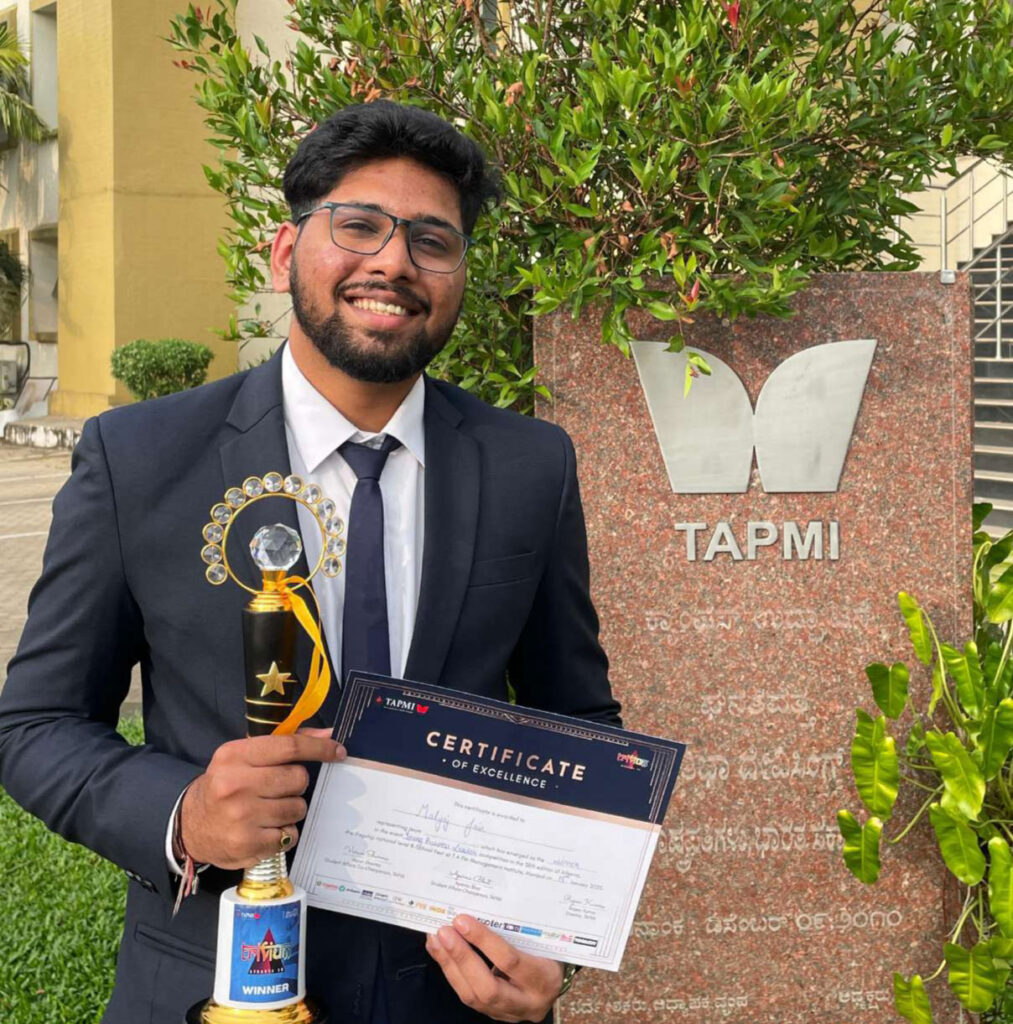
Malyaj Jain, MBA Cohort of 2025, IFMR GSB wins TAPMI’s Young Business Leader Competition 2025

Malyaj Jain, MBA Cohort of 2025, IFMR GSB has won the Young Business Leader competition, the flagship event at T. A. Pai Management Institute (TAPMI), held on 18 and 19 January 2025. This remarkable achievement comes with a cash prize of Rs 60,000.

The two-day competition featured multiple challenging rounds. On the first day, participants solved puzzles to earn points, followed by a case-solving round and an auction. The second day concluded with a rigorous stress interview, after which Malyaj was declared the winner.

This accomplishment is a significant milestone in his MBA journey, and he takes pride in representing IFMR GSB on such a prestigious platform. Congratulations, Malyaj Jain! 

A project co-led by Dr Suresh Govindapuram sanctioned under ICSSR Collaborative Empirical Research Project on Solar Energy and Sustainability 2024-25

Dr Suresh Govindapuram, Assistant Professor of Economics, IFMR GSB is one of the Co-PIs (Co-Project Directors) for the project “Drivers and Barriers of Rooftop Solar Power: An Analysis of Micro and Small Size Hotels in India” sanctioned under Indian Council of Social Science Research (ICSSR) Collaborative Empirical Research Project on Solar Energy and Sustainability 2024-25. 
Other collaborators include Dr Salman Haider (VIT Vellore), Dr Shadab Danish (IIM Raipur), Professor Arup Mitra (SAU Dehli) and Professor Prabakar S (VIT Vellore).

Know More

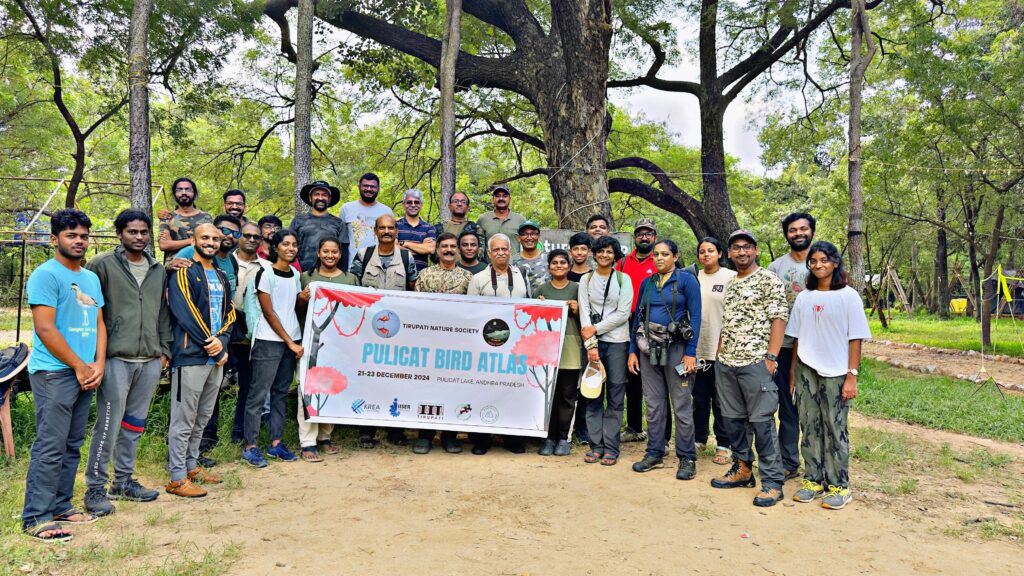
Citizen scientists from Krea participate in the  Pulicat Bird Atlas

Citizen scientists from across India, including students and faculty members from Krea University participated in the Pulicat Bird Atlas, a three-day bird count survey. The event was a collaborative effort anchored by the newly formed Tirupati Nature Society, along with IISER Tirupati, IIT-Tirupati and Krea University. The survey took place in the ecologically rich areas of Pulicat Lake and Sri City, where the team had the opportunity to observe over 150 bird species.

This study was significant as it contributed to the ongoing efforts to monitor and conserve biodiversity in the region. The bird count provided valuable data on bird populations, distribution, and habitat preferences, which are crucial for understanding ecological trends and guiding conservation strategies.

The Pulicat Bird Atlas, or Pulicat Lake Bird Atlas is a citizen science initiative dedicated to systematically documenting bird species in and around the Pulicat Lake and the nearby industrial hub of Sri City. This project draws inspiration from the successful methodologies of the Tirupati Bird Atlas and aims to create a comprehensive database of avian diversity in the area.

IFMR GSB PhD Scholar Pratibha Jain presents case study co-authored by Dr Pallavi Pandey at Ivey Case Study conference in IIM Nagpur

Pratibha Jain, IFMR GSB PhD scholar presented a case at the Ivey Case Study conference in IIM Nagpur.  The case was written under the guidance (co-author) of Dr Pallavi Pandey,  Assistant Professor, HR & OB & Area Chair – OB & HR, IFMR GSB. The case is titled, ‘Empowering Marginalized Communities through Sustainable Management: Lessons from a Grassroots NGO in Rajasthan.’ The conference was conducted from 21 – 22 December 2024.This case concerns a small non-governmental organisation in Rajasthan facing sustainability and strategic management issues due to operating in resource-scarce environments. The case raises a critical question: How can small NGOs balance community trust, operational sustainability, and scalability in resource-constrained environment? Case discussed the dilemma where the founder of the organization Kumar Bharat have to decide, should he focus on improving his communication skills to overcome the language barrier and unlock new funding sources? Or should he explore alternative strategies, like strengthening local partnerships or increasing reliance on community support?

Pratibha Jain, PhD student, IFMR GSB presents her paper at the 2nd International Conference (SEEDS 2024)

Pratibha Jain, PhD student, IFMR GSB recently presented her paper titled ‘Exploring Employee Retention Dynamics in NPOs: A Descriptive Review’ at the 2nd International Conference (SEEDS 2024) organised by Middlesex University Dubai and Jaipuria Institute of Management, Noida, India.

Abstract:
Due to the unique context and characteristics of the nonprofit sector, it differs from the for-profit sector in terms of the importance of values and employees’ willingness to accept lower wages and volunteer their time to meet community needs. This review paper explores employee retention in the nonprofit sector, focusing on the factors influencing employees’ decisions to stay with the organisation. Using a descriptive review approach, the study examines employee retention and turnover in the NPO context.

IFMR GSB PhD Scholar Soumyabrata Basu presents paper co-authored with IFMR GSB faculty at various conferences

Soumyabrata Basu, PhD scholar, IFMR GSB presented a paper that looks into the impact of Insolvency and Bankruptcy Code on Indian firms at the Cross Disciplinary Knowledge Data Research (XKDR) Forum’s Conference held in Mumbai on 10 December 2024. On 19 December he also presented the paper at the India Finance Conference (IFC) held in IIM Raipur. The paper is co-authored with Dr Praveen Bhagawan, Associate Professor, Finance, Accounting and Quantitative Finance & Area Chair – Finance, Accounting and Quantitative Finance, IFMR GSB and Dr Jyoti Prasad Mukhopadhyay, Associate Professor, Economics and Chairperson – PhD, IFMR GSB.

Dr Vijaya C presents a case study at IIM Nagpur IVEY Case Conference

Dr Vijaya C, Assistant Professor, Finance, Accounting and Quantitative Finance, IFMR GSB recently presented a case study titled, ‘Sovereign Gold Bonds: To be or not to be’, at the IIM Nagpur IVEY Case Conference held at IIM Nagpur in December 2024. 

In November 2024, Reserve Bank of India (RBI) was in a dilemma whether to continue or stop the issue of Sovereign Gold Bond (SGB). In November 2015, RBI, in consultation with the Government of India, had introduced the SGB scheme to reduce the widening current account deficit primarily due to the import of physical gold. It also enabled investors to divert their savings to digital gold which had the advantages of safety, low risk, regular interest income and tax benefits. With stable gold prices in the past, the Government had looked at SGB as a cheaper source of financing compared to traditional bonds. However, the COVID-19 pandemic had upset the SGB cart as the significant surge in gold prices meant redemption costs much higher than what the Government had estimated. There were no issues of SGB in the financial year 2024-25 and speculation was rife among investors and analysts as to whether RBI had decided to stop any more issues of SGB. The onus was now on RBI to take the correct decision on the future of SGB and propose the same to the Government with a detailed analysis. The question remained about SGB – to be or not to be!