Leading global academics participate in IFMR GSB Research Symposium 2020

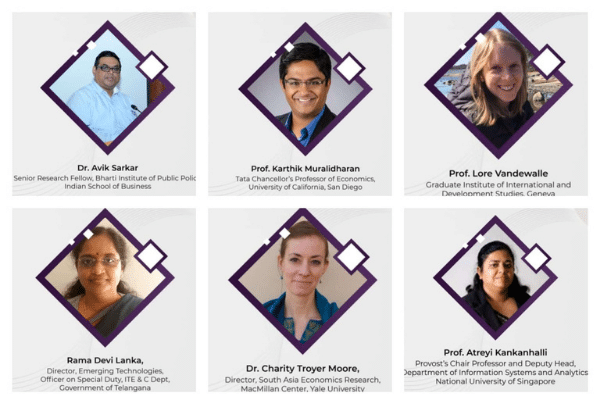
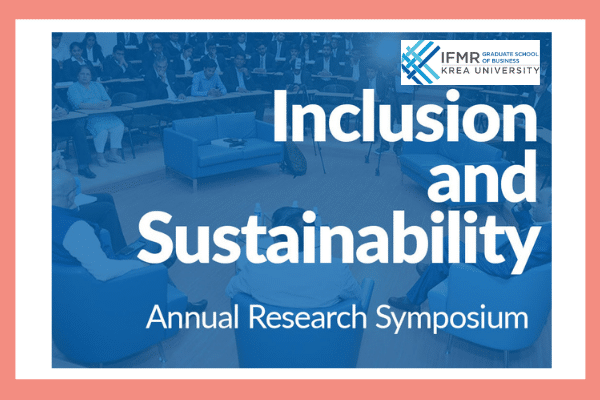
IFMR Graduate School of Business (GSB) hosted the one-day Annual Research Symposium (virtual), focusing on ‘Inclusion’ and ‘Sustainability’. The symposium touched upon a wide range of topical issues and themes such as Financial Inclusion, Sustainable Finance, FinTech, and Digital Inclusion. Students, faculty, researchers and several attendees witnessed presentations and evidence-based research that answered burning questions on inclusion and sustainable development in our societies. Speakers from the United States of America, Singapore, London, United Kingdom, New Zealand, Switzerland and other parts of the world brought multiple perspectives to the discussion, exchanging ideas and sharing their point of view and ways to move forward. Senior practitioners from the Indian industry and academics from reputed Indian institutions like Azim Premji University and Indian School of Business also contributed to this thought leadership.

Vice-Chancellor of Krea University, Dr Sunder Ramaswamy, in his opening message, spoke about the relevance of hosting symposiums in today’s world and how it helps take the discussion forward. “The mission of Krea is to prepare humanity for an unpredictable world. When we designed it, we had no idea that 2020 would really test that mission statement. We’re in the midst of three crises – a health crisis, an economic crisis, and a social justice crisis. I think all of us are just waiting for 2020 to get behind us so that we can start the new year on a different note. Conferences and symposiums like this are critical in terms of finding solutions to the various facets of exclusion and the impact these facets have on sustainability,” he shared.

In addition to discussing policies and reforms in the country, the symposium also put the spotlight on various Indian government initiatives. Rama Devi Lanka – Director, Emerging Technologies, Officer on Special Duty, ITE&C Dept, Government of Telangana – shared her insights on the government’s contribution to inclusion in technology. In her session, she shared her experience of developing a strategy, toolkit and procurement guidelines to enable cloud adoption by various state and central government departments. With respect to Fintech in agriculture, in her session, Suniti Nanda – Fintech Officer, Government of Maharashtra – shed light on how multiple Fintech companies are gearing up to build businesses to support agriculture. Watch the recordings of the sessions here.

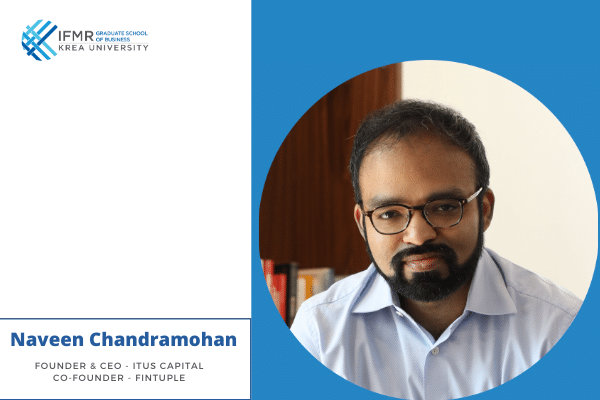
‘Building a successful career’ with Naveen Chandramohan

In an insightful interaction with the students of IFMR Graduate School of Business, Krea University, Naveen Chandramohan- CEO & Founder of Itus Capital & Co-founder of Fintuple Technologies, shared his perspectives on building one’s career and the innovative ways to go about it. Highlighting the key aspects of an effective leader, Mr Chandramohan shared a few stories from his life and stressed on living every day as though it were your last. A seasoned practitioner, he encouraged students to strive to do better and communicate well – relevant to both the professional and personal aspects of life.

The world of ‘Open Banking’ with Aumkar Gholap

In a highly engaging session, Aumkar Gholap – Head of Technology Solutions for Credit Risk, Treasury (ALM), Liquidity Management and Regulatory Reporting India – interacted with the students at IFMR GSB, Krea University, shedding light on various aspects of ‘Open Banking’. Drawing from his rich experience in the financial sector, he explained how the integration of banking processes and technology have helped secure data. He also his shared insights on the use of open APIs that enable third-party developers to build applications around financial institutions and what it takes to create a long-term sustainable model for the service industry.

IFMR GSB’s student-led marketing committee launches ‘Prayatna’

Markaholic, IFMR GSB’s student-led marketing committee, along with the Graduate School of Business’ notable alumni, recently launched an informative marketing workshop series titled ‘Prayatna’. The committee’s first workshop featured Amandeep Singh Kochar – Business Director at VMLY&R, New Delhi and an alumnus of IFMR GSB. Having worked with well-known brands such as TCS, Fresh Marketing Idea, BrandAppZ.com, KRDS, and Brandmovers, Amandeep shared his own experience and ideas on marketing, business development, creative strategies, and more in his session – ‘Succeeding in the World of Direct to Consumer (DTC)’.

Moving forward, the committee plans to host a marketing workshop every fortnight for a couple of hours, in a bid to inform students about all the trending marketing job roles in the industry, spread awareness about all the necessary skills required to excel in the field, engage in discussion through various practical demonstrations and activities, and, ultimately, build a strong student alumni network.

IFMR GSB’s Analytics Club holds its first event of the year

IFMR Graduate School of Business (GSB) has always fostered an engaging learning environment not only through academics but also through the University’s several student-led committees and clubs. In the first of many, the Analytics Club at GSB conducted its first-ever event of the year – ‘The Commencement’. The Analytics Club advocates itself as a platform to help students learn more about data tools and techniques in the business world. The event, with around 40 students in attendance, included multiple quiz rounds and a few creative, number-crunching activities. The scoring of the event depended on the number of likes and votes each team earned via social media. Two teams – InPrecision and Byte-Bits – were declared the winners owing to their high cumulative scores. Moving forward, the club aims to further its mission of using data as a storytelling tool through several such events.

Interning in Supply Chain Companies – All the Scope and Opportunities

The blog is written by Prof. Chandrasekaran N, Professor, Operations Management, IFMR GSB

The supply chain is about a firm strategically managing inbound and outbound processes and other firms fulfilling the ultimate customer demand. It is important to note that there are multiple nodes and flows across the supply network while managing demand and supply for goods or service. The supply chain involves managing 4 processes: supplier relationship management, internal supply chain processes, channel management processes, and customer relationship management. These 4 processes help accomplish the supply chain goals of cost and responsiveness.

The two supply chain goals are divergent. Companies that achieve global scale and class help converging the two goals or towards convergence, at least. The decisions can be: immediate from a shift to a week, referred to as ‘Operational’; a month to six quarters, referred to as ‘Planning bucket’, and finally, ‘strategic’ which are long-term decisions.

Internship Opportunities

As an intern, one would get the opportunity to be with a manufacturing firm’s supply chain function or with a third-party or fourth-party supply chain solutions company. A third-party supply chain service provider is one who executes supply chain processes as desired by the client. On the other hand, a fourth-party solutions provider would advise the network’s design and facilitate the advisory service’s execution through its independent SBU or by another company.

The internship opportunities could be in vast functions of the supply chain processes. In supplier relationship management, an intern can help in supplier intelligence, market analysis such as price and trends pertaining to the availability of material, analysis of total landed cost of a material, competitor intelligence on the usage of material, and purchase source. Those who have an interest in accounting and costing may get involved in the computation of the total cost of ownership of the material, especially those used in MRO (Maintenance, Repairs, and Overhaul) items.

Similarly, the purchase of capital equipment may require a lot of analytical skillsets. An intern would be able to provide support on cost-benefit analysis and simulation of various conditions.

The supply chain involves managing warehouse operations, which includes the following:

  1. Secure warehouse for handling material, components, and value-added activities.
  2. Open warehouses like yard, especially for engineering, capital goods, automotive, metals, and agriculture-based products.
  3. Tankers that are used for liquids and gases.

Without getting into details of the nine-yard warehouse types, all operations in a warehouse focus on utilising cubic space, material handling equipment, and managing people towards receipt, storage, and order management of products. Interns can work in a warehouse looking at technology and engineering design used to construct and utilise a warehouse.

Modern warehouses have adopted technology in material handling and other design features. There are added sustainability and environmental angle to modern warehouse management. An intern can look at the carbon footprint generated in such warehouses and compare it with the traditional ones. Warehouse management engages a lot of outsourcing functions as well.

Firstly, most warehouse management managed by third-party logistics service providers is leased and with the property owners viewing a warehouse as a real estate. Hence, it is essential to analyse the occupancy trends, rentals’ movement to owners, and parity charging the clients. Such analytical skills and logistics infrastructure management will be crucial.

Secondly, workers in a warehouse are generally semi-skilled and unskilled suppliers supplied by the contract manufacturers. This again requires the deployment of analytics towards productivity, cost, and contract management.

Another useful opportunity for interns lies in analysing inventory, models, counting, and accuracy. This may be relevant selectively depending upon the firm which engages the interns. Furthermore, transportation management has enormous opportunities for interns. This includes analysing the transport markets, load factors, market loads versus retention services, contract management, vehicle placement analysis, documentation and completion of waybills, profitability analysis on trip cost, and overall transportation costs. Analysis of service level agreements and their fulfilment will be useful.

With all this, one may note that there is enough scope on demurrage claims, delay charges, and levy of penalties by the different stakeholders. Today, this sector uses portals for vehicle engagement, tracking, and performance management. There are opportunities in milk run, vehicle consolidation, and just in time deliveries. Several new generation companies are using mobile technology applications for performance management of transportation across the supply network.

Today order management, especially after the rise of eCommerce, has become an essential aspect of supply chain management. The use of technology and people management are necessary for order management. There are several incentives based on order deliveries and their contribution towards the bottom line. Interns may be deployed to study improvements in order management. The above are some of the indicative areas where interns can be gainfully engaged in supply chain network functions.

Storytelling through data

In session packed with insights, Arockia Liborious, Data Analytics Leader, Nalco Water, an Ecolab Company shared lessons on the art and science of storytelling through data. Interacting with the students of IFMR GSB, he addressed the need to extract data through simplified processes of information acquisition which can be further transformed into visual depiction. For impactful storytelling, he called for visually appealing data that’s insightful and holds the interest of the audience while addressing the major questions in their minds.

Think big, win bigger- strategies for global business development

In an engaging session, Mr Malur Narayan – Vice President, Technological Business Unit, TCS imparted lessons from his life journey and encouraged young students to be focused, optimistic and fearless. In an interaction with the students of IFMR GSB, Mr Narayanan shed light on core concepts of research, problem synthesis, value proposition, and transformational and disruptive mindset to shape global businesses. He also shared insights on emerging technologies of IoT, autonomous vehicles, and drones in new businesses across the world.

IFMR GSB Student placed third in Trading Challenge

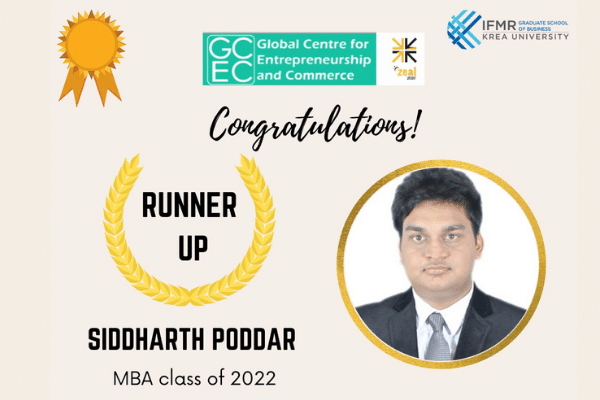
Siddharth Poddar, student of IFMR GSB, MBA Class of 2022 secures third position in Shri Ram Trading Challenge, an online mock-stock competition in which the 2050 participants from various B schools were competing against each other on a virtual platform with Rs. 10 lacs as virtual currency, but with real stocks and live price movements. Participants were required to construct a virtual portfolio over a period of two weeks, from August 31 to September 11, and the individual with the highest portfolio value at the closing bell of the market on September 11 was declared the winner.

The event was organized by The Shri Ram College of Commerce, Delhi in association with Dalal Street Investment Journal.