
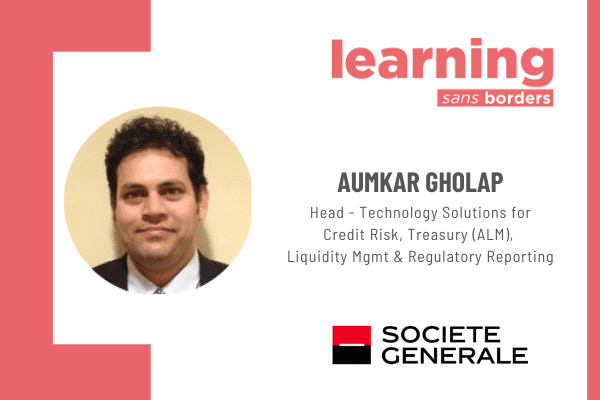
In a highly engaging session, Aumkar Gholap – Head of Technology Solutions for Credit Risk, Treasury (ALM), Liquidity Management and Regulatory Reporting India – interacted with the students at IFMR GSB, Krea University, shedding light on various aspects of ‘Open Banking’. Drawing from his rich experience in the financial sector, he explained how the integration of banking processes and technology have helped secure data. He also his shared insights on the use of open APIs that enable third-party developers to build applications around financial institutions and what it takes to create a long-term sustainable model for the service industry.
IFMR GSB’s student-led marketing committee launches ‘Prayatna’
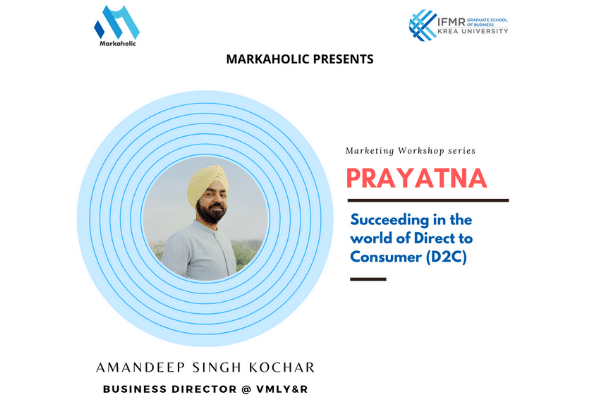
Markaholic, IFMR GSB’s student-led marketing committee, along with the Graduate School of Business’ notable alumni, recently launched an informative marketing workshop series titled ‘Prayatna’. The committee’s first workshop featured Amandeep Singh Kochar – Business Director at VMLY&R, New Delhi and an alumnus of IFMR GSB. Having worked with well-known brands such as TCS, Fresh Marketing Idea, BrandAppZ.com, KRDS, and Brandmovers, Amandeep shared his own experience and ideas on marketing, business development, creative strategies, and more in his session – ‘Succeeding in the World of Direct to Consumer (DTC)’.
Moving forward, the committee plans to host a marketing workshop every fortnight for a couple of hours, in a bid to inform students about all the trending marketing job roles in the industry, spread awareness about all the necessary skills required to excel in the field, engage in discussion through various practical demonstrations and activities, and, ultimately, build a strong student alumni network.
IFMR GSB’s Analytics Club holds its first event of the year

IFMR Graduate School of Business (GSB) has always fostered an engaging learning environment not only through academics but also through the University’s several student-led committees and clubs. In the first of many, the Analytics Club at GSB conducted its first-ever event of the year – ‘The Commencement’. The Analytics Club advocates itself as a platform to help students learn more about data tools and techniques in the business world. The event, with around 40 students in attendance, included multiple quiz rounds and a few creative, number-crunching activities. The scoring of the event depended on the number of likes and votes each team earned via social media. Two teams – InPrecision and Byte-Bits – were declared the winners owing to their high cumulative scores. Moving forward, the club aims to further its mission of using data as a storytelling tool through several such events.
Interning in Supply Chain Companies – All the Scope and Opportunities
Storytelling through data
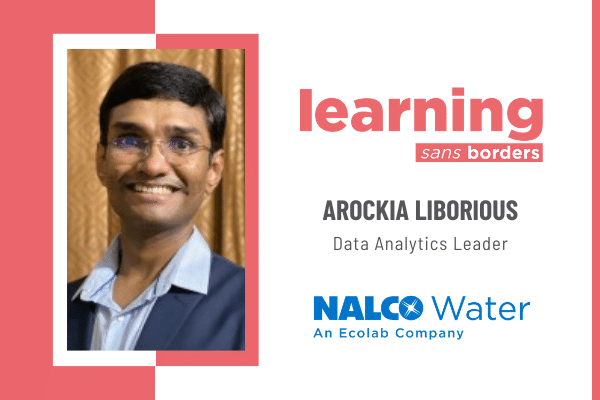
In session packed with insights, Arockia Liborious, Data Analytics Leader, Nalco Water, an Ecolab Company shared lessons on the art and science of storytelling through data. Interacting with the students of IFMR GSB, he addressed the need to extract data through simplified processes of information acquisition which can be further transformed into visual depiction. For impactful storytelling, he called for visually appealing data that’s insightful and holds the interest of the audience while addressing the major questions in their minds.
Think big, win bigger- strategies for global business development
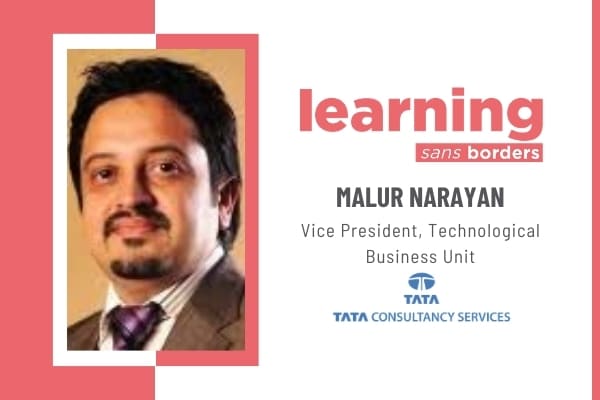
In an engaging session, Mr Malur Narayan – Vice President, Technological Business Unit, TCS imparted lessons from his life journey and encouraged young students to be focused, optimistic and fearless. In an interaction with the students of IFMR GSB, Mr Narayanan shed light on core concepts of research, problem synthesis, value proposition, and transformational and disruptive mindset to shape global businesses. He also shared insights on emerging technologies of IoT, autonomous vehicles, and drones in new businesses across the world.
IFMR GSB Student placed third in Trading Challenge
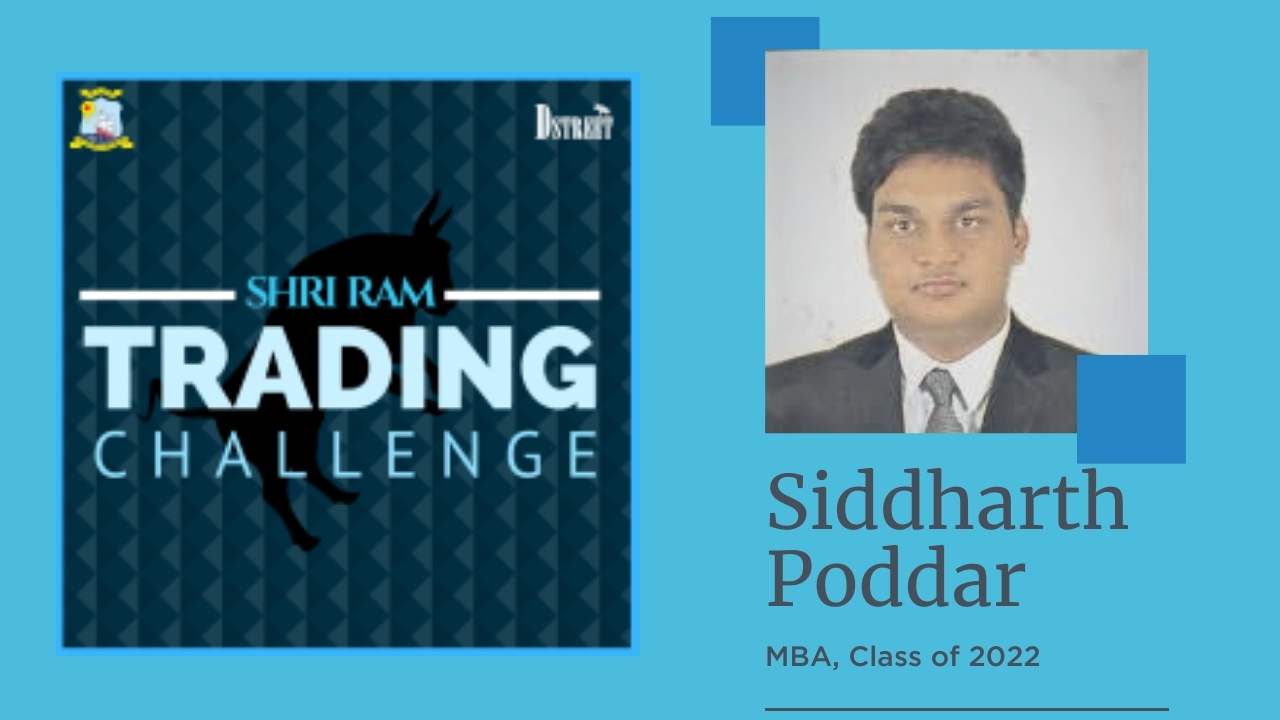
Siddharth Poddar, student of IFMR GSB, MBA Class of 2022 secures third position in Shri Ram Trading Challenge, an online mock-stock competition in which the 2050 participants from various B schools were competing against each other on a virtual platform with Rs. 10 lacs as virtual currency, but with real stocks and live price movements. Participants were required to construct a virtual portfolio over a period of two weeks, from August 31 to September 11, and the individual with the highest portfolio value at the closing bell of the market on September 11 was declared the winner.
The event was organized by The Shri Ram College of Commerce, Delhi in association with Dalal Street Investment Journal.
IFMR GSB students bag CFA Institute scholarships
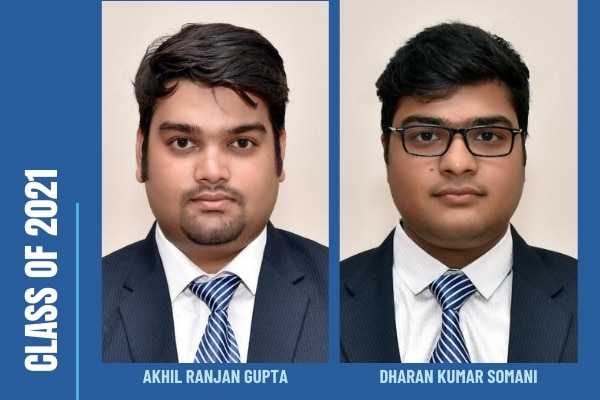
IFMR GSB students, Akhil Ranjan Gupta and Dharan Kumar Somani from the class of MBA 2019-21 have secured the prestigious CFA Institute scholarships.
Sanchalan – the IT and Operations Student Committee presents pan India contest ‘Entangled’

With a rush of adrenaline and picking a lesson from the looming crisis of today, comes ‘Entangled’. A unique case study competition hosted by Sanchalan – the IT and Operations Student Committee from IFMR GSB, challenging graduates with prioritization and resource allocation skills during crisis.
600 participants from across India geared up to compete, make an impact and win the contest. Contestants from 190 institutes and 20% of them from top tier ones vied for the ultimate spot in this innovative case study competition.
Visual Merchandising- a key marketing tool in retail
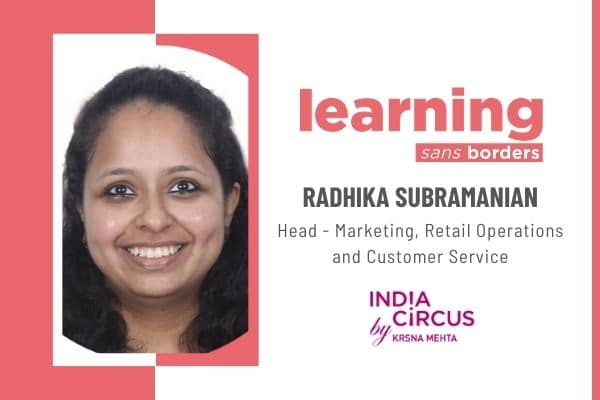
With deep insights into the world of visual merchandising, Radhika Subramanian, Head – Marketing, Retail Operations, and Customer Service at India Circus by Krsnaa Mehta (A Godrej Venture) interacted with the students at IFMR GSB. “The purpose of visual merchandising is to attract, engage and motivate customers towards making the purchase”, with that Radhika shed light on the storytelling nature, principles and process of this key marketing tool in retail. Elaborating on the principles involved, Radhika introduced the concepts of vertical and horizontal display, focal point or pyramiding, balance or symmetry, consistency and repetition, storytelling or cross merchandising, and graphics to the students.