Women’s Work Force Participation in Maharashtra

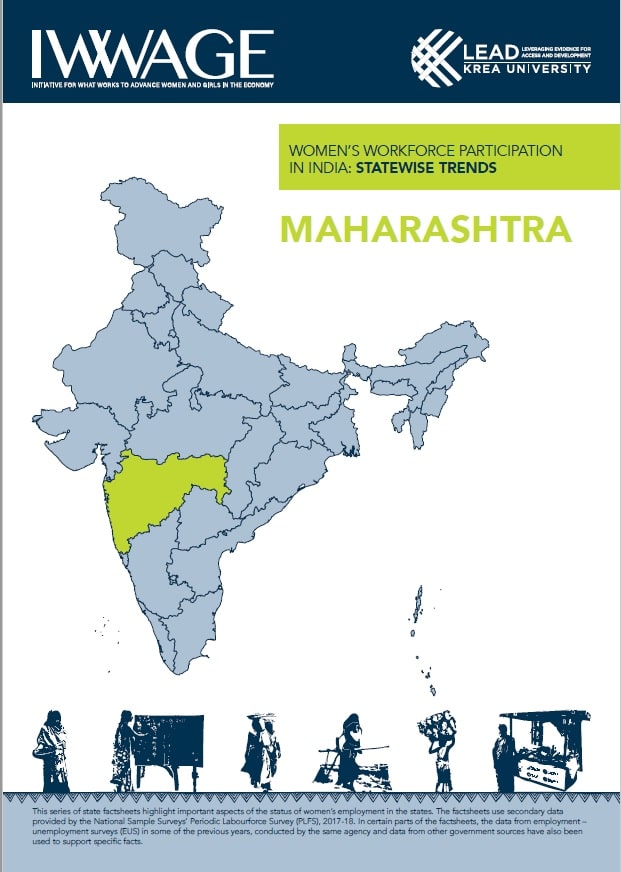
Women’s labourforce participation rates (LFPR) reveals some interesting trends for Maharashtra. As per the figures from the labourforce surveys, the LFPR is significantly higher than the all-India figures, largely driven by higher than average rural employment. The state also shares a decline in self-employment and casual employment and a shift towards regular wage work for both rural and urban women. In Maharashtrathe urban areas witnessed a consistent rise in regular wage work of women since 2004-05. More than 60 per cent of women are employed as regular workers – 70 per cent of which is concentrated in the services sector such as education, health and retail. In rural areas, the share of casual workers is considerably higher at around 42 per cent, followed by 52 per cent in self-employment. The incidence of unpaid family workers among self-employed women exceed 80 per cent.  While the urban areas show considerable diversity of women workers across occupations and sectors, women in the rural areas remain concentrated as manual workers in agriculture or within construction work.

Initiative for What Works to Advance Women and Girls in the Economy (IWWAGE), has developed a series of factsheet that highlight the important aspects of women’s employment across the states in India. It uses secondary data provided by the National Sample Surveys’ Periodic Labour Force Survey (PLFS), 2017-18, and the employment-unemployment surveys (EUS) as well as data from other sources to support state specific analysis. The Maharashtra factsheet is part of this series, and can be accessed here.

Krea announces Post Doctoral and Visiting Research Fellows

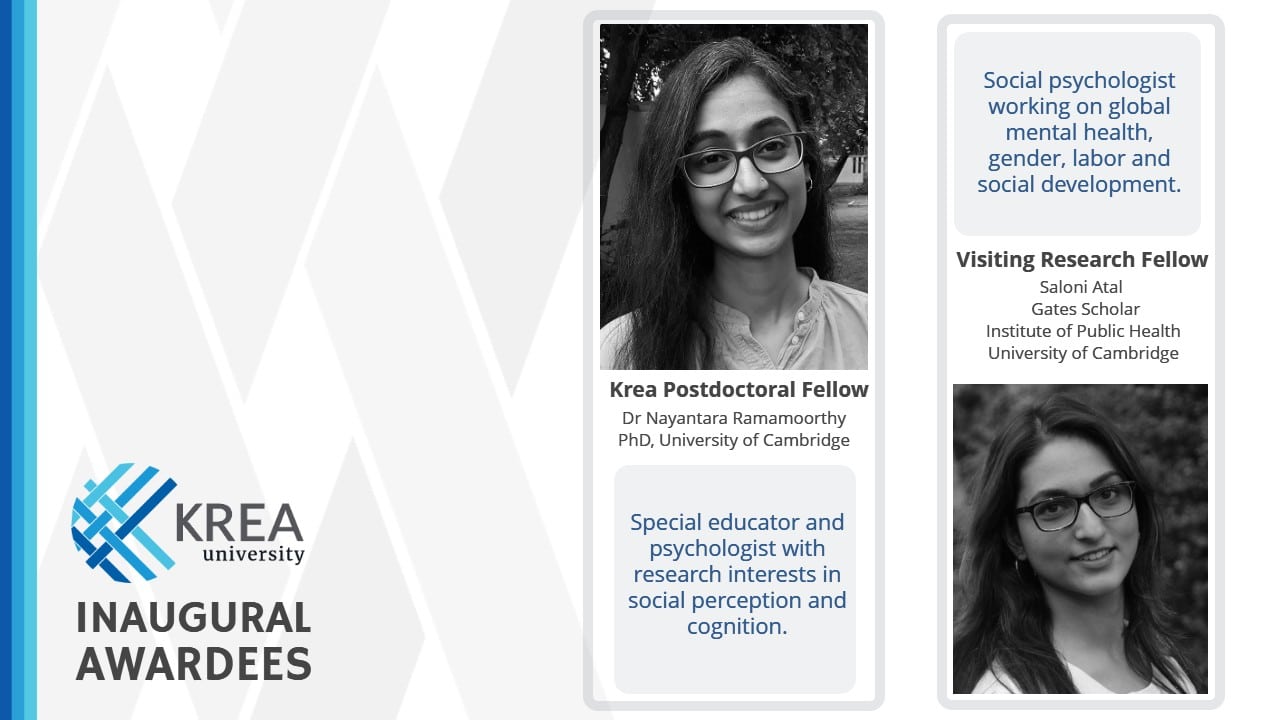
Krea welcomes Dr Nayantara Ramamoorthy, the awardee of the inaugural Krea Faculty Fellowship 2020 and Saloni Atal, our Visiting Research Fellow. Their strong expertise in Psychology ably propels the research vision at Krea. Krea Faculty Fellowship and Visiting Research Fellowship are set up with an aim to strengthen the research mandate at Krea.

Dr Nayantara Ramamoorthy, did her PhD in Psychology at the University of Cambridge with a research focus on attentional mechanisms in gaze perception — the underlying mechanisms that guide individuals to attentionally prioritise one gaze type (e.g., direct gaze) over the other (e.g., averted gaze) when viewing another’s gaze. She has a Masters in Developmental Psychology from Maastricht University, The Netherlands and a Bachelors in Psychology from the University of Delhi. She has also worked as a special educator at the Centre for Child Development and Disabilities, Bangalore, where she designed and implemented intervention plans for children with Autism Spectrum Disorder and trained parents to be active participants in the intervention process. Nayantara’s broader research interests lie in social perception and cognition, particularly with a view to understanding underlying pathways in neuro-atypical gaze perception.

Saloni Atal, MPhil, is a PhD student and a Gates scholar at the Institute of Public Health at the University of Cambridge. Saloni is a social psychologist and works on global mental health, gender, labor and social development. Through her research, she aims to provide policy-relevant evidence that drives change on the ground. She is particularly interested in the socio-political economy of mental health and in developing contextually sensitive tools to measure women’s agency and empowerment. She uses mixed research methods and takes an interdisciplinary approach, drawing on sociocultural theories of knowledge, critical development studies and transnational feminist perspectives.

Vice-chancellor Sunder Ramaswamy shares the learning narrative

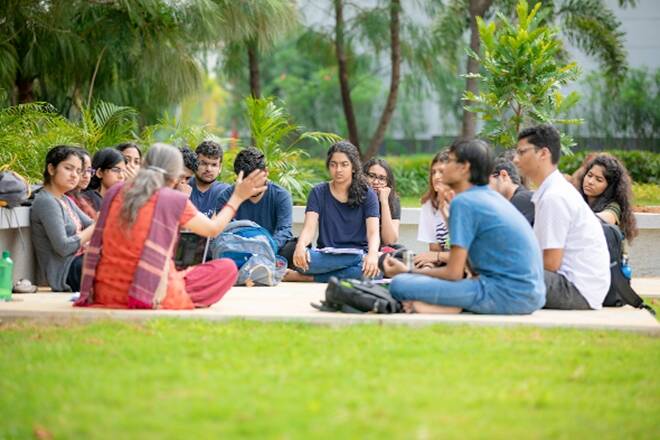
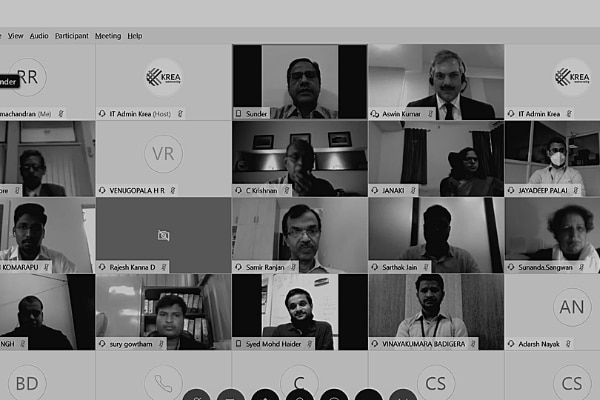
Emphasising on Krea’s mission statement ‘to help humanity prepare for an unpredictable world’, Dr Sunder Ramaswamy discussed how classes weren’t just about dispensing information, but rather about aiding students to learn, to think like a mathematician, a scientist, a philosopher.

Read more.

Supporting Women-led Rural Microenterprises through COVID and Beyond

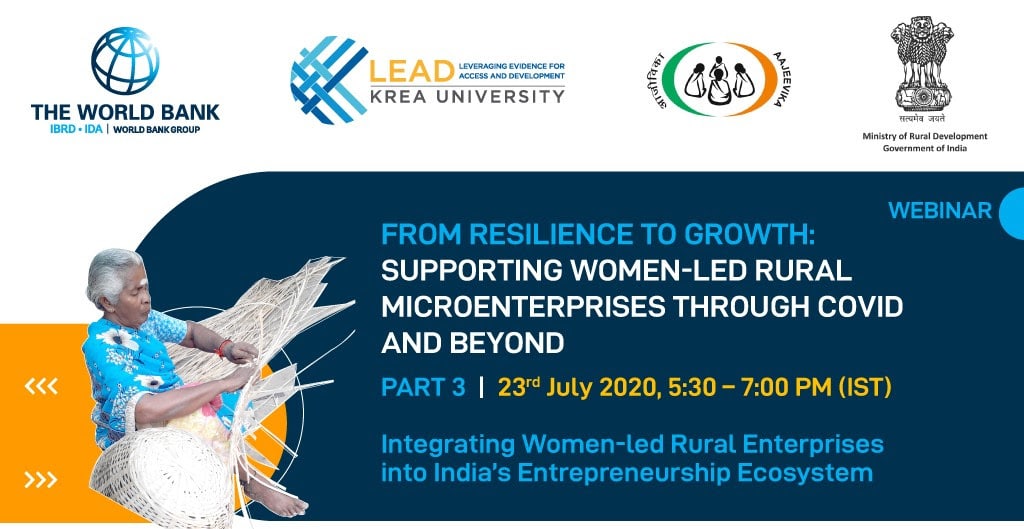
LEAD hosted the third chapter of a webinar series on supporting women-led rural microenterprises amid COVID-19 and beyond. A collaboration with the World Bank and the Ministry of Rural Development, it featured senior policymakers and experts with a discussion on short-term and long-term policy interventions and strategies to enable graduation of women-led enterprises. The panellists and speakers highlighted the need for entrepreneurship development programs that focus on strengthening capabilities, providing handholding support to women entrepreneurs, strengthening access to institutional finance by building credit histories, and improving market linkages for women-led enterprises.

COVID-19 and the Future of Seafood Markets in Chennai

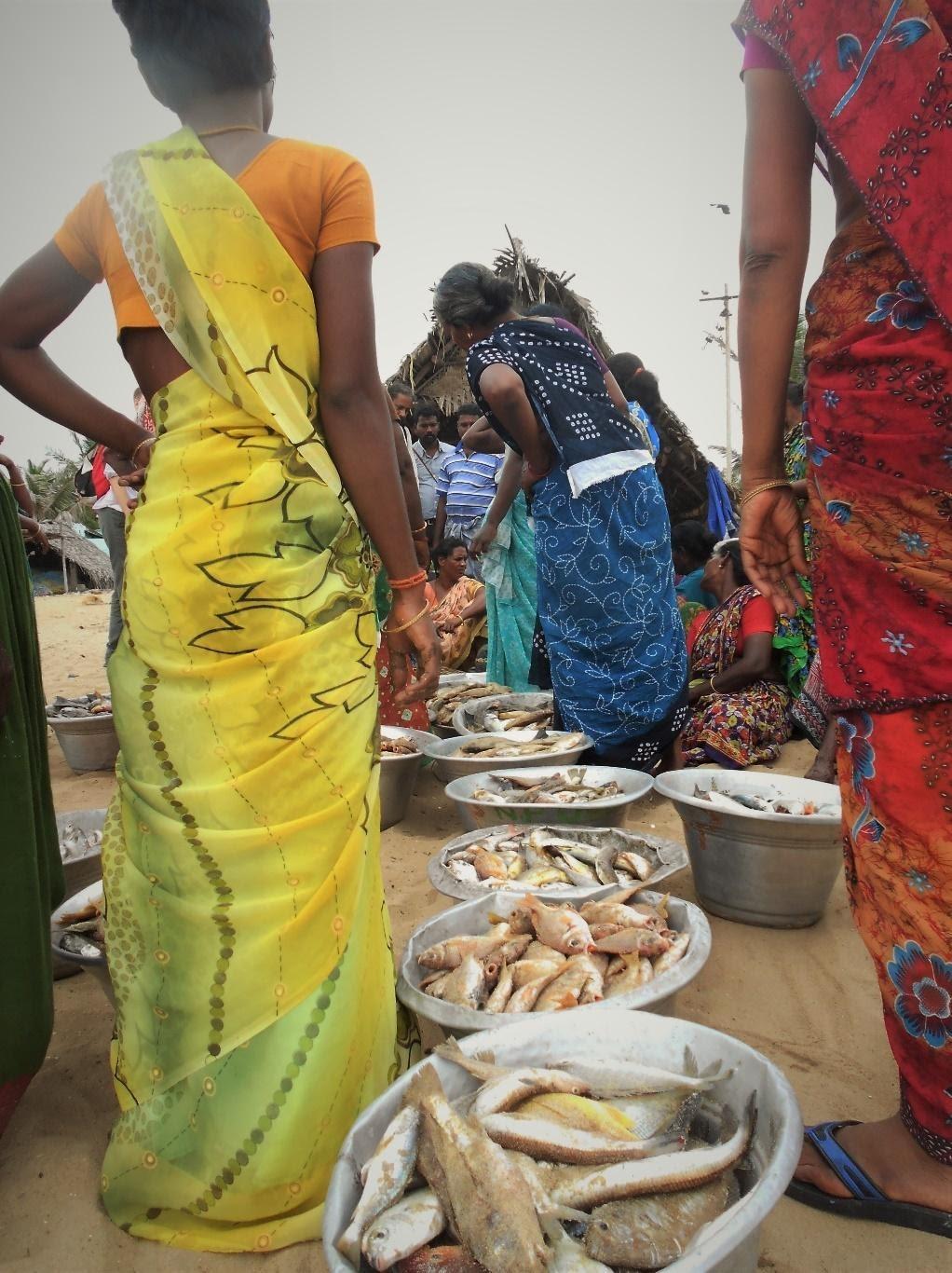
The seafood industry is a lifeline for coastal communities in India and women play a significant role in post-harvest operations. While it’s still early to gauge the impact of COVID-19 on the industry, Research Fellow Rahul Muralidharan notes that rapid insights from the ground are important to shape policy actions and programs. He shares his insights in this piece based on interactions with small-scale fisherfolk, co-operatives and union leaders in Chennai.

Tackling Gender-based Violence Through the Lens of Space

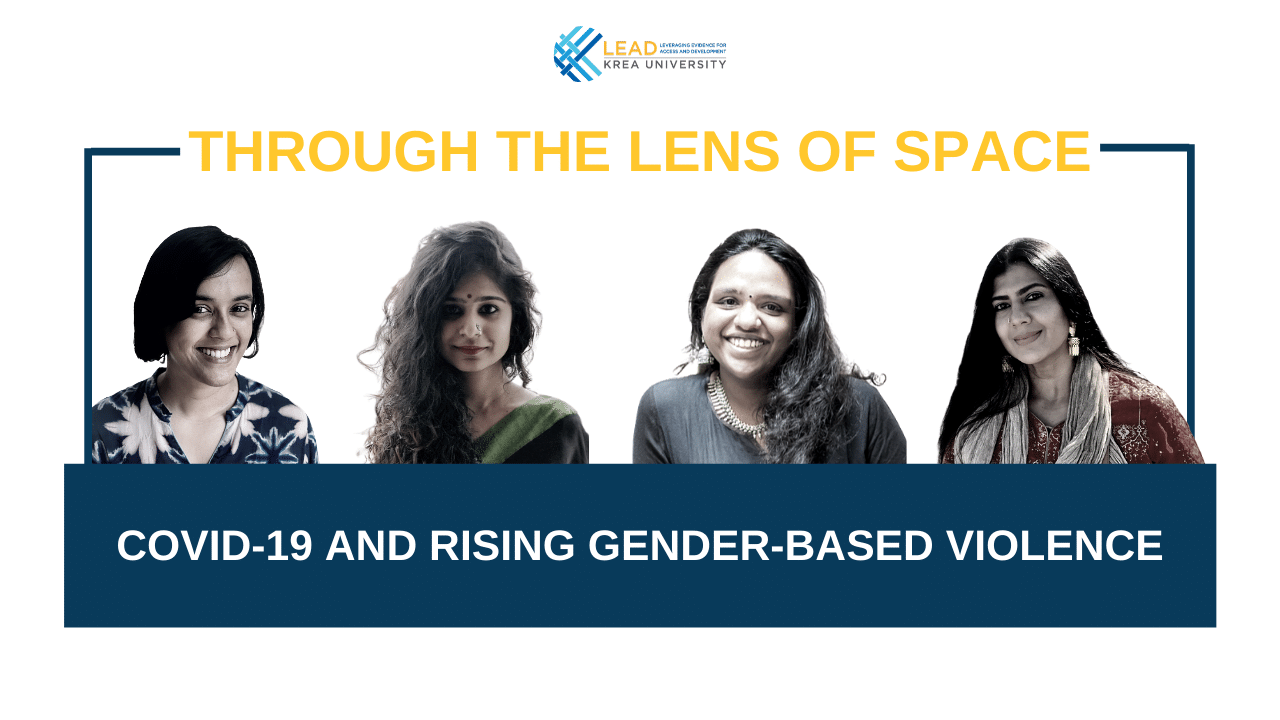
LEAD concluded their three-part webinar series on rising gender-based violence amid COVID-19 . The final part explored the role of space – public, private and digital, in gender-based violence, especially in the current context. Highlighting gaps in current research, the young and dynamic panel answered questions from the participants and presented a way forward towards building safe and inclusive spaces for all.

IFMR GSB welcomes the L&T C EMBA cohort of 2020-23 

IFMR GSB at Krea University, welcomed the new cohort of L&T Executives to the EMBA program 2020-23. Dr Sunder Ramaswamy, Vice-Chancellor at Krea University and Dr Shobha Das, Dean of IFMR GSB, personally welcomed the new executives. Other distinguished guests at the inauguration event included Mr. Ramkishore, Vice President & Head – Divisional Corporate HR, L&T Construction and Mr. Karthikeyan TV, Executive Vice President – Finance and Accounts, L&T Construction. 

Dr Sunder Ramaswamy expressed in his welcome address, “L&T Construction is one of the iconic companies in India which has played a major role in building India’s defining infrastructure projects. The company has admirably continued to invest in its employees even during these tough times.” 

He also added, that we live in a world, where information is cheap, instant and universally available, the differentiation between information and knowledge is how to optimally harness information aided by effective coaching and teaching. IFMR GSB faculty  would teach learners ‘how to learn’ and remain relevant in the increasingly dynamically changing world that we inhabit.

In her welcome note, Dr Shobha Das shared the rich history of IFMR GSB, set up in 1970 – the 1st of its kind in the financial research  and education center in Asia. “This partnership brings together two organizations who excel in their respective fields and both organizations place a lot of importance to knowledge and learning.” , stated Dr Das . She lauded L&T Construction as a much-admired company for several reasons, a key reason being its willingness to invest in employee development, even more admirable, in the current crisis amid uncertainties.

In his insightful address to the incoming cohort, Mr. Ramkishore explained the rigorous selection process that handpicks 45 participants who make it to the committed program. He added, “An MBA instills certain key attributes essential for success; quick thinking, analyzing data and converting it into information, turning information into insights and converting insights into focused actions.” He urged participants to make the most of the virtual situation they are in, free themselves from the constraints of time and space that this opportunity affords and make the most of this education that participants are about to receive.

Reinforcing the partnership, he stated that L&T C partners only with institutions of excellence as their academic partners and IFMR GSB at Krea University is one of them. 

Chief Guest of the inauguration event, Mr. Karthikeyan T V, shared words of wisdom and emphasized that it was up to the participants to make the best use of the faculty and the resources made available to them. “At the end of this three year MBA program, my experience and expectation is that participants would have excellent business sense, that only an MBA course imparts- ‘How to run your business’, ‘How to deal with situations that are commercial oriented’ and ‘How do you think professionally, but in a business focused manner’ , ‘How do I make money’. 

The incoming cohort includes L&T C IC Head HRs- Mr. Srikant Srinivasan, PT&D; Mr. Bartanu Kumar Das, HC ; Ms. Poonam Chandok TI; Mr. J Kabilan B&F; Ms. K Meena Priya IEL; Mr. Girish, Smart World & Communication; Mr. Binu L&T GEO and L&T  Divisional Corporate Academic Contact head – Mr. Raghavendran.
Rajiv Memani joins Krea University Governing Council

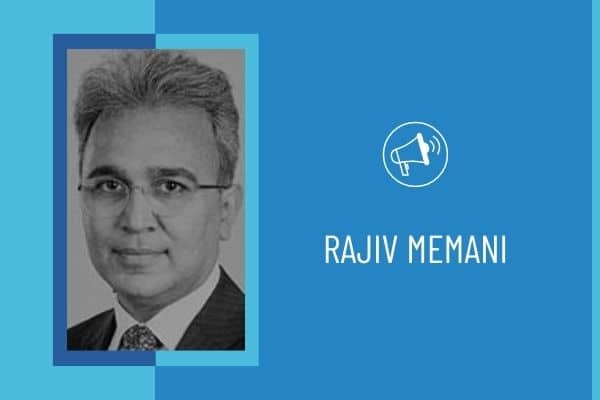
Krea University is delighted to welcome Rajiv Memani, Chairman, CEO, EY India as a member of the governing council.

Rajiv Memani has over three decades of experience in the industry, advising fast-growing Indian entrepreneurial and global organisations establishing or expanding their presence in India and with private equity funds. Under his stewardship, EY has grown to be over a 50,000 people strong company in India and consistently been recognized as the country’s leading professional services organisation.

On joining Krea University as a governing council member, Memani said, “The industry has a pivotal role in advancing higher education through direct involvement in shaping the future generation of graduates. I am honoured to be a part of Krea University’s vision to re-imagine education for the 21st century and align with their efforts to make quality higher education equitable and accessible.”

Rajiv Memani is the Chairman and CEO of EY’s India region that includes Bangladesh. He is also a member of EY’s Global Executive Board as the Chair of Global Emerging Markets Committee.

Rajiv is active with many clients, principally fast-growing Indian multinationals and private equity funds. He has successfully advised clients across disciplines and has been working with several of the largest conglomerates in India.

Rajiv is a member of the National Council of the Confederation of Indian Industry (CII), in addition to being the Chairman of its National Committee on Tax. He has been appointed in several high-powered Government of India committees, including the most recent, Ministry of Finance taskforce that drafted a new Direct Tax Code in 2019.

Rajiv is also a Board member of Indian Institute of Management (IIM), Sirmaur, one of India’s premier management schools.

With his deep commitment to giving back to the society, Rajiv has been the driving force behind EY Foundation for the last 15 years. Under his leadership, the Foundation has positively impacted millions of poor families through sustainable and scalable programs in the areas of education and rural empowerment.

Media Mention- https://bloncampus.thehindubusinessline.com/b-school-corner/ey-india-chairman-rajiv-memani-joins-krea-university-governing-council/article32375679.ece

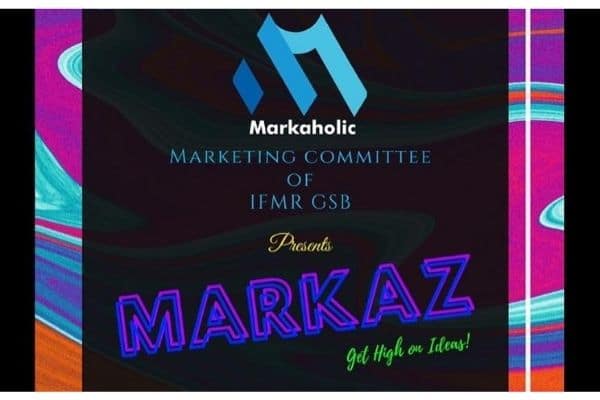
Markaholic, IFMR GSB Marketing Committee hosts ‘Markaz’

Markaholic, the Marketing Committee of IFMR GSB, Krea University organized a 5-day long marketing event, ‘Markaz’. The event aimed to provide exposure about marketing to the first-year students in a non-academic manner where they were required to use their knowledge and creativity to answer a marketing quiz and four other rounds which were to test their marketing creativity.

Pratyush Misra, Amit Kumar Sahoo and Shreyans Bandi were the winner, 1st runner up and 2nd runner up, respectively.

Marketing approach during the pandemic crisis

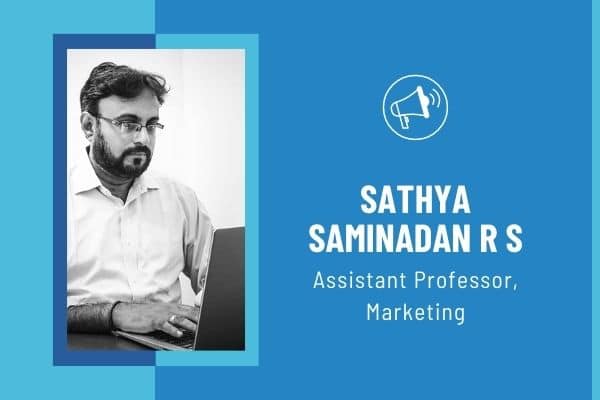
This article is written by Dr. Sathya Saminadhan, Assistant Professor – Marketing at IFMR GSB

It is surprising to see the recent whir regarding the uncertainties in the industrial arena amid the pandemic crisis and many pondering over ideas to tackle it through innovative marketing techniques. There is a golden line in marketing, “Do not rest on your laurels” and this says it all. 

Whether there is a pandemic or global economic crisis the change is inevitable in marketing.  Adaptability is the rule number one to travel smoothly on the inclining line of market leadership. Having said that, the anxiety towards the changing market or the change in approach towards the customer, is trivial. 

Technology in marketing has changed the complete game plan. It would have appeared as a far fetched idea if somebody had mentioned it two decades ago.  Here, change in technology doesn’t pertain to the evolution of product. Evolution is something inexorable, irrespective of the market conditions. Black & White TV evolved as Colour TV twenty years ago, which in turn evolved as LEDs and LCDs, a decade ago. That is technology in product making. But in the past six to eight years the overall theme of marketing itself has changed and it is due to three salient developments namely connectivity, hands-on equipment and video streaming facility. 

Data suggests, 51% of the people above the age of 15, all over the world, are connected to the internet in the modern era. If the data is accurate, these numbers are huge. Reaching every single customer through their hands-on equipment gathers efficiency in marketing, with the support of video streaming platforms. 

Today, the companies have the luxury of understanding the search behaviour, decision making process and purchasing pattern of every single customer. By integrating all the platforms, the companies can strategize showcasing the right communication to the right customer on the right handle. If you are astute and effective on playing with ‘real time bidding’, you can put a relevant product or a service advert on the customer’s Instagram or Facebook timeline, something the consumer was searching for a few hours ago on Flipkart or Amazon. Thanks  to the technological evolution in marketing, the efficiency of reaching the target customer has gone up very high. Gone are those days where you put a hoarding on a busy road and wait for the busy riders to have a look at it. 

In line to the technological revamps, the life cycle of any product has come down drastically. It has become very small and nanoscopic. By the time the product developer, of a company, wakes up from a good night’s sleep, the product’s life cycle is dead. Globalization, regulatory policies across the globe and purchase facilitations like bank loan availabilities have added fuel to the fire in shrinking the life cycle of a product. Being a successful survivor in this intense global race has become very challenging. Competitor staying a click away or a microsecond away is an all-time threat for any company. The companies are expected to be the survival of the fittest at any point of time in the current era irrespective of their brand legacy or pedigree. 

Since these healthy challenges are inevitable in marketing, there is no reason to be anxious about the pandemic crisis and the cascading market changing effect. If it wasn’t the Covid effect it would’ve been something else. Ultimately, change is something the marketers should be expecting. If there is no change in their approach they are knocking the wrong door. 

Today, Ola doing a parcel service, Swiggy transporting groceries and boutiques doing door deliveries clearly signifies that the approach to handle the pandemic is rising to the occasion and sculpting the marketing efforts, slightly out of box. Looking at the situation as a boon for efficiency and making use of the new normal as a learning opportunity, is an ingenious new way to triumph.